

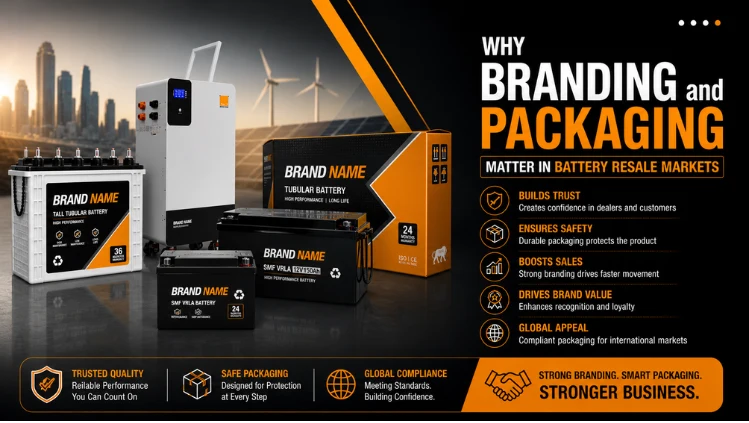
The battery resale market, across automotive, inverter, and industrial segments, has become highly competitive, with many products offering similar specifications and price points.
In such an environment, decisions are rarely based on technical parameters alone. Dealers and distributors often rely on visual trust, familiarity, and ease of resale.
This is where branding and packaging become critical. They are not just visual elements; they directly influence dealer confidence, product movement, and margin stability.
What Defines the Battery Resale Market Today?
The battery resale market operates on thin margins and high competition. Products often have similar specifications, making it difficult for dealers to differentiate based on performance alone.
As a result:
- Dealer trust becomes a key deciding factor
- Product presentation influences buying decisions
- Distribution efficiency impacts profitability
In growing markets like India, Africa, and the Middle East, where brand awareness is still evolving, branding and packaging play a larger role in shaping perception and trust.
Why Does Brand Identity Matter for Battery Dealers?
Brand identity helps dealers make faster and safer purchasing decisions by reducing perceived risk, improving product recall, and making it easier to sell the product to end customers.
How Does Branding Influence Dealer Confidence?
Dealers are responsible for product recommendations and customer satisfaction. A professionally branded battery signals:
- Consistency in quality
- Accountability from the supplier
- Lower chances of complaints or returns
This reduces hesitation during bulk purchasing.
Can Branding Replace Technical Differentiation?
Branding often becomes the primary differentiator influencing dealers’ choice in markets where technical differences are minimal.
When specifications are similar, dealers rely on:
- Brand familiarity
- Visual presentation
- Market perception
This is why well-branded products tend to move faster even without significant technical advantages.
Why Is Branding Critical in Low-Awareness Markets?
Branding helps new or lesser-known products gain trust quickly in markets where customers and dealers are not loyal to established brands.
In such markets:
- Recognition builds faster with consistent branding
- Dealers prefer products that look credible
How Does Packaging Act as a Competitive Differentiator?
Packaging differentiates battery products by improving safety, enhancing visual appeal, and making product information easily accessible to dealers and customers.
Why Is Carton Durability Important for Batteries?
Durable packaging prevents damage during transport and storage, reduces return rates, and protects distributor margins.
Battery logistics involve:
- Heavy loads
- Long transit distances
- Multiple handling points
Weak packaging increases the risk of:
- Leakage
- Physical damage
- Product rejection
How Does Label Clarity Affect Buying Decisions?
Clear labels help dealers and customers quickly understand product specifications, reducing confusion and improving purchase confidence.
Well-structured labels communicate:
- Compatibility
- Capacity
- Usage guidelines
This speeds up decision-making at the point of sale.
Does Warranty Display on Packaging Impact Sales?
Yes, visible warranty information builds trust instantly and reduces perceived risk, making customers more likely to choose the product.
A clearly displayed warranty acts as:
- A promise of reliability
- A support assurance for dealers
- A differentiator in competitive environments
Can Packaging Influence Retail Shelf Performance?
Yes, visually strong and consistent packaging improves product visibility and increases the likelihood of faster stock movement.
In retail settings:
- Products compete for attention
- Dealers prefer items that sell quickly
Packaging plays a key role in both.
What Are the Mandatory Compliance and Labeling Requirements for Batteries?
Battery packaging must include essential technical details, safety warnings, and regulatory symbols to ensure compliance and safe usage across markets.
What Information Must Be Printed on Battery Labels?
Battery labels should include voltage, capacity, manufacturing details, and batch identification for traceability and correct usage.
These details help:
- Dealers verify products
- Customers choose the right battery
- Businesses maintain quality control
What Safety Warnings Are Required on Battery Packaging?
Battery packaging must include handling instructions, hazard warnings, and storage guidelines to prevent misuse and ensure safety.
These warnings reduce:
- Operational risks
- Customer complaints
- Legal liabilities
Which Regulatory Symbols Are Needed for Different Markets?
Regulatory symbols such as certification marks, recycling signs, and hazard indicators are required based on the target market’s compliance standards.
For exporters, missing these can result in:
- Shipment delays
- Regulatory penalties
- Market rejection
Read “Which Certifications Are Needed for Selling Private Label Batteries?” to learn more.
Can Branding Increase Battery Resale Margins?
Yes, strong branding allows businesses to reduce price competition, command better pricing, and improve overall profit margins.
How Does Branding Enable Premium Pricing?
Branding increases perceived value, making customers and dealers less sensitive to price differences.
Instead of competing only on cost, branded products:
- Justify higher pricing
- Position themselves as reliable options
Does Branding Improve Repeat Dealer Orders?
Yes, consistent branding builds recall and trust, leading to repeat purchases from dealers.
When dealers have a positive experience, they prefer:
- Reliable brands
- Products that are easy to resell
How Does Brand Recall Affect Market Expansion?
Strong brand recall reduces the effort required to enter new markets and onboard new dealers.
A recognizable brand:
- Builds trust faster
- Requires less convincing
- Scales more efficiently
How Does Packaging Impact Logistics and Cost Efficiency?
Efficient packaging reduces transportation costs, minimizes product damage, and improves storage and handling efficiency.
For distributors, this means:
- Lower return rates
- Better space utilization
- Improved operational efficiency
Should Battery Packaging Be Localized for Different Markets?
Yes, localized packaging improves compliance, enhances understanding, and increases acceptance in different regional markets.
Localization includes:
- Language adaptation
- Region-specific labeling
- Design preferences based on local expectations
This is especially important for exports across India, Africa, and the Middle East.
What Common Branding and Packaging Mistakes Should Be Avoided?
Common mistakes include inconsistent branding, weak packaging, missing compliance details, and lack of regional customization.
These issues lead to:
- Reduced trust
- Higher returns
- Lower market competitiveness
How to Choose the Right Private Label Battery Partner?
The right partner should offer strong branding support, durable packaging solutions, compliance expertise, and consistent product quality.
Key evaluation factors:
- Customization capabilities
- Understanding of export requirements
- Proven quality control
- Scalable production support
Conclusion
Branding and packaging are no longer optional in battery resale markets—they have become essential drivers of business performance. They influence how dealers make purchasing decisions, how products are perceived in competitive environments, how efficiently they move through logistics channels, and how well margins are protected. When executed strategically, they go beyond presentation and become tools for building trust, reducing operational friction, and improving resale velocity. Businesses that invest in strong branding and durable, well-designed packaging are better positioned to scale, establish market presence, and maintain a sustainable competitive advantage.
FAQs
Yes, packaging affects safety, visual appeal, and buyer confidence, all of which directly influence sales performance.
Battery labels should include voltage, capacity, manufacturing details, safety warnings, and regulatory markings.
Yes, strong branding reduces price competition and allows businesses to command better margins.
Yes, localization improves compliance, understanding, and acceptance in different markets.
Branding should be reviewed periodically based on market trends, expansion plans, and competitive positioning.