

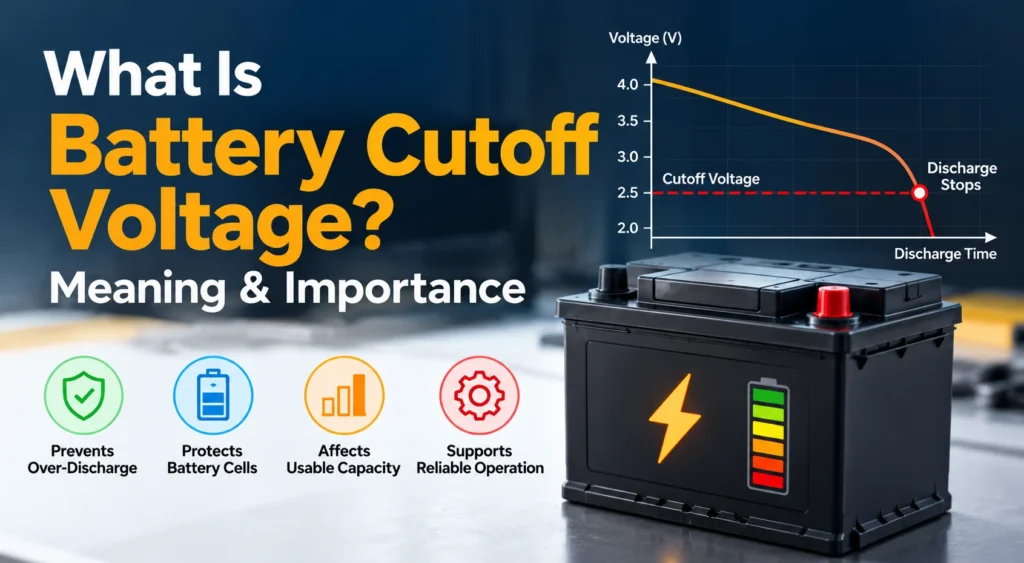
Battery cutoff voltage is the minimum specified voltage at which a battery’s discharge is stopped or considered complete. It defines the lower operating limit of a battery and helps prevent discharge beyond the range specified for the cell or battery. The actual cutoff voltage depends on battery chemistry, cell design, discharge conditions, temperature, application, and manufacturer specifications.
For battery manufacturers, pack designers, OEMs, and equipment manufacturers, selecting and applying the correct cutoff voltage is important for balancing usable capacity, battery performance, cell protection, and service life.
How Does Battery Cutoff Voltage Work?
When a battery supplies power, its voltage generally decreases as it discharges. Once the battery reaches its specified discharge cutoff voltage, the discharge is stopped, or the connected equipment shuts down.
The basic process is:
Battery discharges → voltage decreases → cutoff threshold is reached → discharge stops
In a battery test, the cutoff voltage defines the endpoint of the discharge test. In a battery pack, a Battery Management System (BMS) or protection circuit may use an under-voltage threshold to disconnect the load and prevent further discharge.
For example, if a cell datasheet specifies a discharge cutoff of 2.5 V, the discharge test or protection system can terminate operation when the cell reaches that specified limit under the manufacturer’s stated conditions. This value should not automatically be applied to another cell, even if both use the same general battery chemistry.
Why Is Battery Cutoff Voltage Important?
Cutoff voltage establishes the lower boundary for battery operation and has several important functions.
1. Helps Prevent Over-Discharge
Continuing to discharge a battery below its specified limit creates an over-discharge condition. Depending on the battery chemistry and severity, this can adversely affect the battery’s electrical characteristics, capacity, and safety.
A defined cutoff voltage provides a controlled endpoint before the battery is discharged beyond its intended operating range.
2. Helps Protect Battery Cells
Deep or prolonged over-discharge can cause cell degradation. Lithium-ion batteries, for example, can experience irreversible changes when subjected to severe over-discharge.
Using the manufacturer’s specified voltage limits and appropriate protection circuitry helps keep cells within their designed operating range.
3. Affects Usable Battery Capacity
Cutoff voltage also affects how much of a battery’s capacity can be used.
A higher discharge cutoff can terminate discharge earlier, leaving some stored energy unused. A lower cutoff may allow more energy to be extracted if the cell manufacturer permits it. Therefore, cutoff voltage is one of the conditions that influences measured and usable battery capacity.
4. Supports Consistent Battery Operation
For applications such as electric vehicles, energy-storage systems, power tools, industrial equipment, and portable electronics, maintaining appropriate voltage limits helps the battery system operate within its designed electrical range.
What Happens If a Battery Goes Below Its Cutoff Voltage?
If a battery is discharged below its specified cutoff voltage, it enters an over-discharge condition. The consequences depend on the chemistry, discharge current, temperature, depth of discharge, and duration.
Potential effects include:
- Reduced usable capacity
- Shortened service life
- Cell degradation
- Difficulty recovering a severely over-discharged cell
- Increased safety concerns for certain battery chemistries
The effect is not identical for every battery. This is why the cell manufacturer’s discharge limits should take precedence over generic voltage values found online.
Does Cutoff Voltage Mean the Battery Is Completely Empty?
No. Reaching cutoff voltage does not necessarily mean that a battery has zero energy remaining.
Cutoff voltage represents the specified endpoint for a particular discharge condition. Some energy may remain in the cell but may not be safely or practically accessible within the specified operating range.
The measured voltage can also vary with load and temperature. A high discharge current can cause a greater temporary voltage drop because of the battery’s internal resistance. When the load is removed, the voltage may partially recover.
Therefore, cutoff voltage should not be interpreted as the same thing as zero state of charge.
What Determines Battery Cutoff Voltage?
There is no single cutoff voltage that applies to every battery. The appropriate value is determined by several factors:
| Factor | Why it matters |
| Battery chemistry | Different chemistries have different voltage characteristics and operating limits. |
| Cell design | Electrode materials and cell construction influence discharge behavior. |
| Discharge current | Higher current can cause greater voltage drop under load. |
| Temperature | Temperature affects internal resistance and battery voltage behavior. |
| Application | EVs, power tools, energy-storage systems, and electronics can have different operating requirements. |
| Manufacturer specification | The cell or battery datasheet defines the applicable discharge limits and test conditions. |
This is why battery engineers should not select a cutoff voltage simply from the battery’s nominal voltage or from a generic value associated with its chemistry.
How Is Cutoff Voltage Used in Battery Testing?
Cutoff voltage defines the endpoint of a battery discharge test and directly affects the capacity measured during testing.
In a controlled battery capacity test:
- The battery is discharged at a specified current or load.
- Voltage is monitored throughout the discharge.
- Discharge stops when the battery reaches the specified cutoff voltage.
- Delivered capacity is calculated from the charge supplied before reaching that endpoint.
A change in cutoff voltage can change the measured discharge capacity because it determines how far the battery is discharged during the test. Therefore, battery tests must use consistent conditions, including cutoff voltage, discharge current, and temperature, as specified by the applicable test method or manufacturer specification.
For battery manufacturers and OEMs, controlling these parameters is essential when evaluating cell performance, validating battery packs, and comparing different battery designs.
Battery Cutoff Voltage by Chemistry
Cutoff voltage varies between battery chemistries and even between individual cells using the same chemistry.
| Battery type | Cutoff voltage consideration |
| Lithium-ion | The discharge endpoint depends on the specific cell chemistry, design, and manufacturer’s specification. |
| LiFePO₄ | Has a different voltage profile and discharge limit from conventional lithium-ion cells. |
| Lead-acid | The appropriate end-of-discharge voltage depends on discharge conditions and application. |
| NiMH/NiCd | Uses different discharge characteristics and end-of-discharge criteria from lithium-based batteries. |
There is no universal cutoff voltage for an entire battery chemistry. The correct value should always be taken from the relevant cell or battery datasheet and applied under the specified operating conditions.
Cutoff Voltage vs. Nominal Voltage
Cutoff voltage and nominal voltage describe different aspects of battery operation.
| Voltage term | Meaning |
| Nominal voltage | The representative voltage used to identify or classify a battery or cell. |
| Operating voltage | The voltage measured while the battery is delivering or receiving current. |
| Cutoff voltage | The specified lower voltage limit at which discharge is stopped or considered complete. |
For example, a battery may have a nominal voltage used for product classification while its actual voltage changes during charging and discharging. The cutoff voltage is a separate lower operating limit and should not be inferred from the nominal voltage.
How Does a BMS Control Battery Cutoff Voltage?
A Battery Management System (BMS) controls battery cutoff by monitoring cell voltage and disconnecting the load when a cell reaches its programmed under-voltage threshold.
The process typically works as follows:
- Monitors cell voltage: The BMS continuously monitors the voltage of individual cells in the battery pack.
- Compares voltage with the limit: It checks the measured voltage against the programmed minimum voltage threshold.
- Detects under-voltage: When a cell reaches or falls below the specified cutoff level, the BMS identifies an over-discharge condition.
- Disconnects the load: The BMS activates the protection circuit to stop further discharge.
- Protects the cells: This helps keep the battery within its specified operating voltage range.
For multi-cell battery packs, monitoring individual cells is important because cells connected in series may have different states of charge. As a result, one cell can reach its voltage limit before the overall pack voltage indicates a cutoff condition.
The BMS cutoff setting should be based on the specific cell manufacturer’s specifications, battery-pack design, operating conditions, and protection requirements.
Conclusion
Battery cutoff voltage is a critical parameter for safe, reliable, and efficient battery operation. It defines the lower discharge limit, helps prevent over-discharge, and influences usable battery capacity and battery life. Since the correct cutoff voltage varies by chemistry, cell design, and operating conditions, battery manufacturers and OEMs should always follow the cell or battery manufacturer’s specifications when designing, testing, and managing battery systems.
FAQs
Battery cutoff voltage is the minimum specified voltage at which battery discharge is stopped or considered complete.
It helps prevent over-discharge, protects battery cells, defines the endpoint for discharge testing, and influences usable battery capacity.
The battery enters an over-discharge condition, which can reduce capacity, shorten service life, or damage the cell depending on its chemistry and the severity of the discharge.
Cutoff voltage is the specified lower limit for a particular battery and operating condition. It should not be treated as a universal physical minimum voltage for all batteries.
No. A battery can retain some energy after reaching its cutoff voltage. The cutoff defines the permitted discharge endpoint, not necessarily zero stored energy.
There is no single cutoff voltage for every lithium-ion battery. The appropriate value depends on the specific cell, chemistry, operating conditions, and manufacturer’s specification.