

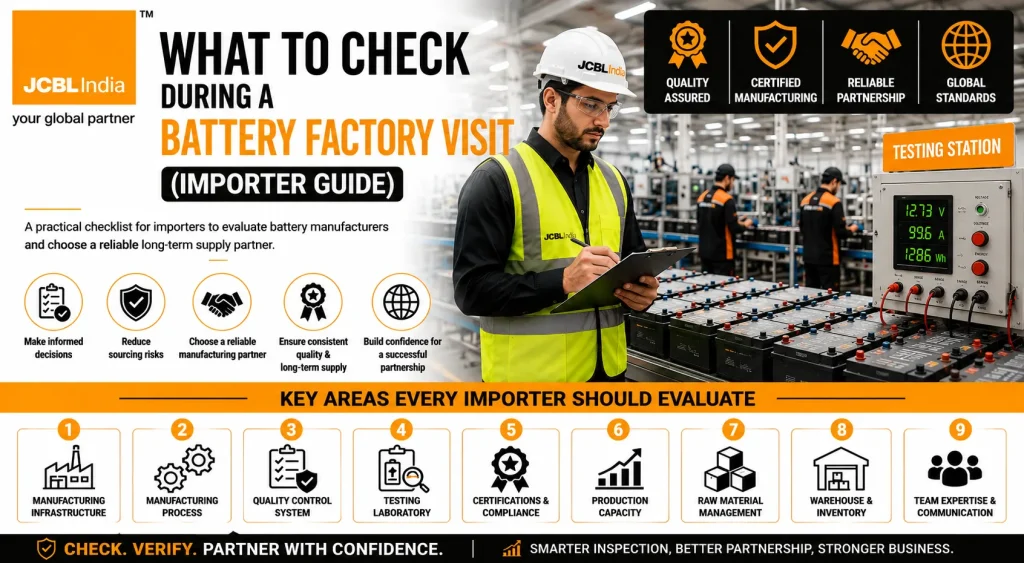
Choosing the right battery supplier goes beyond comparing prices and product specifications. A factory visit gives importers a first-hand view of a manufacturer’s production capabilities, quality standards, and operational practices before placing bulk orders. It also helps identify potential risks that may not be visible in product catalogs or online meetings.
This guide outlines the key areas every importer should evaluate during a battery factory visit to make informed sourcing decisions and select a reliable manufacturing partner.
Why Should Importers Visit a Battery Factory Before Placing Bulk Orders?
A factory visit allows buyers to verify whether a manufacturer can consistently meet quality, production, and delivery requirements.
Benefits of an on-site factory inspection include:
- Verify manufacturing capabilities and production capacity.
- Evaluate quality control systems and testing procedures.
- Confirm certifications and regulatory compliance.
- Assess manufacturing consistency and workplace organization.
- Build confidence before establishing a long-term supply partnership.
For international buyers, a factory visit can significantly reduce sourcing risks and improve supplier selection.
Battery Factory Visit Checklist for Importers
1. Evaluate the Manufacturing Infrastructure
The overall condition of a factory often reflects its operational standards. A well-organized production facility typically indicates better process control and efficiency.
During your visit, check for:
- Modern and well-maintained production equipment
- Clean and organized production areas
- Logical workflow between manufacturing stages
- Adequate safety measures for employees
- Clear separation of raw materials, production, and finished goods
A streamlined manufacturing environment helps support consistent battery production and quality management.
2. Review the Battery Manufacturing Process
Ask the manufacturer to explain each stage of production. A standardized process helps ensure product consistency across every production batch.
Key manufacturing stages generally include:
- Incoming raw material inspection
- Electrode preparation
- Cell or plate manufacturing
- Battery assembly
- Formation and aging
- Final inspection and packaging
A clearly documented manufacturing process demonstrates better production control and traceability.
3. Verify the Quality Control System
Quality assurance should be integrated throughout production rather than performed only after manufacturing is complete.
Look for evidence of:
- Incoming Quality Control (IQC) for raw materials
- In-Process Quality Control (IPQC) during manufacturing
- Final Quality Control (FQC) before shipment
- Batch traceability and inspection records
- Standard operating procedures (SOPs)
A robust quality management system helps maintain consistent product quality across large production volumes.
4. Inspect the Battery Testing Laboratory
Testing facilities reveal how thoroughly products are evaluated before leaving the factory.
Ask whether the manufacturer performs tests such as:
- Capacity testing
- Internal resistance testing
- Charge and discharge cycle testing
- Safety testing
- Environmental and durability testing
Request sample test reports to understand the manufacturer’s testing procedures and documentation practices.
5. Check Manufacturing and Product Certifications
Certifications indicate that the manufacturer follows recognized management systems and product compliance requirements.
Common manufacturing certifications include:
- ISO 9001 for Quality Management Systems
- IATF 16949 for automotive battery manufacturing (where applicable)
- ISO 14001 for Environmental Management
- ISO 45001 for Occupational Health and Safety
Depending on your export market and battery type, verify applicable product certifications and compliance documents such as CE, UL, IEC standards, UN38.3 (for lithium batteries), RoHS, or REACH where required.
Always confirm that certifications are current and relevant to the products being sourced.
6. Assess Production Capacity
A supplier may produce high-quality batteries but still struggle to meet large or recurring orders.
Ask about:
- Monthly and annual production capacity
- Number of active production lines
- Typical lead times
- Peak production capability
- Scalability for future orders
Understanding production capacity helps determine whether the manufacturer can support long-term business growth.
7. Review Raw Material Management
Battery performance begins with the quality of raw materials.
Ask the manufacturer about:
- Supplier qualification process
- Incoming material inspection
- Material traceability
- Inventory management practices
- Storage conditions for sensitive materials
Reliable raw material management contributes to more consistent manufacturing outcomes.
8. Inspect Warehouse and Inventory Management
Proper storage protects both raw materials and finished batteries before shipment.
Look for:
- Clean and organized warehouse facilities
- FIFO (First-In, First-Out) inventory practices
- Clearly labeled inventory
- Appropriate environmental controls where required
- Safe handling and storage procedures
Efficient warehouse management also supports faster order fulfillment and inventory accuracy.
9. Evaluate Export Packaging and Logistics
Packaging plays an important role in protecting batteries during international transportation.
Verify:
- Export-ready packaging methods
- Secure palletization
- Proper product labeling
- Shipping documentation procedures
- Container loading practices
Well-planned packaging reduces the likelihood of transit-related issues and helps meet destination market requirements.
10. Assess OEM and Custom Manufacturing Capabilities
If you plan to sell batteries under your own brand, evaluate the manufacturer’s OEM capabilities.
Discuss:
- Private labeling options
- Product customization
- Packaging customization
- Branding support
- Product development capabilities
An experienced OEM manufacturer can better support evolving market and customer requirements.
11. Meet the Technical and Support Team
A factory visit is also an opportunity to evaluate the people behind the manufacturing process.
Ask about:
- Engineering expertise
- Technical documentation
- Product support
- Warranty procedures
- Response process for quality concerns
A knowledgeable technical team can simplify communication and strengthen long-term business relationships.
Questions to Ask During a Battery Factory Visit
Use these questions to better understand the manufacturer’s capabilities:
- What quality inspections are performed during production?
- Can you share recent battery test reports?
- What is your monthly production capacity?
- Which countries or industries do you currently supply?
- How do you ensure batch traceability?
- Which certifications apply to your manufacturing facility and products?
- What is your process for handling quality issues or customer feedback?
Clear and transparent answers help buyers evaluate supplier reliability with greater confidence.
Red Flags to Watch During a Battery Factory Visit
Not every factory meets the same operational standards. Watch for warning signs that may indicate potential sourcing risks.
Common red flags include:
- Poor housekeeping or disorganized production areas
- Outdated or poorly maintained equipment
- Incomplete quality records
- Limited testing facilities
- Missing or expired certifications
- Inconsistent manufacturing procedures
- Poor inventory management
- Unclear product traceability
If multiple concerns are identified during the visit, additional due diligence may be necessary before moving forward.
Quick Battery Factory Inspection Checklist
| Inspection Area | What to Verify |
| Manufacturing Infrastructure | Equipment, factory layout, production workflow |
| Production Process | Standardized manufacturing stages |
| Quality Control | IQC, IPQC, FQC, batch records |
| Testing Laboratory | Capacity, safety, performance, and durability testing |
| Certifications | Manufacturing and product compliance documents |
| Production Capacity | Output, lead times, scalability |
| Raw Materials | Supplier qualification and traceability |
| Warehouse | Organized storage and inventory management |
| Export Packaging | Packaging quality and shipping readiness |
| OEM Capability | Private labeling and customization |
| Technical Support | Engineering expertise and after-sales support |
Conclusion
A battery factory visit provides valuable insights that cannot be obtained through product brochures or online discussions alone. By evaluating manufacturing infrastructure, production processes, quality control systems, testing capabilities, certifications, and export readiness, importers can make more informed sourcing decisions.
Using a structured inspection checklist helps compare suppliers objectively, minimize procurement risks, and build reliable long-term partnerships with battery manufacturers serving global markets.
FAQs
A factory visit allows importers to verify a manufacturer’s production capabilities, quality control processes, certifications, and operational standards before placing bulk orders.
Verify relevant manufacturing certifications such as ISO 9001, ISO 14001, ISO 45001, and IATF 16949 (where applicable). Depending on the battery type and destination market, check product compliance documents such as CE, UL, IEC standards, UN38.3, RoHS, or REACH.
Review whether the manufacturer follows Incoming Quality Control (IQC), In-Process Quality Control (IPQC), and Final Quality Control (FQC), along with maintaining inspection records and batch traceability.
Ask about production capacity, testing procedures, certifications, lead times, traceability systems, export experience, and how the manufacturer manages quality issues.
Warning signs include poor housekeeping, outdated equipment, missing quality records, limited testing facilities, expired certifications, inconsistent production practices, and weak inventory management.