

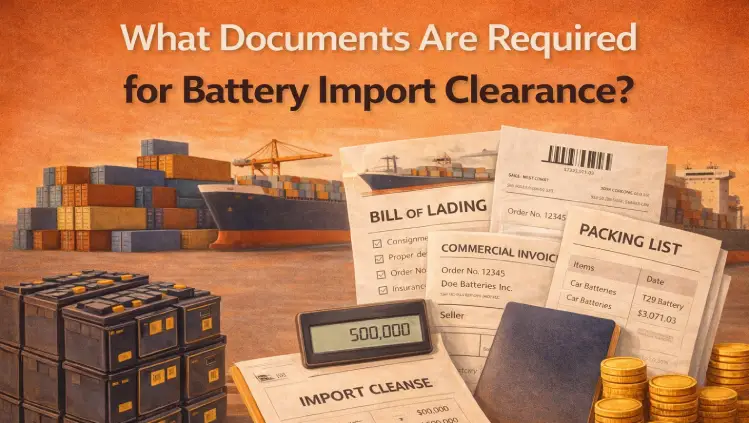
Battery imports require strict compliance because they are classified as hazardous goods. Whether you are importing lead-acid, lithium-ion, or newer sodium-ion batteries, customs authorities carefully verify all documents before granting clearance.
Even minor errors in battery import documentation can lead to shipment holds, demurrage charges, or financial penalties. This is especially critical in car battery customs clearance, where product classification and safety compliance are closely examined.
This guide explains all documents required for battery import clearance in a simple, practical, and B2B-focused way so importers can ensure smooth and compliant international shipments.
Battery Import Documents Checklist (2026 Updated)
| Document | Mandatory | Purpose | HS Code Category | Validity |
| Commercial Invoice | Yes | Declares shipment value | 8507 series | Per shipment |
| Packing List | Yes | Shipment breakdown | All | Per shipment |
| Bill of Lading | Yes | Proof of shipment | All | Per shipment |
| Certificate of Origin | Yes | Duty calculation | All | Per shipment |
| MSDS | Yes | Safety compliance | All | 1–3 years or until composition changes |
| UN38.3 Test Report | Conditional | Lithium battery compliance | 8507.60 | Valid unless design changes |
| Import License | Country-specific | Regulatory approval | Varies | As per the authority |
This checklist covers all essential battery import documents required for smooth customs clearance and regulatory compliance.
Why Proper Battery Import Documentation Is Critical
Batteries are regulated due to chemical hazards, leakage risks, and fire potential. International transport and documentation standards are governed by organizations such as the International Air Transport Association (IATA) and the International Maritime Organization (IMO).
Accurate battery import documentation ensures:
- Faster customs clearance
- Reduced inspection risks
- Compliance with safety regulations
- Avoidance of penalties and cargo rejection
For B2B importers, documentation accuracy directly impacts supply chain efficiency and cost control.
What Are the Core Documents Required for Battery Import Clearance?
Understanding the documents required for battery import clearance helps importers avoid operational disruptions and ensures consistent compliance across shipments.
Commercial Invoice
The commercial invoice is the primary document used by customs to assess the shipment value and applicable duties.
It must include:
- Supplier and buyer information
- HS code for classification
- Detailed product description
- Quantity and pricing
- Incoterms
A well-prepared invoice reduces the risk of valuation disputes. It is also closely linked to financial agreements, making it important to understand how payment terms affect international battery trade.
Packing List
The packing list provides a physical breakdown of the shipment.
It includes:
- Carton or pallet details
- Net and gross weight
- Package dimensions
- Total quantity
Customs authorities use this document to verify shipment consistency.
Bill of Lading (BL)
The Bill of Lading is issued by the shipping carrier and serves as a key transport document. It contains:
- Carrier and shipper details
- Port of loading and destination
- Container number and seal
- Shipment route
It acts as proof of shipment and ownership, making it essential for customs clearance.
Certificate of Origin (COO)
The Certificate of Origin confirms the country where the batteries were manufactured.
Key points:
- Issued by a chamber of commerce or authorized authority
- Used to determine import duty
- Required for trade agreements
Material Safety Data Sheet (MSDS)
MSDS is mandatory for most battery shipments due to their hazardous classification. It includes:
- Chemical composition
- Handling and storage instructions
- Emergency safety measures
This document is critical for ensuring safe transport and compliance with customs regulations.
What Additional Documents Are Required for Lithium and Advanced Batteries?
Advanced battery types require additional import clearance documents for batteries.
2026 Compliance Requirements:
- UN38.3 Test Report → Required for lithium-ion batteries
- State of Charge (SoC) Declaration → Must confirm ≤30% charge for transport
- Sodium-ion batteries (Na-ion) → Newly regulated category in global trade
- Digital Product Passport (DPP) → Required for EU-bound shipments
These documents are essential for ensuring safety, traceability, and regulatory compliance in modern battery trade.
Country-Specific Battery Import Requirements
| Country | Key Requirement |
| India | BIS certification for certain battery types |
| USA | DOT hazardous material compliance |
| EU | CE marking + Digital Product Passport |
| UAE | Conformity certification |
Understanding regional compliance helps ensure smoother processing of battery shipment documents.
What Are the Most Common Documentation Errors?
Documentation errors are one of the leading causes of shipment delays.
Common issues include:
- HS code mismatch across documents
- Incorrect battery classification
- Missing or outdated MSDS
- Incorrect weight declarations
- Vague product descriptions
These problems are especially critical during car battery customs clearance, where documentation accuracy is strictly enforced. To avoid such issues, it is important to understand common mistakes when importing car batteries.
How to Coordinate Documentation with Your Export Supplier
Proper coordination ensures all battery shipment documents are accurate before dispatch.
Best practices include:
- Request draft documents before shipment
- Cross-check invoice values and currency
- Ensure consistency in company names
- Verify HS codes with your customs broker
- Maintain digital and physical copies
Strong coordination helps ensure faster clearance and fewer errors. For large-scale sourcing, it’s also useful to understand how to import automotive batteries in bulk from India.
Real Example of Battery Import Documentation
Here’s a practical example of how battery import documents are used in a real shipment.
A distributor importing automotive batteries from India typically requires:
- Commercial invoice with pricing and HS code
- Packing list with shipment details
- Bill of Lading issued by carrier
- Certificate of Origin for duty calculation
- MSDS for safety compliance
If lithium batteries are included, a UN38.3 test report is also required.
With complete and accurate battery import documentation, the shipment clears customs smoothly without delays or additional costs.
Conclusion
Understanding the documents required for battery import clearance is essential for avoiding delays, penalties, and supply chain disruptions. Each document, from invoices to safety data sheets, plays a critical role in ensuring smooth customs clearance.
For B2B importers, success depends on maintaining accurate battery import documentation and coordinating closely with suppliers. By managing all battery import documents correctly, businesses can achieve faster clearance, reduced risks, and more efficient international operations.
Frequently Asked Questions
Yes, MSDS is required for most battery imports because batteries are classified as hazardous goods. It provides essential safety and handling information required for transport and customs clearance.
The Certificate of Origin is issued by a recognized chamber of commerce or authorized government authority in the exporting country.
No, a Bill of Lading is mandatory as it serves as proof of shipment and ownership. Customs clearance cannot proceed without it.
Yes, lithium battery imports require additional documents, such as a UN38.3 test report to comply with international transport safety regulations.