

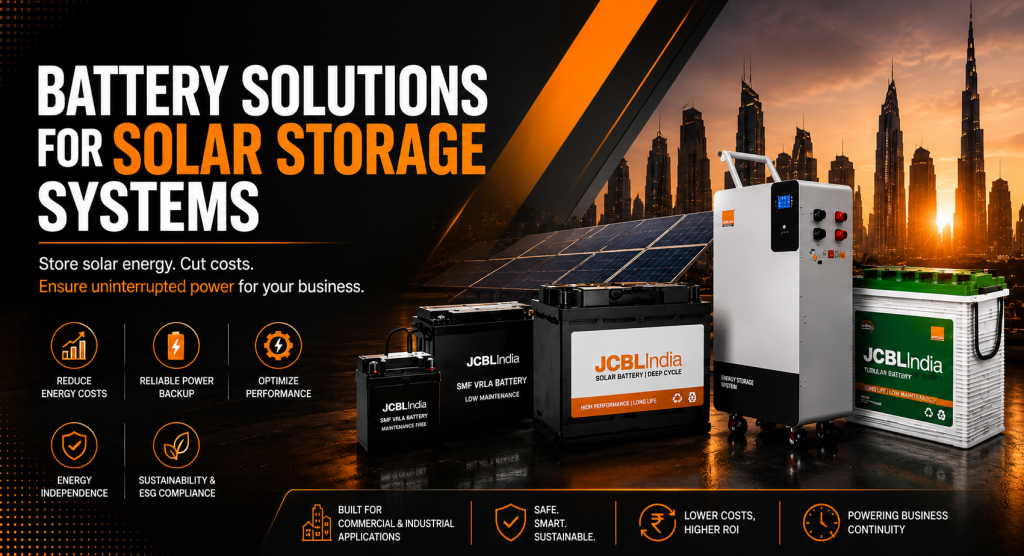
Battery solutions for solar storage systems store excess electricity generated by solar panels and make it available for later use in commercial and industrial operations. They help businesses reduce grid dependence, control energy costs, and ensure an uninterrupted power supply.
In B2B applications, these systems function as a strategic energy asset, supporting uptime, cost optimization, and long-term energy security.
Why Businesses Need Solar Battery Storage Systems
- Energy Cost Optimization: Store solar energy during low-demand hours and use it during peak tariff periods to reduce electricity bills under India’s ToD pricing.
- Reliable Power Backup: Ensure uninterrupted operations in regions with frequent outages or voltage instability.
- Peak Load Management: Reduce demand charges by supplying stored energy during peak consumption.
- Energy Independence: Minimize reliance on the grid and protect against rising electricity costs.
- ESG & Compliance: Support sustainability goals and meet regulatory requirements.
Types of Battery Solutions Used in Solar Storage
Lithium-Ion Batteries (LiFePO4, NMC)
- High energy density and efficiency (90–95%)
- Long cycle life (4,000–7,000 cycles)
- Low maintenance requirements
Best for: Commercial buildings, data centers, industrial plants
Lead-Acid Batteries (Tubular, VRLA)
- Lower upfront cost
- Proven technology with wide availability
- Higher maintenance and shorter lifespan
Best for: Budget-constrained or low-cycle applications
Flow Batteries
- Scalable for large installations
- Longer operational life with minimal degradation
- Higher initial investment
Best for: Utility-scale and large industrial energy storage
Quick Comparison: Which Battery Is Best for Solar Storage?
| Factor | Lithium-Ion | Lead-Acid | Flow Battery |
| Lifespan | High | Medium | Very High |
| Efficiency | High | Medium | Medium |
| Maintenance | Low | High | Low |
| Cost (Upfront) | High | Low | High |
| Best Use Case | C&I | Small setups | Large-scale |
Best choice for most businesses: Lithium-ion (LiFePO4) due to higher ROI, lifespan, and efficiency.
Key Factors to Consider When Choosing a Solar Battery Solution
- Energy Capacity (kWh): Defines how much energy the system can store. Businesses must align capacity with operational load requirements.
- Depth of Discharge (DoD): Higher DoD allows more usable energy per cycle. Lithium-ion batteries typically offer 80–95% DoD.
- Cycle Life: Indicates how many charge/discharge cycles the battery can perform before degradation. Directly impacts ROI.
- Efficiency (%): Round-trip efficiency determines how much stored energy is actually usable. Higher efficiency = lower energy losses.
- Operating Temperature Range: Critical for Indian climates where high temperatures can impact battery performance and lifespan.
- Safety & Certifications: Look for compliance with standards such as IEC, UL, and BIS for safe industrial deployment.
- Total Cost of Ownership (TCO): Includes upfront cost, maintenance, replacement cycles, and energy savings over time, not just initial price.
Applications of Solar Battery Solutions in B2B Sectors
- Manufacturing: Prevents downtime, supports critical machinery, and reduces demand charges through peak load shifting.
- Telecom: Ensures 24/7 uptime, reduces diesel dependency, and supports remote operations in low-grid areas.
- Data Centers: Provides instant backup, maintains power quality, and supports zero-downtime infrastructure.
- Healthcare Facilities: Ensures uninterrupted power for life-critical equipment and reduces emergency reliance on generators.
- Commercial Real Estate: Optimizes energy costs, supports essential systems, and improves tenant reliability.
Challenges in Solar Battery Storage Systems
- High Upfront Investment: Requires capital planning, though lifecycle savings justify the cost.
- Space Requirements: Needs dedicated infrastructure with ventilation and safety compliance.
- Performance Degradation: Capacity declines over time, requiring lifecycle planning.
- Maintenance Needs: Lead-acid requires upkeep; lithium-ion depends on advanced monitoring.
- Safety Considerations: Proper thermal management and certified systems are essential.
Conclusion
Battery solutions for solar storage systems are no longer optional for businesses; they are a core component of energy strategy. From cost savings and operational continuity to sustainability goals, the right battery system delivers measurable long-term value.
For B2B buyers, the focus should be on performance, lifecycle cost, and system integration, not just upfront pricing.
FAQs
A solar battery storage system stores excess electricity generated by solar panels for later use, enabling businesses to reduce grid dependence, manage energy costs, and ensure an uninterrupted power supply.
Lithium-ion batteries, especially LiFePO₄, are the preferred choice for commercial solar storage due to their high efficiency, long lifespan, and low maintenance requirements.
The cost typically ranges from ₹8,000 to ₹30,000 per kWh, depending on battery type, system size, and installation complexity.
Lithium-ion batteries last 8–15 years, while lead-acid batteries typically last 3–7 years depending on usage and maintenance.
Yes, with proper system sizing and integration, solar battery storage can support full business operations, especially when combined with solar generation and grid backup.