

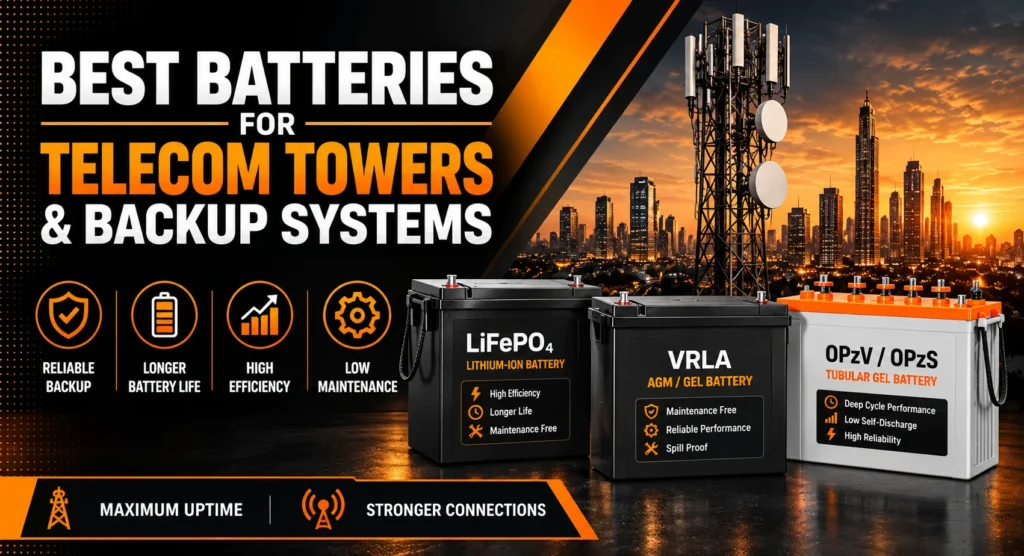
The best batteries for telecom towers and backup systems are LiFePO4 lithium-ion, VRLA (AGM/Gel), and OPzV / Tubular Gel Batteries. Each serves a different operational need based on cost, environment, and backup duration requirements.
Today, telecom operators are rapidly shifting toward lithium-based systems due to longer lifespan, lower maintenance, and improved energy efficiency.
Which Battery is Best for Telecom Towers?
Lithium-ion (LiFePO4) is the best battery for telecom towers overall because it delivers the highest efficiency, longest lifecycle, and lowest maintenance requirements.
However, the best choice still depends on deployment conditions:
- Best overall performance: Lithium-ion (LiFePO4)
- Best for budget deployments: VRLA (AGM/Gel)
- Best for long backup in harsh environments: OPzV / Tubular Gel Batteries
- Best for modern telecom infrastructure (5G, hybrid solar, automation): Lithium-ion
Types of Batteries Used in Telecom Towers
1. Lithium-Ion Batteries (LiFePO4)
Lithium iron phosphate batteries are now the most advanced telecom backup solution. They are widely used in modern telecom infrastructure due to their efficiency and long operational life.
Key advantages:
- 3,000–7,000+ cycle life
- Fast charging capability
- High depth of discharge (80–95%)
- Compact and lightweight design
- Minimal maintenance
- Excellent efficiency in hybrid systems
These batteries are ideal for:
- Telecom towers
- Data centers
- Hybrid solar + diesel systems
- Remote BTS sites
- UPS and critical infrastructure
2. VRLA Batteries (AGM & Gel)
VRLA (Valve-Regulated Lead-Acid) batteries have been a traditional telecom standard for years.
They are still widely used because of their low upfront cost and easy deployment in existing systems.
Key advantages:
- Low initial investment
- Maintenance-free sealed design
- Easy replacement in legacy setups
- Proven telecom reliability
Limitations:
- Shorter lifespan (typically 3–5 years)
- Lower usable depth of discharge
- Slower charging compared to lithium
Best suited for:
- Budget-sensitive telecom deployments
- Legacy BTS infrastructure
- Indoor backup systems
3. OPzV / Tubular Gel Batteries
OPzV / Tubular Gel Batteries are a deep-cycle lead-acid solution designed for long-duration backup and harsh environmental conditions.
Key advantages:
- 5–8+ year lifespan
- Strong deep-discharge capability
- Reliable in high-temperature regions
- Suitable for long backup requirements
They are commonly used in:
- Rural telecom towers
- High-temperature environments
- Areas with frequent power cuts
- Solar hybrid telecom systems
Lithium-ion vs VRLA vs OPzV / Tubular Gel Batteries: Quick Comparison
| Feature | Lithium-ion (LiFePO4) | VRLA (AGM/Gel) | OPzV / Tubular Gel Batteries |
| Lifespan | 8–15 years | 3–5 years | 5–8+ years |
| Maintenance | Very low | Low | Medium |
| Initial Cost | High | Low | Medium |
| Efficiency | High | Medium | Medium |
| Depth of Discharge | 80–95% | ~50% | 60–80% |
| Temperature Performance | Good (with BMS) | Low–moderate | Excellent |
| Footprint | Compact | Bulky | Bulky |
Key Factors to Consider When Choosing Telecom Backup Batteries
Battery selection depends on operational, environmental, and financial factors:
- Backup Duration Requirements: Longer outages require higher-capacity systems with better deep-cycle performance.
- Temperature Conditions: Hot climates require thermally stable systems, while colder regions need batteries with consistent discharge behavior.
- Maintenance Capability: Remote telecom sites benefit from low-maintenance systems like lithium-ion batteries.
- Total Cost of Ownership (TCO): Although lithium-ion has higher upfront cost, it offers the lowest long-term operational cost due to reduced replacement and maintenance cycles.
- Space Constraints: Urban telecom towers often prefer compact lithium systems due to limited installation space.
Common Problems with Telecom Tower Batteries
Battery performance varies significantly based on environmental and infrastructure conditions.
- High-temperature regions (Middle East, Africa, South Asia): Lithium-ion (LiFePO4) or OPzV / Tubular Gel Batteries for better reliability
- Cold climates (Europe, North America): Lithium-ion with thermal management
- Unreliable grid regions (Africa, Southeast Asia): Lithium-ion or OPzV / Tubular Gel Batteries due to frequent charge-discharge cycles
- Advanced telecom markets (US, Europe, 5G networks): Lithium-ion for efficiency, automation, and compact design
Best Practices to Extend Telecom Battery Life
Proper battery management and preventive measures can significantly improve the lifespan and performance of telecom tower batteries. Following best practices ensures reliable backup and reduces long-term operational costs.
- Avoid deep discharge cycles: Limiting discharge levels helps prevent battery stress and extends overall life.
- Maintain optimal operating temperature: Keeping batteries within 20°C–25°C improves performance and reduces degradation.
- Conduct regular inspections: Routine checks of voltage, terminals, and overall condition help detect issues early.
- Use Battery Management Systems (BMS): BMS monitors temperature, charge cycles, and voltage to ensure safe and efficient battery operation.
Conclusion
The best battery for telecom towers ultimately depends on cost considerations, environmental conditions, and required backup duration. VRLA batteries continue to be used in budget-focused and legacy telecom systems, while OPzV / Tubular Gel Batteries are preferred in harsh environments and applications requiring longer backup performance. However, Lithium-ion (LiFePO4) batteries are increasingly becoming the global standard for modern telecom infrastructure due to their superior efficiency, higher reliability, and lower total cost of ownership over time. For telecom operators, particularly in high-temperature and high-demand regions, selecting the right battery technology plays a crucial role in improving uptime, reducing maintenance requirements, and ensuring long-term network stability.
FAQs
Lithium-ion and VRLA batteries are the most widely used, depending on system age and budget.
Lithium-ion and OPzV / Tubular Gel Batteries provide the best long-duration backup performance.
They offer longer lifespan, faster charging, lower maintenance, and better efficiency.
Lithium-ion (LiFePO4) and OPzV / Tubular Gel Batteries perform best in high-temperature environments.