

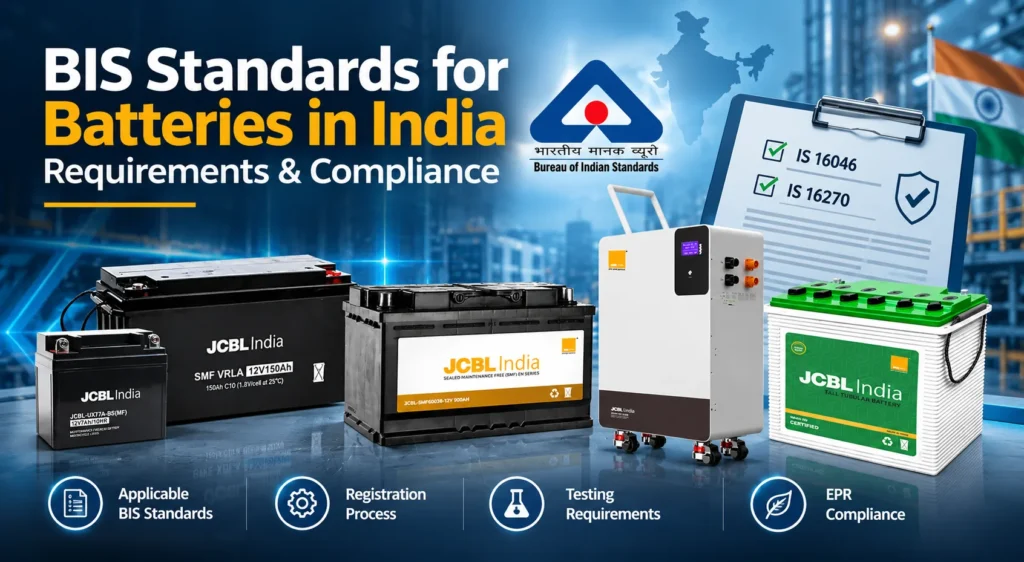
Businesses manufacturing, importing, or selling batteries in India must identify the applicable BIS standard and regulatory scheme before placing a product on the market. The requirement varies by battery type, chemistry, application, and the scope of the applicable Indian Standard.
For portable sealed secondary batteries, IS 16046 is a key BIS standard. However, businesses should not assume that every lithium-ion, lead-acid, or rechargeable battery falls under the same requirement.
What Are the BIS Standards for Batteries in India?
BIS battery requirements in India depend on the specific battery and its application. BIS’s Scheme-II Registration Scheme currently includes IS 16046 for sealed secondary cells and batteries containing alkaline or other non-acid electrolytes for portable applications. IS 16046 is divided into Part 1 for nickel systems and Part 2 for lithium systems. Other applications can involve different Indian Standards, such as IS 16270:2023 for secondary cells and batteries used in solar photovoltaic applications.
Which BIS Standards Apply to Batteries in India?
The correct standard should be selected from the product’s application and technical scope, not just its chemistry.
| Indian Standard | Battery/application | Key point |
| IS 16046 Part 1:2018 | Portable sealed secondary cells and batteries using nickel systems | Safety requirements for portable applications |
| IS 16046 Part 2:2018 | Portable sealed secondary cells and batteries using lithium systems | Safety requirements for portable applications |
| IS 16270:2023 | Secondary cells and batteries for solar photovoltaic applications | General requirements and test methods |
BIS currently lists IS 16046 under its Scheme-II Registration Scheme for the defined portable battery category. BIS laboratory records also show active testing scopes for IS 16046 Parts 1 and 2.
IS 16270:2023 covers secondary cells and batteries for solar photovoltaic applications and includes requirements and tests relating to operating conditions, capacity, endurance, charge retention, deep-discharge protection, safety, and marking.
Important: A standard being relevant to a battery does not, by itself, mean that every product using that standard has the same compulsory BIS route. Businesses must verify the latest BIS notification and applicable scheme for the exact product.
What Is “IS” 16046 Part 2 for Lithium-Ion Batteries?
IS 16046 Part 2:2018 covers safety requirements for portable sealed secondary cells and batteries containing lithium systems for portable applications. BIS laboratory scopes identify testing areas including general safety, insulation and wiring, venting, temperature/voltage/current management, terminal contacts, cell-to-battery assembly, battery safety components, charging procedures, intended use, foreseeable misuse, information for safety, marking, and packaging.
This means “lithium-ion battery” alone is not enough to determine BIS applicability. The intended application and the product’s construction must also fall within the standard’s scope.
Who Needs to Check BIS Battery Compliance?
Businesses that manufacture, import, assemble, or place batteries on the Indian market should assess BIS applicability before commercialization.
This includes:
- Indian battery manufacturers
- Importers bringing batteries into India
- Businesses marketing products under their own brand
- OEMs and product companies sourcing finished battery products
For imported products, the compliance review should cover both the battery manufacturer and the exact product configuration being supplied to India.
Is BIS Certification Mandatory for Batteries in India?
Not for every battery. Compulsory BIS requirements apply where the relevant product is covered by a government notification and BIS conformity scheme.
For example, BIS’s current Scheme-II Registration Scheme includes IS 16046 for sealed secondary cells and batteries containing alkaline or other non-acid electrolytes for portable applications.
Therefore, the correct compliance question is not simply “Does a battery need BIS?” but:
“Does this specific battery fall within a product category covered by a compulsory BIS requirement?”
Businesses should confirm the current BIS scope, notification, and applicable Indian Standard before manufacture or import.
How to Get BIS Registration for Batteries in India
For a battery covered by the applicable BIS registration route, the process can be approached in five steps:
1. Identify the applicable Indian Standard
Check the battery chemistry, application, cell/battery configuration and relevant BIS scope.
2. Test the product
Use a laboratory whose current BIS scope includes the applicable standard. BIS’s laboratory database lists facilities and testing scopes for IS 16046 Parts 1 and 2.
3. Prepare product and manufacturer documentation
Ensure the technical specifications, manufacturing details, test documentation, and other required information accurately represent the product being placed on the market.
4. Submit the BIS application under the applicable scheme
The registration route requires the prescribed application and supporting technical/test documentation. The exact submission requirements should be checked against BIS’s current procedure.
5. Maintain conformity
After registration, manufacturers should control product changes, components, and production quality so that the marketed battery continues to match the approved or registered configuration.
BIS Requirements for Battery Importers in India
For an importer, compliance should be checked before the shipment reaches the Indian market.
A practical sequence is:
Identify the battery → verify BIS scope → confirm applicable IS standard → arrange required testing/documentation → complete BIS registration where applicable → verify marking and records → assess CPCB EPR obligations.
Importers should avoid relying on a supplier statement such as “BIS approved” without checking whether the approval covers the actual manufacturer, battery model, and configuration being imported.
BIS vs. Battery EPR: What Is the Difference?
BIS and Battery EPR are separate compliance requirements.
BIS deals with product conformity under an applicable Indian standard and regulatory scheme.
Battery EPR is governed by the Battery Waste Management Rules, 2022, and subsequent amendments. CPCB states that the rules apply to batteries regardless of chemistry, shape, volume, weight, material composition, or use, subject to the specified exclusions. Producers, including manufacturers and importers, have EPR obligations for batteries they introduce into the market and must register through the CPCB battery EPR portal.
CPCB guidance states that producers must meet applicable recycling/refurbishing obligations and use EPR certificates from registered recyclers to fulfill assigned targets.
So:
| Compliance area | BIS | Battery EPR |
| Primary focus | Product conformity | End-of-life battery management |
| Main authority | BIS | CPCB |
| Key question | Does the product meet the applicable BIS requirements? | What EPR obligations apply to the producer? |
| Typical business action | Testing and BIS registration/certification where applicable | CPCB registration and EPR compliance |
Common BIS Compliance Mistakes
- Assuming every lithium battery uses IS 16046 Part 2: IS 16046 Part 2 is specifically for portable sealed secondary cells and batteries containing lithium systems within its defined scope.
- Confusing BIS registration with EPR registration: A BIS registration and CPCB battery EPR registration serve different regulatory purposes. One does not replace the other.
- Testing a product configuration that later changes: Changes to cells, safety components, or construction should be assessed against the applicable requirements before the revised product is marketed.
- Using outdated regulatory information: BIS and CPCB publish standards, notifications, amendments, and implementation material over time. Always check the current official sources before relying on an older compliance checklist.
Conclusion
BIS compliance for batteries in India starts with identifying the exact product scope and applicable Indian standard. For portable sealed secondary batteries, IS 16046 is particularly important, with Part 1 covering nickel systems and Part 2 covering lithium systems. Other applications can fall under different standards, such as IS 16270:2023 for solar photovoltaic batteries.
Manufacturers and importers should then complete the applicable testing and BIS process while separately assessing CPCB Battery Waste EPR requirements. This product-specific approach provides a more reliable basis for battery compliance in India than treating BIS requirements as a single rule for every battery.
FAQs
No. BIS applicability depends on the specific battery, application, and whether the product is covered by a compulsory BIS requirement.
For portable sealed secondary cells and batteries containing lithium systems, the relevant standard is IS 16046 Part 2:2018.
IS 16046 Part 1:2018 covers portable sealed secondary cells and batteries using nickel systems.
They must first determine whether the imported product falls under a compulsory BIS requirement. Importers should also separately evaluate their CPCB producer/EPR obligations.
No. BIS addresses applicable product conformity requirements, while battery EPR concerns obligations under the Battery Waste Management Rules.