

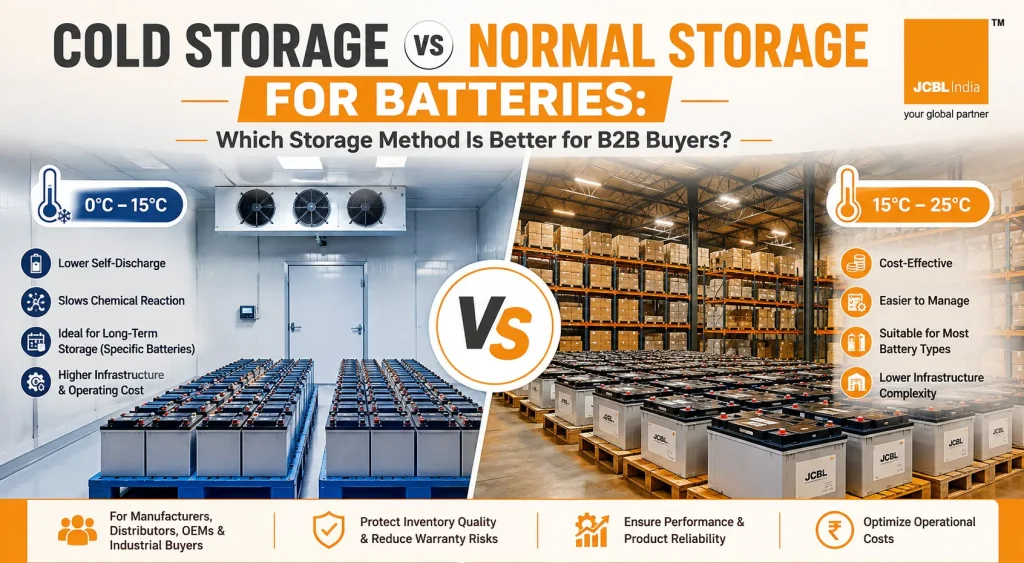
For battery manufacturers, distributors, OEMs, and industrial buyers, storage conditions directly impact inventory quality, product reliability, and operational costs. Whether batteries are stored for weeks or months before reaching customers, choosing the right storage method helps minimize capacity loss, reduce warranty risks, and maintain consistent performance.
A common question among procurement teams is whether cold storage is better than normal warehouse storage. The answer depends on battery chemistry, storage duration, and manufacturer recommendations—not simply on lower temperatures.
Cold Storage vs Normal Storage: Quick Comparison
| Factor | Cold Storage | Normal Storage |
| Temperature Range | 0°C–15°C (application-specific) | 15°C–25°C |
| Suitable for Most Batteries | No | Yes |
| Self-Discharge | Lower for selected chemistries | Within acceptable limits |
| Moisture Risk | Higher if condensation occurs | Minimal |
| Infrastructure Cost | High | Cost-effective |
| Warehouse Complexity | High | Low |
| Best For | Specialized long-term storage | Routine commercial inventory |
Why Battery Storage Matters for B2B Buyers
Battery storage is more than a warehouse practice—it is an essential part of inventory management. Improper storage can accelerate battery degradation, increase replacement costs, and affect customer satisfaction.
For businesses managing large inventories, proper storage helps:
- Preserve battery capacity during storage.
- Reduce warranty claims caused by storage-related issues.
- Improve inventory turnover and product consistency.
- Protect high-value stock from environmental damage.
- Ensure batteries meet customer performance expectations.
This is particularly important in India, where high ambient temperatures and seasonal humidity can significantly affect battery health if storage conditions are not properly controlled.
What Is Cold Storage for Batteries?
Cold storage involves keeping batteries in climate-controlled facilities at temperatures below normal room conditions to slow chemical reactions and reduce self-discharge during extended storage.
However, cold storage is not a standard requirement for all battery types. It is generally used only when recommended by the manufacturer for specific chemistries or long-term inventory management. Maintaining stable humidity levels is equally important, as condensation can damage battery terminals and electrical components.
What Is Normal Storage?
Normal storage refers to storing batteries in a clean, dry, and well-ventilated warehouse with temperatures typically maintained between 15°C and 25°C. This method is widely recommended for most lead-acid, lithium-ion, VRLA, tubular, and industrial batteries.
In addition to temperature control, effective warehouse practices such as humidity management, proper ventilation, and inventory rotation help preserve battery quality throughout the storage period.
Cold Storage vs Normal Storage: Key Differences
1. Temperature Management
Cold storage slows self-discharge for selected battery chemistries but requires strict temperature and humidity control. Normal storage maintains stable environmental conditions suitable for most commercial batteries.
2. Inventory Performance
While lower temperatures may reduce chemical activity, improper cold storage can expose batteries to condensation when moved to warmer environments. Normal storage minimizes this risk while maintaining consistent battery performance.
3. Operational Cost
Cold storage requires refrigeration systems, monitoring equipment, and higher energy consumption. Normal warehouse storage is simpler to manage and offers lower operating costs for large inventories.
4. Scalability
For manufacturers and distributors handling high-volume inventory, normal storage is easier to implement across multiple warehouse locations. Cold storage is generally reserved for specialized applications with defined storage requirements.
Which Storage Method Is Suitable for Different Battery Types?
| Battery Type | Recommended Storage Method | Reason |
| Lithium-ion | Controlled normal storage | Maintains performance while minimizing condensation risks |
| Lead-acid | Normal storage | Prevents freezing risks and supports longer service life |
| VRLA Batteries | Normal storage | Stable under recommended warehouse conditions |
| Tubular Batteries | Normal storage | Suitable for commercial inventory management |
| Nickel-Based Batteries | Cold storage may be suitable for specific long-term applications | Depends on manufacturer recommendations |
Since storage requirements vary by battery design, businesses should always follow the manufacturer’s recommended storage guidelines.
Business Risks of Improper Battery Storage
Poor storage practices can create significant operational and financial challenges for businesses.
Common risks include:
- Faster battery degradation
- Reduced shelf life
- Increased warranty claims
- Higher replacement costs
- Inventory losses due to damaged stock
- Delivery delays caused by failed quality inspections
- Reduced customer confidence and repeat business
Implementing appropriate storage conditions helps protect inventory value while improving supply chain reliability.
Best Battery Storage Practices for Warehouses
Whether using normal or temperature-controlled storage, following established warehouse practices helps maximize battery performance.
Recommended practices include:
- Maintain storage temperatures between 15°C and 25°C, unless otherwise specified by the manufacturer.
- Control warehouse humidity to prevent corrosion and condensation.
- Keep batteries away from direct sunlight and heat sources.
- Rotate inventory using the First-In, First-Out (FIFO) method.
- Inspect stored batteries periodically for voltage, leakage, swelling, or terminal corrosion.
- Store batteries in their original packaging or approved storage racks.
- Avoid stacking batteries beyond recommended limits.
- Follow the manufacturer’s charging and storage recommendations for rechargeable batteries.
These practices are particularly valuable for businesses operating across India’s diverse climate conditions, where summer heat and monsoon humidity can affect battery quality.
Which Storage Method Offers Better Value for B2B Buyers?
For most manufacturers, distributors, wholesalers, and industrial buyers, controlled normal warehouse storage delivers the best return on investment.
It provides reliable inventory protection, lower operating costs, easier warehouse management, and compatibility with most commercial battery chemistries.
Cold storage should only be considered when supported by manufacturer recommendations or when specialized battery applications require controlled long-term storage. Investing in cold storage without a clear technical need can increase operational costs without delivering meaningful performance benefits.
Conclusion
When comparing cold storage and normal storage for batteries, there is no universal solution. However, for most B2B applications, controlled normal warehouse storage remains the preferred choice. It supports inventory quality, reduces operational costs, simplifies warehouse management, and meets the storage requirements of most commercial battery chemistries.
Cold storage should only be implemented where battery manufacturers specifically recommend it for long-term preservation or specialized applications. By following proper storage guidelines and maintaining stable environmental conditions, manufacturers, distributors, and industrial buyers can extend battery shelf life, minimize inventory losses, and ensure consistent product performance across the supply chain.
FAQs
No. Most commercial batteries are designed to be stored in controlled warehouse conditions between 15°C and 25°C. Cold storage is only recommended for specific battery chemistries or extended storage applications.
For most industrial and commercial batteries, maintaining temperatures between 15°C and 25°C in a dry, well-ventilated warehouse helps preserve battery performance and shelf life.
Cold storage can reduce self-discharge for certain battery chemistries during long-term storage. However, its effectiveness depends on proper humidity control and manufacturer recommendations.
High humidity can cause corrosion, condensation, and damage to battery terminals. Controlling moisture is just as important as maintaining the correct storage temperature.
For most distributors and wholesalers, normal warehouse storage offers the best balance of inventory protection, operating costs, and ease of management.