

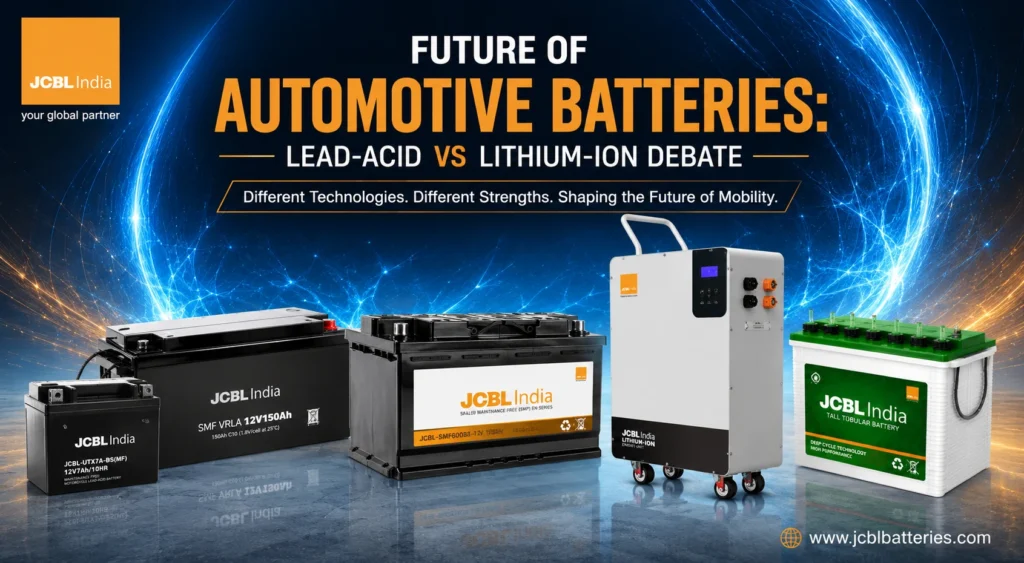
The automotive battery industry is entering a period of significant change. The growth of electric vehicles (EVs), hybrid vehicles, advanced electronics and connected vehicle systems is increasing demand for different battery technologies.
Lithium-ion batteries are becoming central to vehicle electrification, while lead-acid batteries continue to serve millions of conventional vehicles and specific auxiliary applications. The question for automotive manufacturers, suppliers, distributors and aftermarket businesses is no longer simply which battery is better, but which technology is best suited to each automotive application.
Lead-Acid vs Lithium-Ion: Key Differences
Lead-acid and lithium-ion batteries have different strengths, making them suitable for different vehicle requirements.
| Factor | Lead-Acid | Lithium-Ion |
| Energy density | Lower | Higher |
| Weight | Higher | Lower |
| Upfront cost | Generally lower | Generally higher |
| Charging efficiency | Lower | Higher |
| Cycle life | Generally lower | Generally higher |
| Manufacturing ecosystem | Highly established | Rapidly expanding |
| Recycling infrastructure | Highly established | Developing |
| Conventional vehicle applications | Strong | Limited |
| EV traction applications | Limited | Dominant |
For automotive businesses, these differences matter because battery selection depends on vehicle architecture, power requirements, cost targets and operating conditions, not just energy density.
Why Lead-Acid Batteries Still Have a Future
Lead-acid is not simply an older battery technology being displaced by lithium-ion. Its established automotive ecosystem gives it a strong position in markets where reliability, affordability, serviceability and infrastructure matter.
The technology is supported by decades of automotive manufacturing experience, widespread aftermarket availability and a mature collection and recycling network. Modern variants such as AGM (Absorbent Glass Mat) and EFB (Enhanced Flooded Battery) have also evolved to meet the higher electrical demands of vehicles equipped with start-stop systems and advanced electronics.
Its continued relevance is reinforced by:
- A mature supply chain: Manufacturing, distribution, servicing and replacement networks are already established across major automotive markets.
- Proven vehicle integration: Lead-acid technology is widely compatible with conventional starting and low-voltage automotive systems.
- Advanced product formats: AGM and EFB technologies extend lead-acid’s suitability to newer vehicle requirements.
- Established recycling: Lead batteries benefit from a well-developed collection and recycling infrastructure. In the U.S., Battery Council International reports that approximately 99% of lead batteries are recycled.
This makes lead-acid particularly resilient in the automotive aftermarket, where replacement demand is driven by the large existing vehicle fleet rather than only by new-vehicle sales.
For battery manufacturers and distributors, this installed base represents an important commercial opportunity even as vehicle electrification accelerates.
What Is Driving the Shift Toward Lithium-Ion?
Lithium-ion’s growth is being driven less by the replacement of conventional batteries and more by the fundamental shift in vehicle design toward electrification.
Electric and hybrid vehicles require battery systems capable of delivering substantial amounts of energy while managing weight, space, and repeated charge-discharge cycles. Lithium-ion technology fits these requirements more effectively than conventional lead-acid technology, making it the dominant battery technology for modern EV traction applications.
The scale of this transition is significant. According to the International Energy Agency (IEA), global EV battery deployment reached approximately 1.2 TWh in 2025, nearly 30% higher than in 2024. The IEA expects global EV battery deployment to approach 3 TWh by 2030.
Beyond rising EV production, several developments are strengthening lithium-ion’s position:
- Vehicle electrification: Growing EV and hybrid adoption is creating a rapidly expanding market for rechargeable high-energy battery systems.
- Weight reduction: Higher energy density enables manufacturers to meet energy requirements with less battery mass.
- Vehicle architecture: New EV platforms are being designed around high-voltage battery systems from the outset.
- Technological development: Improvements in battery chemistry, manufacturing and pack design continue to expand lithium-ion’s automotive capabilities.
- Broader electrification: Battery technology is becoming increasingly important across propulsion, energy management and auxiliary vehicle systems.
However, greater capability also brings greater system complexity. Lithium-ion automotive systems require careful consideration of cell chemistry, battery management, thermal control, charging, safety and electronic integration.
For automotive battery manufacturers and suppliers, this shift represents more than a new product category. It signals a move toward more technically integrated battery systems and new capabilities across the automotive supply chain.
Lead-Acid vs Lithium-Ion: Which Is Better for Automotive Applications?
There is no universal winner.
Lead-acid remains the stronger fit where cost, starting power, established infrastructure and conventional vehicle compatibility are priorities. Lithium-ion is better positioned where low weight, high energy density, efficiency and repeated cycling are more important.
The application matters more than the technology label.
| Application | Likely Technology Advantage |
| Conventional ICE starting | Lead-acid |
| Start-stop systems | EFB/AGM lead-acid |
| Cost-sensitive aftermarket | Lead-acid |
| EV traction battery | Lithium-ion |
| Hybrid applications | Lithium-ion and other advanced technologies |
| Lightweight auxiliary systems | Increasingly lithium-ion |
| High-cycle applications | Lithium-ion |
This distinction is particularly important for businesses operating across different automotive markets. A battery strategy designed entirely around EV demand could overlook the continuing replacement market for conventional vehicles.
Will Lithium-Ion Replace Lead-Acid Batteries?
No. Lithium-ion is unlikely to completely replace lead-acid batteries across the automotive industry. Instead, both technologies are expected to coexist, serving different vehicle types and applications.
- Lithium-ion: Increasingly dominant in EV and hybrid traction systems, where energy density, lower weight and cycling performance are priorities.
- Lead-acid: Likely to remain important for conventional vehicle starting, start-stop systems and cost-sensitive 12V applications.
- Both technologies: Will continue to serve different requirements as automotive architectures become more diverse.
The IEA reports that global EV battery deployment reached approximately 1.2 TWh in 2025, reflecting the rapid expansion of electrified vehicles.
For automotive OEMs, manufacturers, distributors and aftermarket suppliers, the key opportunity is therefore not choosing one technology over the other, but building the capabilities and product portfolio needed to serve ICE, hybrid and electric vehicles.
The future of automotive batteries is more likely to be defined by technology diversification and application-specific selection than by the complete replacement of lead-acid with lithium-ion.
Future Trends Shaping Automotive Batteries
1. Rapid Growth of EV Battery Demand
EVs will remain the primary driver of automotive battery growth. The IEA expects global EV battery deployment to rise from around 1.2 TWh in 2025 to almost 3 TWh by 2030.
2. Continued Development of Advanced Lead-Acid
Lead-acid manufacturers are likely to focus on improving performance, durability, charging capability and suitability for modern vehicle electrical systems.
AGM and EFB technologies will remain important where vehicles require more advanced low-voltage battery performance.
3. Expansion of Lithium-Ion Beyond EV Traction
As lithium-ion technology becomes more cost-competitive, its use can expand into additional automotive applications where weight, efficiency and cycle life justify the higher system complexity.
4. Greater Focus on Battery Recycling
Recycling will become increasingly important for both technologies.
Lead-acid already benefits from a mature recycling ecosystem. Lithium-ion recycling and recovery infrastructure, meanwhile, will need to expand as the number of end-of-life EV batteries increases.
For India, this is particularly relevant as EV adoption and domestic battery manufacturing develop alongside the need for organized collection, recycling, and material recovery systems.
5. More Application-Specific Battery Design
Future automotive batteries will increasingly be designed around the vehicle’s architecture rather than treated as one-size-fits-all components.
Battery manufacturers will need to consider factors such as:
- Vehicle voltage architecture
- Energy requirements
- Weight
- Charging patterns
- Climate and operating conditions
- Safety requirements
- Total cost of ownership
- End-of-life recycling
What the Lead-Acid vs Lithium Debate Means for Automotive Businesses
For OEMs, battery manufacturers, distributors and aftermarket suppliers, the changing market creates both challenges and opportunities.
Businesses should prepare by:
- Maintaining expertise in advanced lead-acid technologies
- Developing capabilities in lithium-ion battery systems
- Tracking EV and hybrid vehicle adoption
- Understanding application-specific battery requirements
- Strengthening battery recycling and reverse-logistics networks
- Diversifying product portfolios instead of relying on one technology
- Monitoring changing OEM specifications and vehicle architectures
For businesses serving the Indian automotive market, this balanced approach is particularly relevant because conventional vehicles, hybrids and EVs are expected to coexist across different vehicle segments and price points.
The Future of Automotive Batteries: Two Technologies, Different Roles
The future of automotive batteries is unlikely to be a simple lead-acid vs lithium-ion winner-takes-all scenario.
Lithium-ion is set to dominate high-energy applications as global vehicle electrification expands. The IEA expects EV battery deployment to continue increasing substantially through 2030 and beyond.
Lead-acid, however, retains important advantages in conventional automotive and auxiliary applications, supported by its mature manufacturing, distribution and recycling ecosystem.
For the automotive industry, the more realistic future is coexistence and specialization: lithium-ion for applications where energy density, weight and cycling performance are critical, and lead-acid where cost, established infrastructure and proven starting performance remain priorities.
The companies best positioned for this transition will be those that understand where each battery technology creates the most value, rather than treating the future as a choice between two competing technologies.
Conclusion
The future of automotive batteries is unlikely to be defined by a single technology. Lithium-ion will continue to gain importance as EV adoption expands, particularly where energy density, lower weight and high cycling performance are priorities. At the same time, lead-acid batteries are expected to remain relevant across conventional vehicles, start-stop systems and cost-sensitive automotive applications.
For OEMs, manufacturers, distributors and aftermarket businesses, the opportunity lies in understanding where each technology delivers the best value. Rather than choosing between lead-acid and lithium-ion, businesses that build expertise and product capabilities across both technologies will be better positioned for the evolving global and Indian automotive battery market.
FAQs
Neither technology is universally better. Lithium-ion offers advantages in weight, energy density and cycling performance, while lead-acid remains competitive for conventional starting, cost-sensitive and established automotive applications.
Not completely. Lithium-ion is likely to gain market share as vehicle electrification expands, while lead-acid is expected to remain important in conventional vehicles and selected auxiliary applications.
Lithium-ion batteries generally offer a longer cycle life than conventional lead-acid batteries. Actual service life depends on battery design, vehicle application, charging conditions, temperature and operating patterns.
Lead-acid batteries remain attractive because of their established supply chain, relatively low cost, starting performance and mature recycling infrastructure.
The automotive battery market is expected to become increasingly diversified. Lithium-ion will lead EV traction applications, while advanced lead-acid technologies are likely to continue serving conventional vehicles, start-stop systems and other applications where their cost and established infrastructure remain advantages.