

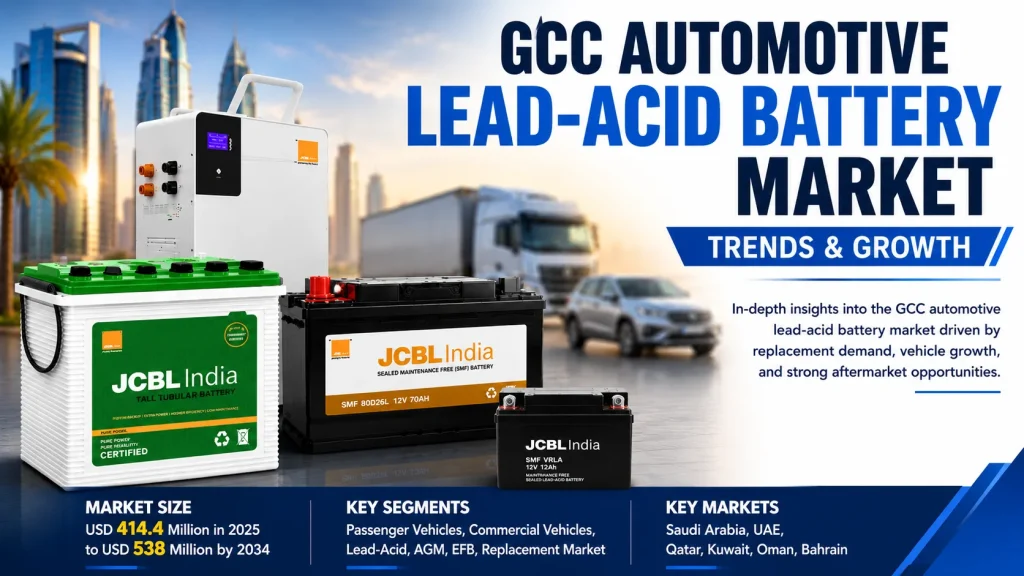
Automotive lead-acid batteries continue to play a critical role across the Gulf Cooperation Council (GCC) automotive sector. Despite advancements in vehicle technologies, lead-acid batteries remain the preferred choice for Starting, Lighting, and Ignition (SLI) applications in conventional passenger and commercial vehicles due to their reliability, affordability, and proven performance.
The GCC Automotive Lead-Acid Battery Market is primarily driven by replacement demand, expanding vehicle fleets, and growing transportation activities. According to industry estimates, the market was valued at approximately USD 414.4 million in 2025 and is expected to reach USD 538 million by 2034, reflecting steady long-term demand across Saudi Arabia, the UAE, Qatar, and other GCC countries.
What Is Driving the GCC Automotive Lead-Acid Battery Market?
The GCC Automotive Lead-Acid Battery Market is growing due to rising vehicle ownership, harsh climate conditions that shorten battery life, increasing replacement demand, and continued reliance on lead-acid batteries in passenger and commercial vehicles.
1. Growing Vehicle Ownership Across GCC Countries
An expanding vehicle fleet directly increases the need for battery replacements. As more vehicles remain in operation, the installed base requiring periodic battery replacement continues to grow.
Saudi Arabia remains the largest automotive market in the region, with approximately 15.88 million registered and roadworthy vehicles recorded in 2024. The UAE and Qatar also maintain substantial vehicle populations, supporting consistent demand for automotive lead-acid batteries.
2. Extreme Climate Conditions Accelerating Battery Wear
The GCC’s climate is one of the most important factors influencing battery demand. High temperatures accelerate electrolyte evaporation, internal corrosion, and overall battery degradation.
In the UAE, automotive batteries typically last only 2–3 years, compared to the global average of 4–5 years. This shorter lifespan creates recurring replacement demand and strengthens the aftermarket battery segment throughout the GCC.
3. Continued Dependence on Lead-Acid Batteries
Although vehicle technologies are evolving, conventional vehicles continue to dominate GCC roads. Automotive lead-acid batteries remain essential for starting engines and powering critical electrical systems, ensuring continued market demand.
Why Replacement Demand Dominates the GCC Lead Acid Battery Market
Replacement demand dominates the GCC Lead Acid Battery Market because high temperatures and intensive vehicle use shorten battery lifespans, leading to frequent replacements across the region.
The GCC’s hot climate creates challenging operating conditions for automotive batteries. Prolonged exposure to heat accelerates battery degradation, reducing performance and overall service life. As a result, vehicle owners and fleet operators replace batteries more frequently than in many other regions.
Demand is further supported by the region’s large and growing vehicle population. Additionally, modern vehicles are equipped with more electronic features and electrical systems, increasing battery workloads and contributing to faster wear.
Key Factors Driving Replacement Demand
- Extreme temperatures that reduce battery lifespan.
- A large vehicle fleet requiring regular battery replacements.
- Higher battery usage in commercial and logistics fleets.
- Increasing electrical loads from modern vehicle technologies.
Passenger and Commercial Vehicles Remain the Largest Demand Contributors
Passenger vehicles and commercial vehicles are the primary demand-generating segments in the GCC Automotive Lead-Acid Battery Market. Passenger vehicles drive demand through their large ownership base, while commercial vehicles create significant replacement demand due to intensive operating conditions and higher vehicle utilization.
Passenger vs Commercial Vehicle Battery Demand
| Factor | Passenger Vehicles | Commercial Vehicles |
| Primary Demand Driver | Large vehicle ownership base | Fleet operations and logistics |
| Battery Usage | Daily personal transportation | Heavy-duty and long-distance operations |
| Replacement Frequency | Moderate | High |
| Market Contribution | High-volume demand | Strong aftermarket demand |
Passenger Vehicles
Passenger vehicles account for a substantial share of automotive lead-acid battery demand across the GCC. Rising urbanization, increasing personal mobility, and strong preference for private vehicle ownership continue to support battery consumption throughout the region.
Additionally, SUVs and larger passenger vehicles remain particularly popular in GCC countries, contributing to sustained demand for reliable automotive batteries and regular replacement cycles.
Commercial Vehicles
Commercial vehicles represent a major demand segment within the GCC Automotive Lead-Acid Battery Market and were identified as the largest vehicle-type segment in 2025. Growth in logistics, freight transportation, e-commerce deliveries, and infrastructure development continues to expand commercial vehicle fleets across the region.
Because these vehicles operate for longer hours and under more demanding conditions, batteries are exposed to greater wear and often require replacement more frequently than those used in passenger cars.
Key Takeaway
Passenger vehicles provide consistent demand due to their large numbers, while commercial vehicles generate strong aftermarket opportunities because of higher battery usage and replacement requirements. Together, these segments remain the foundation of demand in the GCC Automotive Lead-Acid Battery Market.
Key Trends Shaping the GCC Automotive Lead-Acid Battery Market
1. Rising Aftermarket Battery Sales
The expanding installed vehicle base across GCC countries continues to drive aftermarket battery sales. As vehicles age, battery replacement becomes a routine maintenance requirement, creating sustained demand throughout the region.
2. Growing Demand for Maintenance-Free Batteries
Consumers and fleet operators increasingly prefer maintenance-free batteries because they require less servicing, offer greater convenience, and perform reliably in demanding climatic conditions.
3. Increasing Adoption of AGM and Enhanced Flooded Batteries
Automotive manufacturers and vehicle owners are gradually adopting Absorbent Glass Mat (AGM) and Enhanced Flooded Batteries (EFB) due to their improved durability, better charge acceptance, and compatibility with modern vehicle electrical systems.
4. Strong Demand from Saudi Arabia, UAE, and Qatar
The three largest demand centers within the GCC Automotive Lead-Acid Battery Market continue to be Saudi Arabia, the UAE, and Qatar.
| Country | Key Demand Driver |
| Saudi Arabia | Largest vehicle fleet and growing logistics sector |
| UAE | High vehicle ownership and shorter battery lifespan due to extreme heat |
| Qatar | Growing vehicle parc and increasing replacement battery demand |
Together, these markets create substantial opportunities for battery manufacturers, distributors, and aftermarket suppliers.
Future Outlook
The GCC Automotive Lead-Acid Battery Market is expected to maintain steady growth over the coming years, driven primarily by replacement demand, expanding vehicle fleets, and continued use of lead-acid batteries in passenger and commercial vehicles.
While vehicle technologies will continue to evolve, conventional vehicles will remain a significant part of the regional automotive landscape. Combined with harsh operating conditions and a large installed vehicle base, replacement demand is expected to remain the primary growth engine of the GCC Lead Acid Battery Market through the next decade.
For a broader perspective on regional battery demand beyond automotive applications, explore our guide on GCC Battery Market: Growth Trends, Demand Drivers & Future Outlook, covering automotive, industrial, lead-acid, lithium-ion batteries, and country-wise market trends.
Conclusion
The GCC Automotive Lead-Acid Battery Market is expected to maintain steady growth, driven primarily by replacement demand, expanding vehicle fleets, and continued reliance on conventional vehicles across the region. Harsh climatic conditions, particularly high temperatures, continue to shorten battery lifespans, making replacement batteries a critical component of the automotive aftermarket.
Passenger vehicles remain a major source of battery demand due to their large ownership base, while commercial vehicles generate strong aftermarket opportunities through intensive usage and frequent replacement requirements. Additionally, Saudi Arabia, the UAE, and Qatar continue to lead regional demand, supported by growing transportation activities and vehicle populations.
As the region’s automotive sector evolves, automotive lead-acid batteries will continue to play a vital role in powering passenger and commercial vehicles, ensuring sustained demand and long-term growth opportunities across the GCC market.
FAQs
The market was valued at approximately USD 414.4 million in 2025 and is projected to reach USD 538 million by 2034.
High temperatures reduce battery lifespan, resulting in more frequent battery replacements and strong aftermarket demand.
Passenger vehicles and commercial vehicles are the primary demand-generating segments across the GCC.
Saudi Arabia, the UAE, and Qatar are among the leading markets due to their large vehicle fleets and strong replacement demand.
Major trends include rising aftermarket battery sales, growing demand for maintenance-free batteries, increasing adoption of AGM and EFB batteries, and sustained demand from passenger and commercial vehicles.