

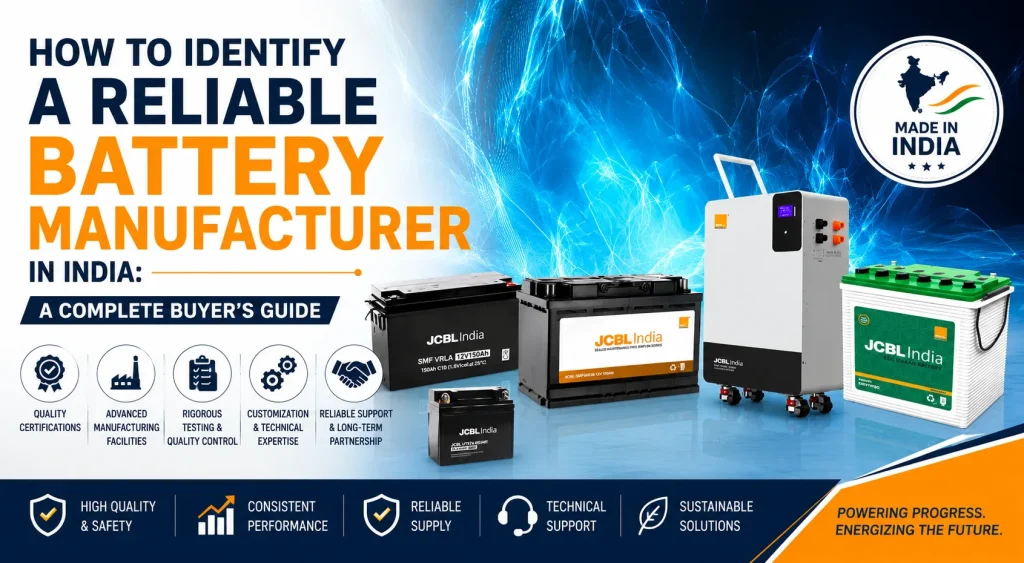
India has become one of the fastest-growing battery manufacturing hubs, driven by the rapid adoption of electric vehicles (EVs), renewable energy storage, industrial automation, telecom infrastructure, and consumer electronics. As demand grows, businesses are faced with an important decision: how do you identify a reliable battery manufacturer in India?
Whether you are an OEM, distributor, EPC contractor, or industrial buyer, choosing the right manufacturing partner goes beyond comparing prices. Product quality, certifications, testing capabilities, production capacity, and after-sales support all influence battery performance and long-term business success.
This guide explains the key factors to evaluate before selecting a battery manufacturer in India.
How Do You Identify a Reliable Battery Manufacturer in India?
A reliable battery manufacturer in India should have recognized quality certifications, advanced manufacturing facilities, robust testing procedures, transparent sourcing practices, consistent production capacity, customization capabilities, dependable technical support, and a proven industry track record. Evaluating these factors helps businesses choose a long-term manufacturing partner that delivers safe, high-quality, and reliable batteries.
Why Choosing the Right Battery Manufacturer Matters
The performance of a battery directly impacts the reliability and safety of the equipment it powers. Choosing a dependable manufacturer helps businesses:
- Improve product reliability and performance
- Reduce maintenance and replacement costs
- Ensure compliance with quality and safety standards
- Minimize supply chain disruptions
- Receive consistent technical and warranty support
- Build long-term procurement partnerships
Selecting a trusted manufacturer reduces operational risks while improving customer satisfaction and business continuity.
10 Factors to Identify a Reliable Battery Manufacturer in India
1. Verify Industry Certifications and Compliance
Industry certifications indicate that a manufacturer follows recognized quality, safety, and environmental standards. Look for ISO 9001, ISO 14001, ISO 45001, BIS (where applicable), IEC standards, RoHS compliance, and CE certification for export markets. These certifications reflect strong quality management and regulatory compliance.
2. Assess Manufacturing Infrastructure
Modern manufacturing facilities play a vital role in ensuring consistent product quality and timely deliveries. Choose manufacturers with automated production lines, advanced equipment, in-house testing laboratories, dedicated assembly units, and sufficient production capacity to meet large-scale requirements.
3. Review Quality Control and Testing Processes
Reliable manufacturers implement quality checks at every production stage, not just before dispatch. Key evaluations should include raw material inspection, electrical performance, capacity, cycle life, thermal safety, leakage, insulation, and final product testing to ensure consistent performance and reliability.
4. Evaluate Manufacturing Experience
A manufacturer’s industry experience often reflects its technical expertise and production reliability. Consider factors such as years of operation, OEM partnerships, industries served, export experience, engineering capabilities, and long-term customer relationships.
5. Check Product Range and Customization Capabilities
A reliable battery manufacturer should offer solutions for diverse applications, including lithium-ion, lead-acid, EV, solar, UPS, telecom, industrial batteries, and custom battery packs. Customization capabilities ensure the battery meets your specific technical and operational requirements.
6. Examine Raw Material Quality and Supply Chain Reliability
Battery performance starts with high-quality materials. Evaluate whether the manufacturer follows strict supplier qualification, raw material inspection, transparent sourcing, and efficient supply chain management to maintain consistent product quality and uninterrupted deliveries.
7. Evaluate Warranty and Technical Support
Strong after-sales support reflects a manufacturer’s confidence in its products. Look for clear warranty terms, technical documentation, application support, responsive customer service, and engineering assistance to minimize downtime and improve operational efficiency.
8. Confirm Production Capacity and Delivery Reliability
Consistent supply is essential for business continuity. Assess the manufacturer’s production capacity, lead times, inventory management, on-time delivery performance, and export capabilities to ensure they can support your current and future demand.
9. Review Customer Reputation and Industry Presence
A proven market reputation is a strong indicator of reliability. Review customer testimonials, case studies, client portfolios, repeat business, industry certifications, and market presence to evaluate the manufacturer’s credibility and service quality.
10. Consider Sustainability and Environmental Practices
Responsible manufacturers adopt sustainable practices that support long-term business and environmental goals. Look for environmentally compliant production, battery recycling initiatives, energy-efficient manufacturing, waste management systems, and responsible material sourcing.
Questions to Ask Before Choosing a Battery Manufacturer
Before finalizing a supplier, ask these essential questions:
| Question | Why It Matters |
| Which quality certifications do you hold? | Confirms compliance with recognized standards |
| What testing procedures do you follow? | Verifies product quality and safety |
| Can you customize battery solutions? | Ensures application-specific requirements can be met |
| What industries do you currently serve? | Demonstrates relevant manufacturing experience |
| What warranty do you provide? | Indicates confidence in product quality |
| What is your production capacity? | Confirms ability to support future demand |
| Do you export internationally? | Reflects adherence to global quality expectations |
Common Mistakes Buyers Should Avoid
Many procurement decisions focus only on price, which can lead to long-term quality and supply issues.
Avoid these common mistakes:
- Selecting a manufacturer based solely on the lowest price
- Ignoring certifications and compliance
- Overlooking quality testing procedures
- Failing to verify production capacity
- Not reviewing customer references
- Ignoring warranty and technical support
- Choosing suppliers without evaluating supply chain reliability
A comprehensive evaluation helps reduce procurement risks and improves long-term value.
Why India Is Emerging as a Global Battery Manufacturing Hub
India’s battery manufacturing industry has expanded rapidly due to increasing investments in electric mobility, renewable energy, and advanced manufacturing. Government initiatives such as the Production Linked Incentive (PLI) Scheme for Advanced Chemistry Cell (ACC) Battery Storage, combined with the National Program on Advanced Chemistry Cell Battery Storage, are strengthening domestic manufacturing capabilities. India’s growing engineering talent, competitive production costs, and expanding industrial infrastructure have also positioned the country as an attractive destination for battery manufacturing and exports.
According to the International Energy Agency (IEA), battery demand is expected to continue rising globally as electric mobility and energy storage adoption accelerate. Meanwhile, Invest India, the Ministry of Heavy Industries, and NITI Aayog continue to support domestic battery manufacturing through policy initiatives aimed at strengthening India’s clean energy and advanced manufacturing ecosystem.
Conclusion
Identifying a reliable battery manufacturer in India requires more than comparing prices or product specifications. Businesses should evaluate certifications, manufacturing infrastructure, testing capabilities, production capacity, technical expertise, customer support, and sustainability practices before making a procurement decision.
As India’s battery industry continues to expand alongside the EV and renewable energy sectors, partnering with an experienced and quality-focused manufacturer can improve product reliability, reduce operational risks, and support long-term business growth.
FAQs
Look for industry certifications, advanced manufacturing facilities, robust quality testing, consistent production capacity, product customization options, strong technical support, and a proven track record in serving diverse industries.
Key certifications include ISO 9001 for quality management, ISO 14001 for environmental management, ISO 45001 for occupational health and safety, BIS compliance (where applicable), IEC standards, RoHS compliance, and CE certification for export markets.
Comprehensive testing verifies battery safety, performance, capacity, cycle life, and reliability, helping ensure consistent product quality and reducing the risk of premature failures.
Evaluate the manufacturer’s production capacity, manufacturing infrastructure, automation level, testing facilities, lead times, OEM experience, and ability to fulfill bulk or customized orders consistently.
India offers a strong manufacturing ecosystem, competitive production costs, skilled engineering talent, supportive government initiatives, and a rapidly growing EV and renewable energy sector, making it an attractive hub for battery manufacturing and exports.