

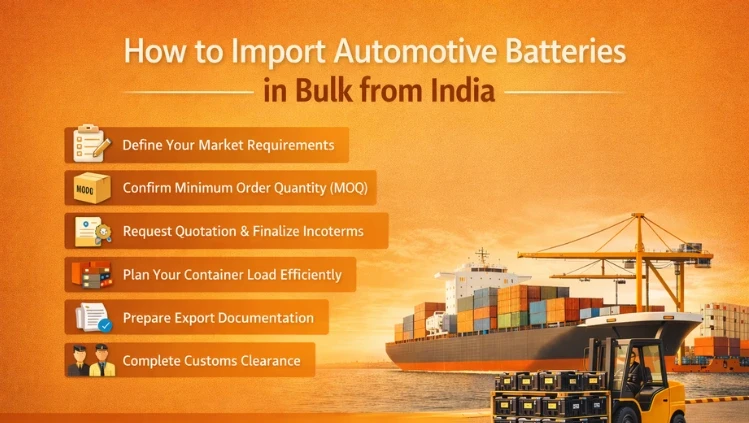
To import automotive batteries in bulk from India, you must follow a 6-step process, including defining market requirements, confirming container-based MOQ, finalizing Incoterms, planning container loading, preparing export documents, and clearing customs. Success depends on aligning battery specs, such as JIS or DIN, with market demand and optimizing freight efficiency through proper container planning.
If you plan to import automotive batteries in bulk from India, the process is straightforward when structured correctly. Many first-time importers overcomplicate it. Experienced distributors focus on specification accuracy, freight optimization, and compliance readiness.
Step-by-Step Process to Import Automotive Batteries in Bulk from India
Follow this structured 6-step framework to minimize risk and maximize margins:
- Define Your Market Requirements
- Confirm Minimum Order Quantity (MOQ)
- Request Quotation and Finalize Incoterms
- Plan Your Container Load Efficiently
- Prepare Export Documentation
- Complete Customs Clearance and Inland Logistics
Below is a detailed explanation of each step from a practical importer’s perspective.
Step 1: Define Your Market Requirements
Every successful bulk shipment starts with clarity. If you misalign specifications, you risk warranty issues and distributor resistance.
Battery Type Selection
Choose battery types based on your vehicle segment and price positioning:
- SMF (Sealed Maintenance Free)
- Dry Charged
- Start-Stop batteries (AGM or EFB)
- Heavy-duty automotive variants
- American BCI Types
Each category serves a different application range. Budget segments behave differently from premium urban markets.
You can review available configurations under the Auto Starting Series automotive battery range.
Which Size Standards Should You Order?
Battery dimensions must match regional vehicle standards.
- JIS for Japanese vehicle platforms
- BCI for American specifications
- DIN for European models
Incorrect sizing creates fitment rejection. Retailers rarely accept non-standard units.
How Does Climate Affect Battery Performance?
High-temperature regions demand better heat resistance and electrolyte stability. Cold regions require stronger Cold Cranking Amps for reliable ignition.
When you import automotive batteries in bulk from India, climate alignment directly affects warranty performance and customer retention.
You can review available configurations under the Auto Starting Series.
Step 2: Understand Minimum Order Quantity (MOQ)
Most exporters operate on container-based MOQ structures because batteries are dense and freight-sensitive.
Why Do Exporters Prefer Container-Based MOQ?
Container loading improves freight efficiency. Production batching becomes predictable. Export documentation becomes easier to manage.
MOQ is not a barrier. It is a logistics efficiency tool.
Can You Mix Different Models in One Container?
Yes. Most manufacturers allow:
- Multiple Ah ratings
- Combination of JIS and DIN models
- Mixed product variants
This helps new importers test their market without overexposure to one SKU.
How Does MOQ Affect Lead Time?
Larger orders require production scheduling and raw material allocation. During peak season, early confirmation secures manufacturing slots.
For a deeper explanation, see What Is the Minimum Order Quantity for Automotive Battery Export?
Step 3: Request Quotation and Confirm Incoterms

Once volumes are clear, request a quotation from your chosen car battery exporter in India. Review pricing carefully before confirming.
FOB vs CIF
Incoterms define responsibility for freight, insurance, and risk transfer during shipment, directly impacting logistics control and cost transparency.
| Term | Buyer Responsibility | When to Choose |
| FOB | Buyer arranges freight and insurance | When managing your own forwarder |
| CIF | Supplier arranges freight | When preferring simplified logistics |
Choosing the correct Incoterm depends on your freight expertise, cost comparison strategy, and operational control preferences.
What Payment Terms Are Common?
Export battery trade usually operates under:
- TT
- Confirmed LC at sight
Select payment structure based on relationship maturity and transaction size.
What Should You Verify on the Proforma Invoice?
Before approval, check:
- Model numbers
- Ah capacity
- Size standard
- Port of loading
- Packaging configuration
Clear alignment prevents shipment disputes.
Step 4: Plan Your Container Load Properly
Freight cost determines landed price competitiveness. Smart container planning protects margins.
Container Options
Container selection depends on shipment volume, distribution scale, and working capital capacity.
20ft vs 40ft Container
| Container Type | Typical Use Case |
| 20ft | Regional distributor volume |
| 40ft | National or multi-city distribution |
Capacity depends on pallet layout and weight distribution.
What Factors Affect Container Efficiency?
- Gross weight limits
- Pallet stacking stability
- SKU distribution balance
- Space utilization
Under-loading increases per-unit cost. Overloading risks compliance issues.
For advanced guidance, read “How to Plan a Full Container Load of Car Batteries.”
Step 5: Prepare Export Documentation
Documentation accuracy determines customs speed.
Automotive lead-acid batteries usually fall under HS Code 850710. Always confirm classification with your customs broker.
Standard export documents include:
- Commercial Invoice
- Packing List
- Bill of Lading
- Certificate of Origin
- MSDS
Hazardous Goods Compliance
Lead-acid batteries are classified under IMO Class 8 for corrosive substances. Proper packaging, labeling, and documentation are mandatory under International Maritime Organization guidelines.
Failure to comply can result in port delays or inspection holds.
Work closely with your bulk battery supplier in India to validate documentation before dispatch.
Step 6: Customs Clearance and Local Logistics

Once the shipment reaches your port, clearance procedures begin.
Import Duties
Confirm applicable duty rates based on HS Code 850710. Calculate total landed cost before pricing distribution margins.
Port Handling Costs
Expect:
- Terminal handling charges
- Broker fees
- Inspection costs
Budgeting for these prevents unexpected financial pressure.
Inland Transportation and Storage
Prepare warehouse space before container arrival. Batteries must be stored in dry and ventilated conditions with safe pallet stacking.
Efficient local coordination accelerates distribution.
Common Mistakes to Avoid When Importing Car Batteries
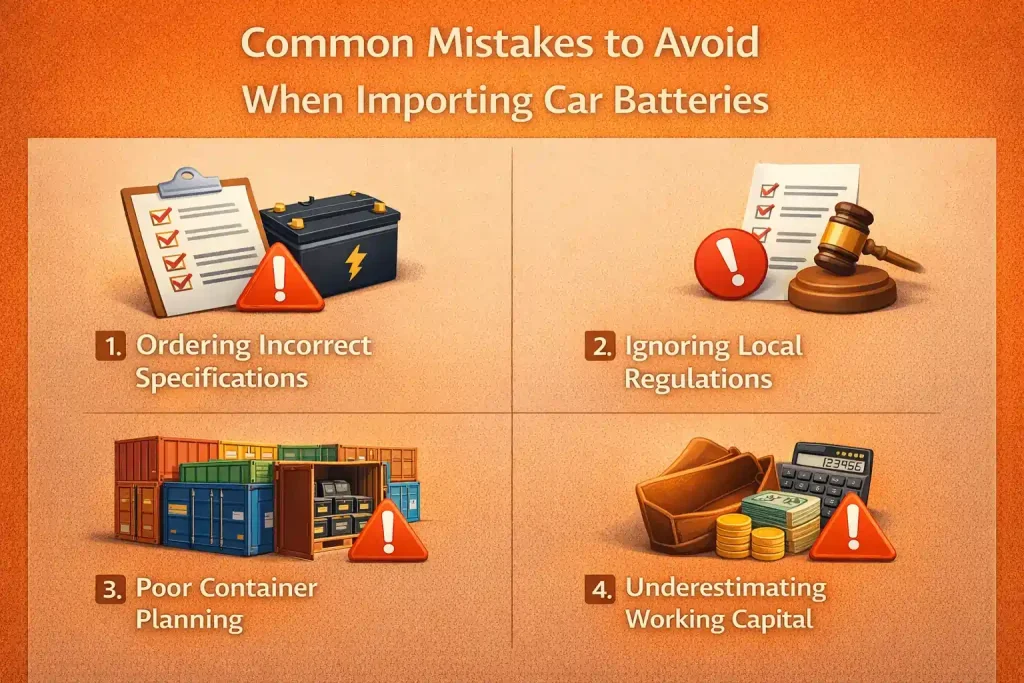
Even experienced traders make avoidable mistakes.
1. Ordering Incorrect Specifications
Failing to verify terminal layout, size standard (JIS/BCI/DIN), Ah rating, or CCA requirements can result in installation incompatibility, increased warranty claims, and slow-moving inventory.
Even minor specification mismatches can damage retailer trust and reduce repeat orders.
2. Ignoring Local Regulations
Automotive batteries are regulated products in many countries due to environmental and hazardous material considerations.
Importers must verify requirements such as:
- Recycling compliance registration
- Environmental labeling standards
- Hazardous goods documentation
- Import licensing where applicable
Overlooking compliance can lead to customs holds, fines, or shipment rejection.
3. Poor Container Planning
Underutilized containers increase landed cost per unit and reduce margin competitiveness. Improper pallet stacking, weight imbalance, or incorrect SKU distribution can also cause:
- Freight inefficiencies
- Cargo inspection delays
- Handling damage during transit
Container optimization is a financial strategy, not just a logistics task.
4. Underestimating Working Capital Requirements
Bulk importing requires capital allocation beyond product cost. Many new importers underestimate the total cash cycle.
Key financial components include:
- Ocean freight and insurance
- Import duties and port handling
- Inland transportation
- Warehousing costs
- Distributor credit periods
Inadequate cash flow planning can disrupt supply continuity and strain supplier relationships.
Proactive planning and structured supplier coordination significantly reduce risk when importing automotive batteries at scale.
For a deeper operational breakdown, refer to:
“Common Mistakes to Avoid When Importing Car Batteries”
How to Build a Long-Term Supply Relationship
Bulk importing becomes profitable when structured as a repeat cycle. Forecast demand realistically. Communicate market feedback clearly. Standardize high-performing SKUs.
Strong relationships with a reliable car battery exporter in India improve pricing stability and production priority.
Explore more: https://jcblbatteries.com/
Frequently Asked Questions
Sea freight transit generally ranges from 15 to 35 days depending on destination region, excluding production lead time.
Yes. Most exporters allow mixed SKUs within a container, provided total volume meets MOQ requirements.
Import licensing depends on your country’s regulations. Some markets require environmental or recycling compliance documentation.
Warranty terms typically range from 12 to 24 months depending on battery type and agreed commercial terms.
MOQ is usually container-based (20ft or 40ft) to optimize freight efficiency and production planning.