

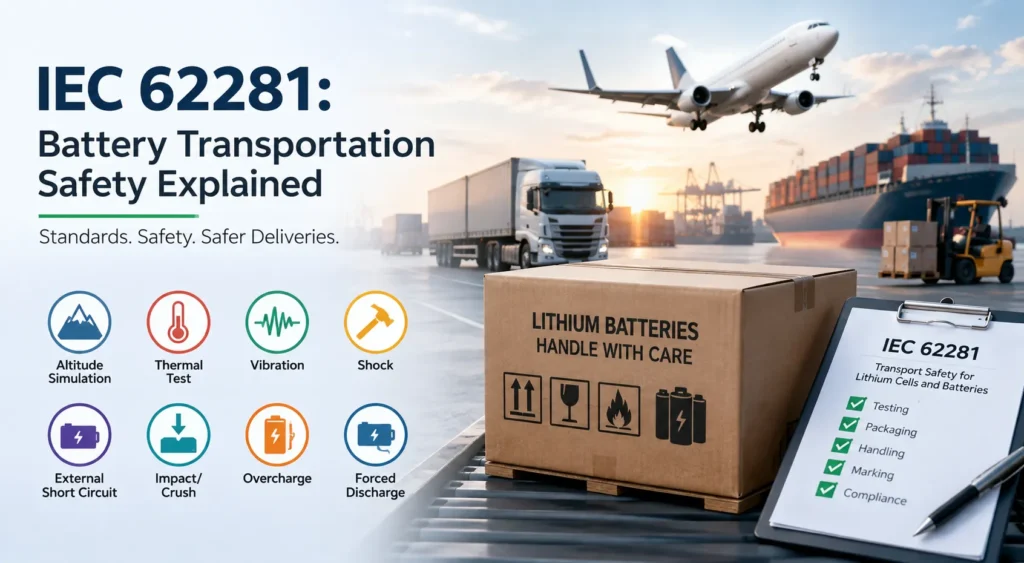
Lithium batteries are widely used in electronics, energy storage systems, medical devices, industrial equipment, and electric mobility. Because lithium cells and batteries can present safety risks when exposed to mechanical, thermal, or electrical stress during transportation, specific safety and testing requirements apply.
IEC 62281 defines test methods and requirements for the safe transport of primary and secondary (rechargeable) lithium cells and batteries. It provides a structured framework for evaluating whether lithium batteries can withstand conditions they may encounter during transportation.
What Is IEC 62281?
IEC 62281 is an international standard that specifies safety requirements and test methods for primary and rechargeable lithium cells and batteries during transportation.
The standard focuses on battery safety during transport rather than general battery performance, design, or end-use safety. It applies to lithium cells and batteries transported for purposes other than recycling or disposal, subject to the exemptions and provisions of applicable transport regulations.
The current IEC publication is based on IEC 62281:2019, with Amendment 1:2021 and Amendment 2:2023.
What Does IEC 62281 Cover?
IEC 62281 addresses key aspects of lithium battery transportation safety, including:
- Transport-related safety requirements
- Applicable test methods
- Sampling and retesting considerations
- Test reporting and certification
- Safety information
- Packaging and handling
- Battery marking
- Requirements relevant to primary and rechargeable lithium cells and batteries
The standard also contains provisions for batteries that form an integral part of equipment.
IEC 62281 Battery Transport Tests
The tests in IEC 62281 are designed to evaluate how lithium cells and batteries respond to physical, environmental, and electrical stresses that can occur during transportation.
Depending on the battery type and applicable requirements, testing addresses conditions such as:
| Test area | What it evaluates |
| Altitude simulation | Battery response to reduced-pressure conditions |
| Thermal test | Stability through temperature changes |
| Vibration | Resistance to transport-related vibration |
| Shock | Ability to withstand mechanical shocks |
| External short circuit | Safety under an external short-circuit condition |
| Impact/crush | Response to physical mechanical damage |
| Overcharge | Safety of applicable rechargeable batteries during overcharging |
| Forced discharge | Response of applicable rechargeable cells to forced discharge |
The exact tests and conditions depend on the type and configuration of the cell or battery. IEC 62281 should therefore be applied using the requirements relevant to the specific product rather than treating every lithium battery as identical.
An important feature of the 2019 edition is that testing provisions for secondary cells and batteries include a requirement for 25 charge and recharge cycles before the applicable tests.
IEC 62281 Requirements for Safe Battery Transportation
For manufacturers, exporters, and battery suppliers, IEC 62281 compliance is not limited to completing laboratory tests. Transport safety also involves appropriate documentation, packaging, handling, marking, and safety information.
A practical compliance process includes:
- Identify the battery type: Determine whether the product is a primary lithium battery or a rechargeable lithium battery and establish its relevant configuration.
- Determine applicable tests: Identify the IEC 62281 tests applicable to the specific cell or battery.
- Complete the required testing: Conduct testing through an appropriate laboratory or qualified testing facility.
- Document the results: Maintain the required test reports, certificates, and technical records.
- Review packaging and handling: Ensure the battery is packaged and handled in a manner consistent with applicable transport requirements.
- Confirm marking and safety information: Check that required product and transport information is available.
- Check transport regulations: Confirm the dangerous-goods requirements applicable to the destination, transport mode, and shipment.
This last step is particularly important because IEC 62281 does not replace applicable dangerous-goods regulations. Air, sea, road, and other transport modes can have additional requirements.
Why IEC 62281 Matters for Battery Manufacturers and Exporters
For B2B battery manufacturers, IEC 62281 provides a recognized framework for demonstrating that lithium cells and batteries have been evaluated for transport-related safety risks.
Compliance can help businesses:
- Establish a documented approach to transport safety
- Support customer and logistics requirements
- Reduce risks associated with transportation and handling
- Maintain technical evidence for battery designs
- Support international supply chain activities
- Identify safety issues before batteries enter transportation
For companies exporting lithium batteries, IEC 62281 should therefore be considered alongside the specific dangerous-goods rules applicable to the shipment.
IEC 62281 Compliance Checklist
Before shipping a lithium cell or battery, manufacturers and exporters should verify:
- Battery type and configuration have been identified.
- Applicable IEC 62281 tests have been determined.
- Required testing has been completed.
- Test results and certification are documented.
- Packaging and handling requirements have been reviewed.
- Required markings and safety information are available.
- Applicable transport regulations have been checked.
- Documentation can be provided to customers, carriers, or authorities when required.
Conclusion
IEC 62281 provides a dedicated framework for lithium battery transportation safety, covering relevant test methods and requirements for primary and rechargeable lithium cells and batteries. For manufacturers and exporters, compliance involves more than testing alone: the battery’s documentation, packaging, handling, marking, and applicable transport regulations must also be considered.
Used alongside the relevant UN transport requirements and mode-specific dangerous-goods regulations, IEC 62281 can provide a clear and structured basis for managing lithium battery transport safety.
FAQs
IEC 62281 is used to evaluate the safety of primary and rechargeable lithium cells and batteries during transportation through defined test methods and requirements.
IEC 62281 itself is an international standard, while mandatory transport requirements depend on the applicable dangerous-goods regulations and transport mode. Manufacturers should identify which regulatory requirements apply to their shipment.
No. IEC 62281 and UN 38.3 address closely related transport-safety testing, but they are separate documents. IEC 62281 itself identifies deviations from the UN Manual of Tests and Criteria, Chapter 38.3.
IEC 62281 addresses transport-related testing such as altitude simulation, thermal testing, vibration, shock, external short circuit, impact/crush, and applicable electrical safety tests.
Yes. IEC 62281 covers secondary (rechargeable) lithium cells and batteries, which includes lithium-ion battery types, subject to the standard’s scope and applicable transport provisions.
The current IEC publication is IEC 62281:2019 with Amendment 1:2021 and Amendment 2:2023. IEC lists the consolidated version as IEC 62281:2019+AMD1:2021+AMD2:2023.