

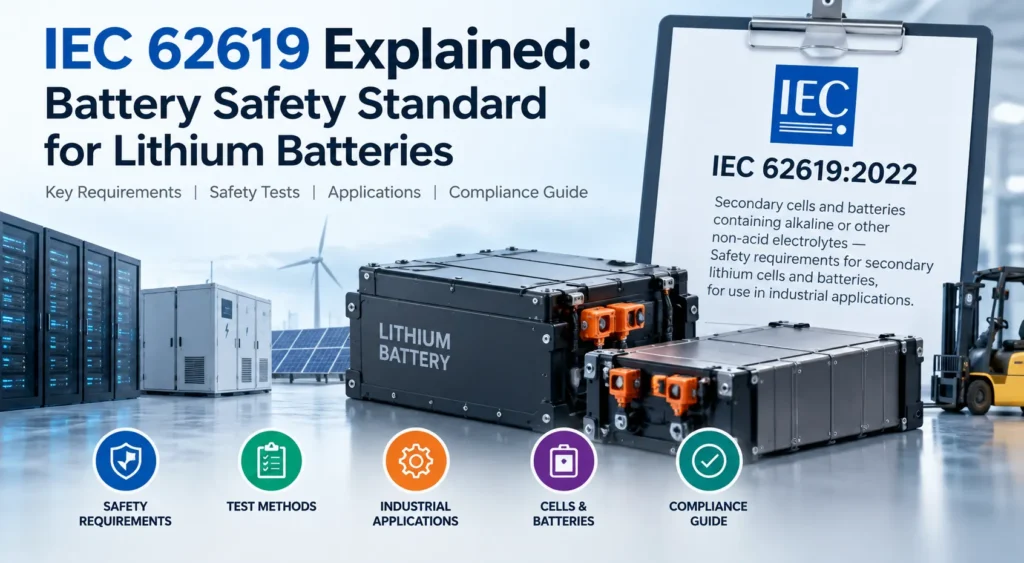
IEC 62619 is an international safety standard for secondary lithium cells and batteries used in industrial applications, including stationary applications. It specifies safety requirements and tests intended to support the safe operation of these batteries. The current edition, IEC 62619:2022, covers applications such as telecom systems, UPS, energy storage, forklifts, AGVs, railway and marine vehicles, while excluding road vehicles.
For battery manufacturers, suppliers, and industrial buyers, understanding IEC 62619 helps determine whether a lithium battery has been evaluated against relevant safety requirements for its intended application.
What Is IEC 62619?
IEC 62619 is a lithium battery safety standard for industrial applications. Its official title is “Secondary cells and batteries containing alkaline or other non-acid electrolytes—Safety requirements for secondary lithium cells and batteries, for use in industrial applications.”
The standard focuses on the safe operation of secondary lithium cells and batteries. It establishes requirements and test methods that help assess battery safety under specified conditions.
In simple terms, IEC 62619 helps manufacturers and buyers evaluate whether an industrial lithium battery has been designed and tested with relevant safety risks in mind. The standard applies to both cells and batteries, making it relevant across different stages of an industrial battery system.
What Does IEC 62619 Cover?
IEC 62619 covers secondary lithium cells and batteries intended for a range of industrial applications.
Stationary applications
Examples include:
- Telecom power systems
- Uninterruptible power supplies (UPS)
- Electrical energy storage systems
- Utility switching systems
- Emergency power systems
Motive applications
The standard also covers lithium batteries used in applications such as:
- Forklift trucks
- Golf carts
- Automated guided vehicles (AGVs)
- Railway vehicles
- Marine vehicles
IEC specifically excludes road vehicles from these examples. Where another IEC standard provides requirements for a special application and conflicts with IEC 62619, the application-specific standard takes precedence. IEC gives the IEC 62660 series for road vehicles as an example.
What Are the Main Safety Requirements of IEC 62619?
IEC 62619 establishes safety requirements intended to address risks associated with the operation of industrial lithium cells and batteries.
The standard takes a system-level approach rather than simply checking whether a cell works under normal conditions. Its requirements and tests are intended to assess safe operation under specified conditions and help identify potentially hazardous battery behavior.
For manufacturers, this means the battery design, protective functions, and relevant operating conditions need to be considered as part of the safety assessment.
The exact requirements depend on the product and its intended application, so IEC 62619 should not be treated as a generic checklist that applies identically to every lithium battery.
What Tests Are Used Under IEC 62619?
IEC 62619 includes specified safety tests for secondary lithium cells and batteries.
These tests are used to evaluate how the product behaves under defined operating or abnormal conditions. The objective is not simply to measure battery performance but to assess whether the battery can operate safely within the conditions covered by the standard.
For B2B buyers, the important point is to look beyond a statement such as “IEC 62619 compliant.” A technical review should consider:
- Which battery or cell was tested
- Which edition of IEC 62619 was used
- Whether the tested configuration represents the supplied product
- What test documentation is available
- Whether additional application-specific standards apply
IEC also publishes an IECEE Test Report Form for IEC 62619:2022, providing a standardized framework for reporting testing against the standard.
Which Lithium Batteries Need IEC 62619?
IEC 62619 is relevant when secondary lithium cells or batteries are intended for industrial applications within its scope.
Typical examples include batteries for:
- Industrial backup power
- Telecom infrastructure
- UPS systems
- Stationary energy storage
- Industrial vehicles
- Automated material-handling equipment
- Railway applications
- Marine applications
However, the presence of lithium-ion chemistry alone does not mean IEC 62619 is automatically the correct standard. The intended application, battery design and applicable regulations or standards must be considered.
For example, lithium-ion cells used for electric road-vehicle propulsion fall under the IEC 62660 series rather than IEC 62619 where the applicable requirements conflict.
What Should You Check for IEC 62619 Compliance?
For manufacturers and buyers, an IEC 62619 claim should be supported by clear technical documentation, not just a statement on a product page. Check the following before approving an industrial lithium battery:
- Applicable Edition: Confirm which version of IEC 62619 is referenced, particularly IEC 62619:2022.
- Application Scope: Make sure the battery’s intended use falls within the standard’s scope.
- Test Evidence: Request the relevant IEC 62619 test report or supporting documentation.
- Product Match: Verify that the tested cell or battery configuration matches the product being supplied.
- Additional Requirements: Check whether other application-specific standards or regulations also apply.
For B2B procurement, reviewing the standard, test evidence and product configuration together provides a more reliable basis for evaluating an IEC 62619 claim than relying on a compliance statement alone.
Why Is IEC 62619 Important for B2B Battery Buyers?
For industrial battery buyers, IEC 62619 can be an important part of technical supplier evaluation.
It can help buyers:
- Identify batteries evaluated against an established international safety standard
- Compare supplier documentation more effectively
- Review whether the battery’s intended application falls within the standard’s scope
- Support technical qualification and procurement decisions
- Identify when additional application-specific standards may be needed
However, IEC 62619 should not be treated as proof that a battery meets every safety, regulatory, or market-access requirement. A battery may need to meet additional standards depending on where and how it will be used.
How to Check IEC 62619 Compliance When Buying a Lithium Battery
Before purchasing an industrial lithium battery, ask the supplier for documentation that clearly identifies the standard and tested product.
A practical check includes:
- Confirm the standard edition: Check whether the documentation refers to IEC 62619:2022.
- Check the application: Make sure the intended use falls within the standard’s scope.
- Review test documentation: Request the applicable test report or supporting evidence.
- Verify the tested product: Confirm that the tested cell or battery configuration corresponds to the product being supplied.
- Check additional requirements: Determine whether another IEC standard or local regulation also applies.
- Review technical specifications: Confirm voltage, capacity, configuration and operating conditions against the intended system.
This approach gives procurement teams a clearer picture than relying only on a supplier’s general claim of “IEC 62619 certified.”
Conclusion
IEC 62619:2022 provides safety requirements and tests for secondary lithium cells and batteries used in industrial applications, including stationary and selected motive applications. For manufacturers and B2B buyers, its value lies in providing a recognized framework for evaluating battery safety rather than serving as a universal requirement for every lithium battery.
The right approach is to match IEC 62619 with the battery’s intended application, review the available test documentation, and confirm whether additional standards or regulations apply to the final product or market.
FAQs
IEC 62619 is an international safety standard for secondary lithium cells and batteries used in industrial applications, including stationary applications. It specifies safety requirements and tests intended to support their safe operation.
IEC 62619 is an international standard, but it is not automatically mandatory for every lithium battery. Whether it is required depends on the battery’s intended application, applicable regulations, market requirements and customer specifications.
IEC 62619 covers safety requirements and tests for secondary lithium cells and batteries used in industrial applications, including stationary applications. IEC 63056 provides additional and specific safety requirements for lithium cells and batteries used in electrical energy storage systems. The applicable standard depends on the battery’s intended use.
Yes. IEC 62619:2022 is the second edition and replaces the 2017 edition. It is important for manufacturers and buyers to check which edition is referenced in test reports, technical specifications, or customer requirements when evaluating a battery.
IEC 62619 is not the primary standard for lithium cells used for road-vehicle propulsion. The IEC 62660 series addresses lithium-ion cells for road-vehicle propulsion applications. The applicable standard should therefore be determined based on the battery’s intended application.
IEC 62619 is a technical standard, not a certification itself. A battery may be tested or certified against the standard by an appropriate organization. Buyers should review the relevant test reports or certification documentation rather than relying only on a supplier’s claim of “IEC 62619 certified.”