

At a Glance
- Payment terms in international battery trade determine when and how importers pay for bulk battery shipments.
- The most common battery export payment terms include Telegraphic Transfer (TT), Letter of Credit (LC), and Documents Against Payment (DP).
- Choosing the right payment structure helps importers manage cash flow, shipment timing, and financial risk.
International battery trade typically involves high-value container shipments of automotive, inverter, or industrial batteries. Because these orders are usually placed in bulk, the payment agreement between the importer and exporter plays a critical role in ensuring smooth transactions.
A well-structured payment agreement helps businesses maintain stable working capital, predictable shipment timelines, and transparent trade relationships. Poorly defined payment terms, on the other hand, can lead to shipment delays, banking disputes, and financial risk.
Understanding the most common battery export payment terms helps importers choose a payment structure that supports long-term supply partnerships.
What Are Payment Terms in International Battery Trade
Payment terms in international battery trade are the agreed financial conditions that define how and when an importer pays an exporter for a battery shipment. These terms specify the payment method, timeline, and banking procedures required before goods are shipped or released.
In bulk battery exports, payment terms balance the financial risk between both parties. Exporters require payment security before shipping large orders, while importers need assurance that goods will be produced and delivered as agreed.
Typical payment agreements clarify:
- Advance payment requirements
- Balance payment timing
- Banking method used for transfer
- Responsibility for international bank charges
Clearly defined payment terms help prevent cash flow disruptions and trade disputes.
What Are Common Payment Terms in Battery Export?
Several battery export payment terms are widely used in international trade. The choice usually depends on order size, supplier relationship, and risk tolerance.
Telegraphic Transfer (TT)
Telegraphic Transfer (TT) is one of the most common payment methods used in battery exports.
Under this structure, importers typically pay:
- 30% advance payment before production
- 70% balance before shipment
Other variations may include:
- 50% advance + 50% before dispatch
- 100% advance for smaller orders
TT payments are fast and involve minimal banking procedures, making them common for repeat orders.
Letter of Credit (LC)
A Letter of Credit (LC) is a bank-guaranteed payment mechanism used in international trade. The buyer’s bank guarantees payment to the exporter once the exporter provides documents proving shipment.
LCs are usually used when:
- Importers work with a supplier for the first time
- Order values are high
- Buyers require additional financial security
Most international LCs follow the UCP 600 (Uniform Customs and Practice for Documentary Credits) rules issued by the International Chamber of Commerce.
Documents Against Payment (DP)
Documents Against Payment (D/P) is another method sometimes used in the international battery trade.
Under this structure:
- The exporter ships the goods
- Shipping documents are sent to the bank
- The importer must pay before receiving the documents needed to clear the cargo
DP creates a shared risk arrangement, but it requires trust and coordination between banks.
TT vs LC in Battery Trade: Key Differences
Both TT and LC are widely used in battery export transactions, but they differ significantly in terms of risk, cost, and processing time.
| Factor | Telegraphic Transfer (TT) | Letter of Credit (LC) |
| Payment Security | Moderate | High |
| Bank Involvement | Minimal | Extensive |
| Processing Time | Fast | Slower |
| Banking Charges | Lower | Higher |
| Documentation | Simple | Detailed |
| Common Usage | Repeat orders | First-time transactions or high-value shipments |
Many battery suppliers prefer TT for repeat customers, while LC is typically used for new buyers or large orders where additional financial security is required.
How Payment Terms Affect Importer Risk
The chosen battery export payment terms directly affect the level of financial risk faced by importers.
Advance Payment Exposure
When importers pay large advances, they temporarily lose control over funds until the shipment is produced and dispatched.
This makes it important to always confirm:
- Proforma invoice details
- Production timelines
- Written payment terms
Shipment Delay Risk
Production usually begins only after the advance payment is received. Payment delays can push back manufacturing schedules and shipping bookings.
Currency Fluctuation
Most international battery trade transactions are conducted in USD or EUR. Exchange rate changes between order confirmation and payment can increase the final purchase cost.
Bank Charges
International transfers may include:
- Sending bank charges
- Intermediary bank fees
- Currency conversion costs
Clarifying bank charge responsibilities helps prevent unexpected expenses.
Impact of Payment Structure on Cash Flow Planning
Payment schedules strongly influence an importer’s working capital cycle.
Bulk battery shipments usually involve:
- Manufacturing lead time
- Ocean freight transit time
- Port clearance procedures
During this period, funds remain tied up before the batteries can be sold.
Importers should also understand the Minimum Order Quantity (MOQ) for Bulk Battery Supply before finalizing payment terms, since MOQ directly affects the financial scale of an order.
Proper payment planning helps businesses manage:
- Inventory investment
- Warehouse storage costs
- Seasonal demand cycles
Payment Terms and Supplier Trust
Payment structures often evolve as importer–supplier relationships develop.
For first transactions, suppliers may request:
- Higher advance payments
- Letter of Credit arrangements
As trust grows, payment conditions may become more flexible.
Businesses exploring global sourcing should also review “How to Import Automotive Batteries in Bulk from India” to better understand documentation requirements and logistics planning.
A consistent order history often gives you better leverage in negotiating payment schedules.
Aligning Payment Terms with Container Planning
Battery shipments are typically transported using full container loads (FCL) because batteries are heavy and regulated cargo. Payment milestones should align with shipment logistics.
Businesses planning bulk shipments should also learn “How to Plan a Full Container Load of Car Batteries” to optimize container space and logistics costs.
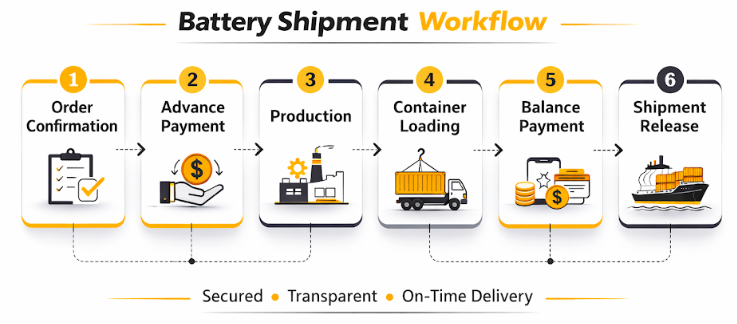
Typical Payment Workflow for Container Shipments
- Order Confirmation: The importer approves the quotation and receives a proforma invoice.
- Advance Payment: The importer transfers the agreed advance amount (usually 30%).
- Production Phase: Supplier begins manufacturing and prepares the shipment.
- Container Loading: Batteries are packed and loaded into export containers.
- Balance Payment: The importer pays the remaining amount before shipment documents are released.
- Shipment Dispatch: Exporter releases the bill of lading and shipping documents.
Common Payment Mistakes in Battery Trade
Even experienced importers occasionally make avoidable payment mistakes.
- Paying Without a Clear Proforma Invoice: Every payment should be supported by a detailed invoice specifying quantity, price, and shipment terms.
- Ignoring Bank Charges: Unclear responsibility for bank charges can increase the total cost of an order.
- Not Confirming Incoterms: Incoterms determine who pays for shipping, insurance, and port handling.
- Misaligned Payment Milestones: Payment timing must match production and shipping schedules.
Practical Tips for Negotiating Payment Terms
Negotiating payment terms helps reduce financial risk and improve trade efficiency.
- Start With Conservative Terms: Use payment structures that provide financial security for both parties in the first transaction.
- Build Trust Gradually: Long-term business relationships often lead to more flexible payment agreements.
- Start With Trial Orders: Testing a supplier with a smaller shipment helps verify product quality and reliability.
Pro Tip
Always verify the supplier’s SWIFT code and beneficiary bank details before sending international payments. Incorrect banking information can cause delays due to intermediary bank routing, especially when transferring funds across multiple international banking networks.
Conclusion
Understanding payment terms in international battery trade is essential for managing risk, maintaining cash flow stability, and ensuring smooth shipment coordination. Since battery exports often involve high-value container shipments, clearly defined payment structures protect both the importer and exporter.
By choosing appropriate battery export payment terms, aligning payment schedules with production timelines, and building trust with reliable suppliers, businesses can create efficient and secure global battery supply chains.
FAQs
Most battery export transactions require a partial advance payment, typically between 30% and 50%. The remaining balance is usually paid before shipment.
A Letter of Credit (LC) is often considered the safest payment method because banks guarantee payment once the shipment documents are verified.
In TT vs LC battery trade, TT involves direct bank transfers between importer and exporter, while LC requires bank guarantees and detailed documentation.
Bank charges are usually split between the importer and the exporter, depending on the agreement. This should always be clarified in the purchase contract.