

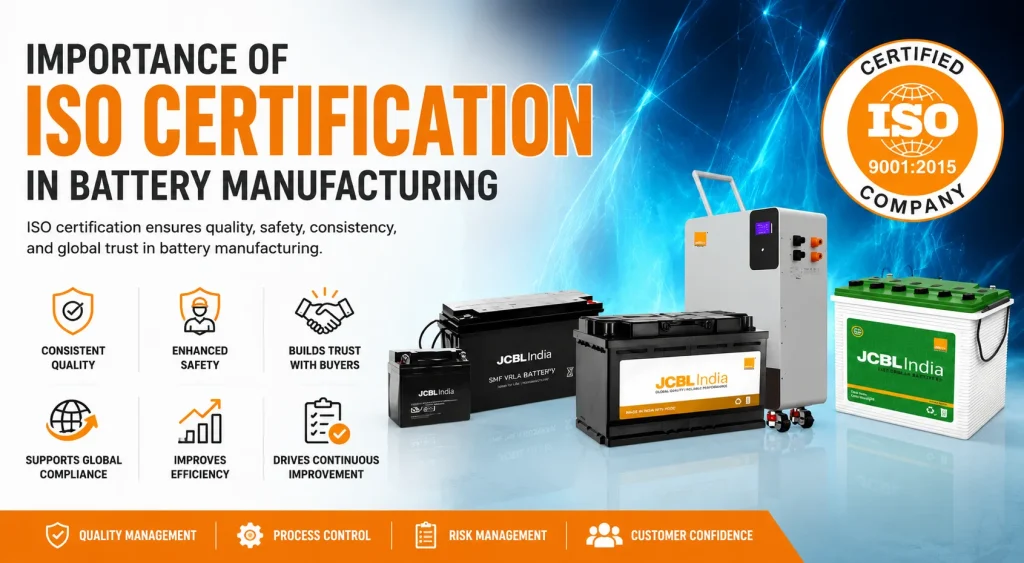
Battery manufacturers today operate in a market where product quality, safety, and consistency are critical. Whether supplying automotive OEMs, industrial equipment manufacturers, renewable energy projects, or export markets, businesses are expected to meet internationally recognized quality standards. This is where ISO certification plays an important role.
ISO certification demonstrates that a manufacturer follows structured management systems designed to improve quality, operational efficiency, and continual improvement. For battery manufacturers, it also strengthens customer confidence, supports compliance with global procurement requirements, and enhances competitiveness across domestic and international markets.
What Is ISO Certification?
ISO (International Organization for Standardization) develops internationally recognized standards that help organizations improve the way they operate. ISO certification confirms that an independent certification body has verified a company’s management system against a specific ISO standard.
It is important to understand that ISO certification evaluates how a manufacturer manages its processes, not the performance of an individual battery product. A certified manufacturer demonstrates that it follows documented procedures, monitors quality, addresses non-conformities, and continually improves its operations.
For battery manufacturers, this provides customers with greater confidence in the consistency and reliability of the production process.
Why ISO Certification Matters in Battery Manufacturing
1. Ensures Consistent Product Quality
Battery manufacturing involves multiple stages, where consistency is essential. ISO certification establishes standardized processes and quality controls that help manufacturers maintain uniform production and minimize process variations.
Key benefits include the following:
- Standardized operating procedures
- Consistent quality checks
- Better process control
- Reliable production outcomes
2. Strengthens Manufacturing Safety
ISO standards encourage manufacturers to adopt structured risk management and process monitoring practices, creating a more controlled and traceable production environment.
This includes:
- Risk identification and preventive controls
- Process traceability
- Regular operational reviews
3. Builds Trust with OEMs and Global Buyers
OEMs and industrial buyers often assess a supplier’s quality management capabilities alongside product performance. ISO certification demonstrates adherence to internationally recognized manufacturing practices, strengthening buyer confidence during supplier selection.
4. Supports Export and Regulatory Requirements
Many international customers prefer or require ISO-certified suppliers. Certification helps battery manufacturers meet supplier qualification requirements and compete more effectively in global markets.
5. Improves Manufacturing Efficiency
ISO certification promotes continuous improvement by encouraging manufacturers to streamline workflows and standardize operations.
As a result, manufacturers benefit from:
- Clear documentation
- Standardized workflows
- Ongoing process improvement
- Better operational efficiency
6. Enhances Business Credibility
ISO certification reflects a manufacturer’s commitment to quality management and continual improvement. It strengthens credibility with procurement teams, OEMs, and global buyers, making the business a more reliable long-term supply partner.
Key ISO Certifications Relevant to Battery Manufacturing
Different ISO standards address different aspects of manufacturing operations. Depending on the company’s products and target markets, several certifications may be relevant.
| ISO Standard | Purpose | Relevance to Battery Manufacturing |
| ISO 9001 | Quality Management System | Establishes consistent quality management processes across manufacturing operations. |
| IATF 16949 | Automotive Quality Management | Widely adopted by manufacturers supplying automotive OEMs and Tier-1 suppliers. |
| ISO 14001 | Environmental Management System | Supports structured environmental management throughout manufacturing activities. |
| ISO 45001 | Occupational Health and Safety Management | Promotes systematic workplace health and safety management. |
| ISO 50001 (where applicable) | Energy Management System | Helps manufacturers improve energy management and operational efficiency. |
How ISO Certification Improves Battery Manufacturing Processes
ISO certification supports continuous improvement throughout the manufacturing lifecycle rather than focusing on a single production stage.
Key improvements include the following:
- Standardized inspection of incoming raw materials
- Documented production procedures for consistent manufacturing
- Defined quality control checkpoints during production
- Process traceability for improved record management
- Corrective and preventive action systems to address process issues
- Internal audits and management reviews for ongoing improvement
- Better documentation that supports quality assurance and customer requirements
Together, these practices create a more controlled and transparent manufacturing environment.
Benefits of Choosing an ISO-Certified Battery Manufacturer
For OEMs, distributors, and industrial buyers, selecting an ISO-certified battery manufacturer offers several advantages.
- Greater confidence in standardized manufacturing processes
- Consistent documentation and quality management practices
- Improved production traceability
- Easier supplier qualification during procurement
- Better alignment with international sourcing expectations
- Stronger foundation for long-term business partnerships
While certification alone should not be the only evaluation criterion, it is an important indicator of a manufacturer’s commitment to internationally recognized management systems.
How to Verify a Battery Manufacturer’s ISO Certification
Before selecting a manufacturing partner, buyers should verify the authenticity and scope of the certification.
A practical checklist includes the following:
- Request a copy of the current ISO certificate.
- Verify that the certificate has been issued by an accredited certification body.
- Check the validity and expiry dates.
- Confirm that the certification scope covers battery manufacturing operations.
- Review whether the manufacturer undergoes regular surveillance or renewal audits.
- Ask about the quality management processes implemented under the certified system.
Verifying these details helps buyers make informed sourcing decisions.
Common Misconceptions About ISO Certification
#1 ISO certification guarantees defect-free batteries.
Fact: ISO certification does not guarantee that every battery will be free from defects. It confirms that the manufacturer follows structured management systems designed to improve process consistency and quality.
#2 ISO certification is only important for export businesses.
Fact: Certified management systems benefit manufacturers serving both domestic and international customers by improving operational consistency and customer confidence.
#3 One ISO certification covers every business requirement.
Fact: Each ISO standard serves a different purpose. Manufacturers often adopt multiple certifications based on their products, customer expectations, and industry requirements.
Conclusion
ISO certification has become an important benchmark for battery manufacturers seeking to strengthen quality management, operational consistency, and customer confidence. By implementing internationally recognized management systems, manufacturers can improve process control, support supplier qualification, and align with the expectations of OEMs and global buyers. For businesses sourcing batteries in India or international markets, partnering with an ISO-certified manufacturer provides greater assurance that standardized manufacturing practices and continual improvement are embedded throughout the production process.
FAQs
No. ISO certification verifies that a manufacturer follows recognized management systems for consistent production and continual improvement. Product quality should also be evaluated through applicable testing and quality assurance processes.
ISO 9001 is the most widely recognized quality management standard. Manufacturers supplying the automotive sector may also require IATF 16949, while ISO 14001 and ISO 45001 support environmental and workplace management.
ISO certification is not universally mandatory. However, many OEMs, industrial buyers, and international customers prefer or require certified suppliers as part of their procurement process.
Certified suppliers demonstrate structured quality management systems, documented manufacturing processes, and continual improvement practices that align with automotive supply chain expectations.
Buyers should review the manufacturer’s certificate, verify the issuing certification body, confirm the certification scope, and ensure the certificate is current and applicable to battery manufacturing.