

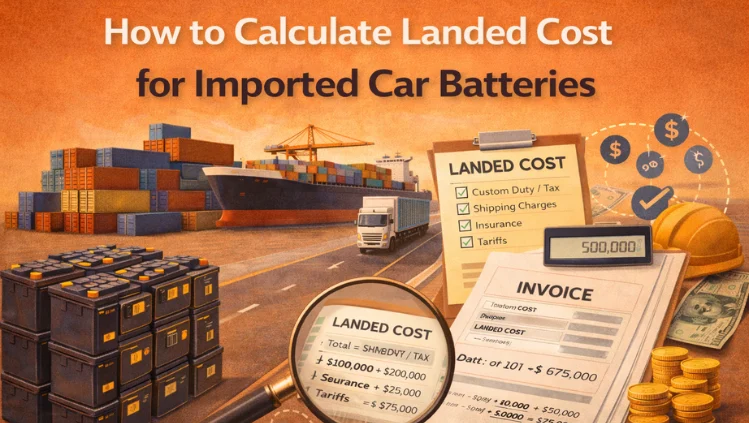
Importers often evaluate battery suppliers based only on the ex-factory or FOB price, but that number rarely reflects the true cost of importing automotive batteries. In reality, international freight, insurance, customs duties, and inland logistics can significantly increase the final cost of a shipment.
For distributors and automotive aftermarket businesses, understanding the landed cost for imported car batteries is essential before placing bulk orders. Without calculating the full cost structure, businesses may underestimate investment requirements and misprice products in the market.
This guide explains how to calculate the complete landed cost step by step, covering product cost, freight, insurance, duties, and local logistics. The goal is to help importers perform accurate battery import cost calculations and make better purchasing decisions when evaluating bulk battery import pricing.
Quick Summary: Steps to Calculate Landed Cost
Use this simplified process to estimate the total cost of importing car batteries:
- Calculate the total product cost from the manufacturer.
- Add international freight charges.
- Include cargo insurance and port handling costs.
- Calculate customs duties and applicable taxes.
- Add inland transportation and warehouse handling charges.
Following these steps helps importers estimate the true landed cost before confirming a shipment.
Landed Cost Formula
Landed Cost = (P + F + I + D + L)
Where:
- P = Product Cost
- F = Freight Cost
- I = Insurance
- D = Duties and Taxes
- L = Local Charges (transportation, handling, warehousing)
This formula forms the basis of most professional battery import cost calculation models used by distributors and procurement teams.
What Is the Landed Cost for Imported Car Batteries?
Landed cost is the total price of a product once it has arrived at the buyer’s door.
For car battery imports, landed cost includes the manufacturer’s price, international freight, insurance, customs duties, clearance fees, inland transportation, and warehouse handling.
Importers rely on landed cost calculations to determine the true per-unit purchase price, compare suppliers accurately, and set profitable resale pricing.
Key Cost Components in Battery Import
The following table summarizes the typical expenses involved when importing automotive batteries.
| Cost Component | What It Includes |
| Product Cost | FOB or ex-factory battery price from the manufacturer |
| Freight | Ocean shipping or air freight |
| Insurance | Cargo protection during transit |
| Import Duties | Customs duty based on HS classification |
| Port Handling | Terminal handling and customs clearance |
| Inland Transportation | Trucking from port to warehouse |
| Storage & Handling | Unloading, palletizing, short-term warehousing |
| Hazardous Materials Fees | Surcharges for transporting regulated goods |
Automotive lead-acid batteries typically fall under HS Code 8507.10 (Lead-acid accumulators), which customs authorities use to determine applicable duties and regulatory requirements.
Because batteries contain hazardous materials such as lead and electrolyte solutions, some carriers apply dangerous goods or HazMat surcharges, which should also be included in cost calculations.
1. How to Calculate Product Cost (FOB)
The starting point in any import cost calculation is the price quoted by the manufacturer.
Product cost depends on:
- battery unit price
- total order quantity
- exchange rate between currencies
- international payment charges
Product Cost = Unit Price × Quantity
For example, purchasing 2,000 batteries at $25 each results in a product cost of $50,000.
Payment terms can also influence the final cost. Bank transfer fees, documentary credit charges, and transaction commissions should be considered when evaluating supplier quotations.
Importers should also monitor exchange rate volatility. Large transactions may benefit from locking exchange rates through forward contracts or currency hedging to maintain stable landed cost projections.
2. How to Add International Freight Cost
Freight is typically the second largest expense in the landed cost structure.
Most automotive battery shipments are transported by sea freight because of the product weight and volume.
Key freight factors include:
- container size (20-foot or 40-foot containers)
- port-to-port shipping distance
- shipment weight and density
- seasonal freight rate changes
Lead-acid batteries are heavy products, so freight cost per container can be significant.
To determine freight cost per unit, importers divide the total freight charge by the number of batteries shipped.
Proper container planning improves efficiency and reduces freight cost per battery.
3. How to Include Cargo Insurance and Handling Charges
Cargo insurance protects shipments against damage, theft, or transit risks during international transport.
Typical marine cargo insurance ranges between 0.3% and 0.6% of shipment value depending on coverage terms.
Other handling charges may include:
- port handling fees
- terminal handling charges (THC)
- customs brokerage services
- documentation and inspection charges
Although smaller than freight or product cost, these charges must be included to ensure accurate landed cost estimates.
4. How to Calculate Import Duties and Taxes
Import duties represent a significant portion of the final landed cost.
Duties depend on several factors:
- product classification (HS Code)
- country-specific tariff schedules
- value-added tax (VAT) or goods and services tax (GST)
- environmental or recycling levies in certain markets
For example, lead-acid automotive batteries are generally classified under HS Code 8507.10, which customs authorities use to determine duty rates.
Importers should verify applicable tariffs with local customs authorities before confirming large shipments.
For reference on international trade terms and regulations, importers can review guidance on Incoterms 2020 from the International Trade Administration.
5. How to Add Inland Transportation and Warehouse Costs
After customs clearance, batteries must be transported from the port to the importer’s warehouse or distribution center.
Typical inland logistics costs include:
- trucking or rail transportation
- fuel surcharges
- forklift unloading
- palletizing and warehouse handling
- short-term storage
The distance between the port and warehouse can significantly influence the final landed cost.
Efficient logistics planning helps distributors control post-import handling expenses.
Sample Landed Cost Calculation for a Battery Import Shipment
Example Shipment Cost Breakdown* | |
| Product Cost | $50,000 |
| Freight | $4,000 |
| Insurance | $500 |
| Import Duties | $6,000 |
| Local Handling | $1,500 |
| Total Landed Cost | $62,000 |
*Disclaimer: The costs shown above are provided for illustrative purposes only. Actual landed costs may vary depending on supplier pricing, shipping distance, freight rates, customs duties, exchange rate fluctuations, insurance coverage, and local logistics charges.
To determine the per-unit cost:
Per-Unit Landed Cost = Total Landed Cost ÷ Total Units
Example:
$62,000 ÷ 2,000 batteries = $31 per battery
This final number represents the estimated import cost per battery, which distributors use when planning wholesale pricing.
Landed Cost Breakdown in Bulk Battery Imports
In many large shipments, the landed cost distribution typically looks like this:
- Product cost → 70–80%
- Freight → 8–12%
- Duties and taxes → 5–10%
- Handling and transport → 3–6%
Understanding this distribution helps distributors manage bulk battery import pricing and negotiate better supply terms.
Cost Comparison by Order Quantity
Larger orders usually reduce the landed cost per battery due to economies of scale.
| Order Quantity | Total Landed Cost | Landed Cost per Battery |
| 500 units | $18,500 | $37 |
| 1,000 units | $33,000 | $33 |
| 2,000 units | $62,000 | $31 |
Freight and logistics costs remain relatively stable across shipments, which means larger orders typically reduce the cost per unit.
Common Mistakes in Landed Cost Calculation
Many importers underestimate costs due to incomplete calculations.
Common mistakes include:
- ignoring bank transfer or LC charges
- not factoring currency fluctuations
- overlooking port storage or demurrage costs
- miscalculating freight per battery
- forgetting inland transportation expenses
Businesses should also learn how to avoid common battery importing mistakes to protect margins and reduce unexpected costs.
How Landed Cost Impacts Your Selling Price
For distributors and automotive spare-parts businesses, landed cost directly affects product pricing and profitability.
Accurate calculations help companies:
- determine distributor margins
- set competitive wholesale prices
- compare international suppliers
- manage inventory planning
Understanding the landed cost for imported car batteries enables better procurement decisions and more sustainable pricing strategies.
Tools for Battery Import Cost Calculation
Importers often rely on structured tools to evaluate supplier quotations and logistics expenses.
Common methods include:
- spreadsheet-based cost models
- freight forwarder quotations
- supplier cost breakdown sheets
- logistics planning software
Conclusion
Calculating the landed cost for imported car batteries gives distributors a clear understanding of the true cost of international procurement. By including product price, freight, insurance, duties, and inland logistics, importers can determine the accurate per-unit cost of a shipment.
For automotive aftermarket businesses, this level of cost visibility supports better supplier comparisons, smarter purchasing decisions, and more reliable pricing strategies. Before confirming any bulk order, importers should always calculate the complete landed cost structure to ensure profitable and sustainable battery sourcing.
FAQs
VAT is calculated on the customs value plus applicable duties and shipping charges, depending on the country’s tax regulations.
FOB includes goods delivered to the export port, while CIF includes cost, insurance, and freight to the destination port.
No. FOB covers delivery to the export port only. The buyer pays for international freight and subsequent shipping expenses.
Yes. Insurance protects shipments from loss or damage during transit and is considered a standard part of responsible import planning.
Ordering full container loads, negotiating freight rates, and sourcing directly from manufacturers can help lower the landed cost per unit.