

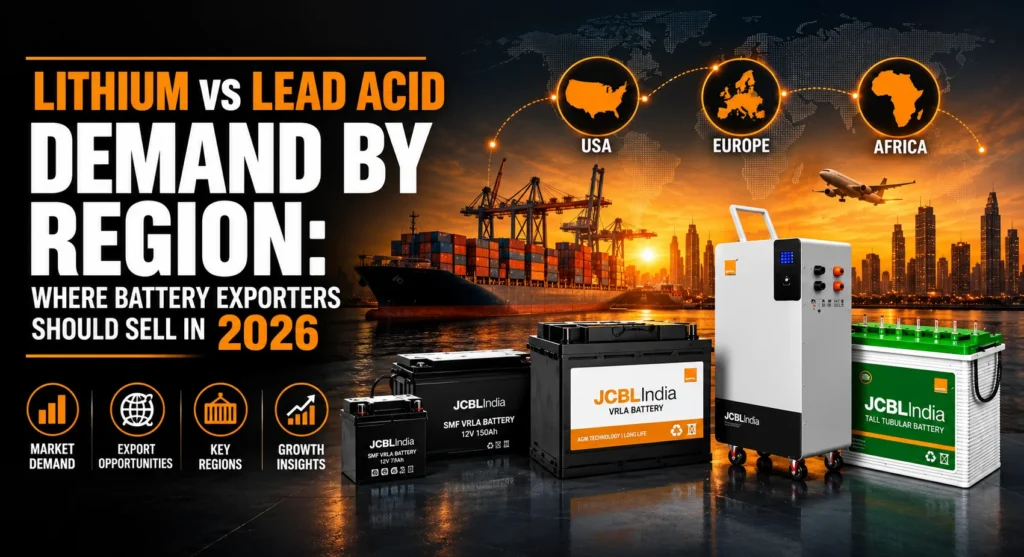
Global battery demand is now divided along clear regional and economic lines. Developed regions are rapidly shifting toward lithium-ion technologies driven by EVs, renewable energy, and AI infrastructure, while developing regions continue to rely on lead-acid batteries for affordability-driven applications like telecom backup and automotive replacement markets.
Global Lithium vs Lead Acid Battery Demand by Region (2026 Comparison)
| Region | Dominant Battery Type | Primary Demand Drivers |
| China | Lithium-ion | EV production, energy storage, manufacturing dominance |
| Europe | Lithium-ion | EV regulations, renewable energy, grid modernization |
| North America | Lithium-ion | EV growth, AI data centers, utility-scale storage |
| India & Southeast Asia | Mixed (Lithium growing) | EV 2W/3W, solar storage, telecom expansion |
| Africa | Lead Acid | Telecom backup, solar off-grid, cost-sensitive power |
| Middle East | Lead Acid | Industrial UPS, oil & gas infrastructure |
| Latin America | Lead Acid | Automotive replacement, industrial backup systems |
Why Regional Battery Demand Differs in 2026
Global battery demand in 2026 is shaped by a structural split between high-income electrified economies and cost-sensitive developing markets.
According to the International Energy Agency (IEA), lithium-ion battery deployment has increased nearly 6× since 2020, driven primarily by electric vehicles and energy storage expansion. EVs alone now account for more than 70% of global lithium-ion demand.
At the same time, lead-acid batteries continue to dominate in regions where:
- Upfront cost is the primary buying factor
- Infrastructure is less electrified
- Maintenance simplicity is critical
What Drives Global Lithium Battery Demand?
Lithium-ion batteries dominate in 2026 due to structural shifts in mobility and energy systems.
Electric Vehicles (EVs) Are the Core Driver
EV adoption remains the largest demand source globally.
- Global EV battery deployment reached ~1.2 TWh in 2025
- China accounts for ~60% of global EV battery demand
- Europe contributes ~15%
- North America contributes ~10%
AI Data Centers & Energy Storage Expansion
North America and Europe are experiencing unprecedented AI cluster scaling and hyper-scale data center energy infrastructure expansion, requiring high-density lithium-ion backup systems and grid stabilization storage.
Renewable Energy Integration
Lithium-ion batteries are now essential for:
- Solar storage
- Wind energy balancing
- Grid frequency stabilization
Why Is Global Demand for Lead Acid Batteries Still Strong?
Lead-acid batteries remain highly relevant in 2026 due to cost efficiency and established usage ecosystems.
They continue to dominate in:
- Telecom tower backup systems
- Automotive starter batteries (SLI)
- UPS and industrial backup systems
- Off-grid solar applications
Unlike lithium-ion, lead acid remains preferred where:
- Upfront cost matters more than lifecycle efficiency
- Replacement cycles are short and predictable
- Service infrastructure is already established
Which Regions Have the Highest Lithium Battery Demand?
China: Global Lithium Manufacturing Leader
China is the center of global lithium demand and supply.
- ~60% of global EV battery deployment
- ~80% of global battery cell production
- Largest LFP battery manufacturing base
Key demand drivers:
- EV manufacturing scale
- energy storage expansion
- domestic clean energy policy
Europe: Regulation-Driven Lithium Growth
Europe’s lithium demand is policy-driven and sustainability-focused.
Key drivers:
- Strict CO₂ emission targets
- Rapid EV adoption
- Renewable energy grid expansion
Countries leading demand:
- Germany
- France
- Netherlands
- Nordic region
North America: AI + EV Convergence Market
North America is now a dual-growth lithium market.
Key drivers:
- EV production growth (US IRA policy support)
- AI-driven data center expansion
- utility-scale battery storage
Lithium-ion batteries are increasingly used for:
- Hyperscale data center backup systems
- Grid stabilization for renewable integration
- EV charging infrastructure support
India & Southeast Asia: Fastest Emerging Hybrid Market
This region represents a transition market where both technologies coexist.
Key drivers:
- Electric two/three-wheeler adoption
- Telecom infrastructure expansion
- Solar energy adoption in rural areas
India’s lithium-ion demand is projected to grow by nearly 48% by 2030 according to industry projections (ICEA).
Why Is Africa Still Dominated by Lead Acid Batteries?
Africa remains one of the strongest global lead-acid markets due to infrastructure and cost constraints.
Key drivers:
- Telecom tower backup systems
- Off-grid solar installations
- Automotive battery replacement market
- Unreliable grid electricity
Lead acid remains dominant because it is:
- Affordable upfront
- Widely serviceable
- Easy to recycle locally
Why Does the Middle East Rely on Lead Acid Batteries?
The Middle East continues to have strong lead-acid demand for industrial stability applications.
Key drivers:
- Oil & gas infrastructure backup
- Industrial UPS systems
- Commercial building power backup
High temperature tolerance and predictable replacement cycles keep lead acid relevant.
Why Is Latin America Still a Strong Lead Acid Market?
Latin America continues to rely heavily on lead-acid batteries.
Key drivers:
- Automotive replacement market
- Commercial fleet batteries
- Industrial backup systems
- Rural power infrastructure
Cost sensitivity remains the primary factor influencing battery selection.
Lithium vs Lead Acid by Application (2026 Export View)
| Application | Battery Type | Key Regions |
| Electric Vehicles | Lithium-ion | China, Europe, North America |
| Data Centers | Lithium-ion | North America, Europe |
| Renewable Energy Storage | Lithium-ion | Global developed markets |
| Telecom Backup | Lead Acid + Lithium | Africa, India, Southeast Asia |
| Automotive Replacement | Lead Acid | Latin America, Africa |
| Industrial UPS | Lead Acid | Middle East, South Asia |
| Solar Off-grid Systems | Lead Acid | Africa, India |
Should You Export Lithium or Lead Acid Batteries in 2026?
Export Lithium Batteries If You Target:
- EV manufacturers
- Renewable energy companies
- Data center infrastructure providers
- Developed economies (EU, US, China)
Export Lead Acid Batteries If You Target:
- Telecom operators in emerging markets
- Automotive aftermarket distributors
- Industrial backup system suppliers
- Africa, Latin America, Middle East
Key Battery Market Trends in 2026
1. LFP Battery Dominance
LFP batteries now account for over 50% of EV batteries globally and over 90% of energy storage systems.
2. China Controls Battery Supply Chain
China produces over 80% of global battery cells, making it central to global trade flows.
3. Energy Storage Is Growing Faster Than EVs in Some Markets
Grid-scale storage is becoming one of the fastest-growing lithium demand segments.
Conclusion
Global battery demand in 2026 is increasingly region-specific rather than technology-neutral. Lithium-ion batteries lead in high-growth markets driven by EV adoption, AI infrastructure expansion, and renewable energy systems, while lead-acid batteries remain dominant in cost-sensitive regions where affordability, reliability, and ease of maintenance are more important than efficiency. For exporters, success depends on aligning battery choice with the right region, application, price sensitivity, and infrastructure maturity.
FAQs
China, Europe, and North America have the highest lithium battery demand due to EV adoption, renewable energy storage, and AI-driven data center expansion.
Lead acid batteries remain strong in Africa, Latin America, and South Asia due to low cost, established infrastructure, and widespread use in telecom and automotive backup systems.
Lithium batteries are better for developed markets and energy transition sectors, while lead acid batteries remain profitable in emerging economies and backup power markets.
Lithium is replacing lead acid in EV and energy storage sectors, but lead acid remains dominant in cost-sensitive and backup power applications globally.