

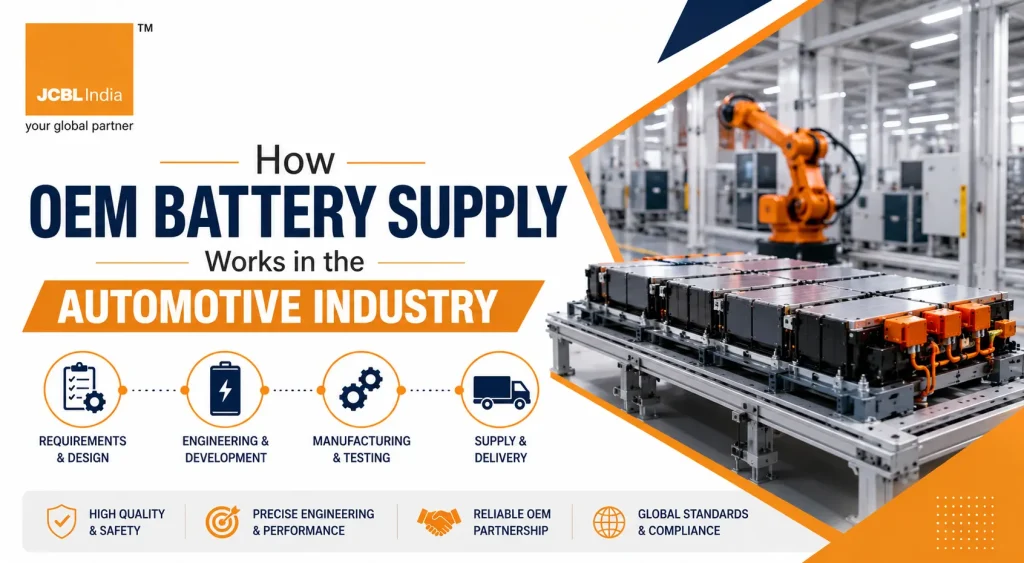
The automotive industry is undergoing a major shift toward electrification, making reliable battery supply a critical part of vehicle manufacturing. OEM battery supply enables automotive companies to receive battery systems that are specifically designed, tested, and manufactured according to their vehicle requirements.
Unlike off-the-shelf battery solutions, OEM batteries are developed through close collaboration between battery manufacturers and vehicle makers. This process ensures that battery systems meet specific requirements related to performance, safety, integration, and production scalability.
What Is OEM Battery Supply?
OEM battery supply is a manufacturing partnership where a battery supplier develops and delivers customized battery solutions for an automotive manufacturer’s vehicles. The supplier works according to the vehicle maker’s technical specifications, including battery design, capacity, power requirements, size limitations, and quality standards.
In the automotive sector, OEM battery supply covers the complete process from engineering and prototype development to production, testing, and delivery of battery systems for vehicles.
How Does OEM Battery Supply Work in the Automotive Industry?
1. Defining Vehicle Battery Requirements
The OEM battery supply process begins when an automotive battery manufacturer defines its battery requirements based on vehicle design and performance goals.
Key factors considered during this stage include:
- Vehicle type and application
- Required driving range
- Power output needs
- Available installation space
- Weight limitations
- Safety and regulatory requirements
For example, a battery system designed for a passenger electric vehicle may have different specifications compared with one developed for commercial vehicles or industrial applications. The OEM supplier uses these requirements to develop a battery solution that fits the vehicle platform.
2. Battery System Design and Engineering
After understanding the vehicle requirements, battery engineers begin designing the battery system.
This stage involves selecting suitable battery cells, developing module configurations, and designing the complete battery pack structure. Engineers also focus on:
- Battery Management System (BMS) integration
- Thermal management solutions
- Electrical connections
- Mechanical protection
- Vehicle interface compatibility
The goal is to create a battery system that works seamlessly with the vehicle’s electrical and control systems.
3. Prototype Development and Validation
Before moving into large-scale production, OEM battery suppliers develop prototypes for testing and validation.
- Performance consistency
- Safety parameters
- Charging and discharging behavior
- Durability under different operating conditions
- Compatibility with vehicle systems
Testing helps identify potential improvements before production begins. This reduces manufacturing risks and ensures that the final battery system meets automotive quality expectations.
4. Battery Manufacturing and Assembly
Once the design is approved, the battery supplier begins production. Automotive OEM battery manufacturing involves multiple stages, including:
- Battery cell processing
- Module assembly
- Battery pack integration
- Electronic system installation
- Quality inspection
Advanced manufacturing facilities use strict quality control procedures to maintain consistency across production batches. Each battery system must meet predefined specifications before being supplied to the automotive manufacturer.
5. Quality Testing and Compliance Checks
Quality control is one of the most important parts of OEM battery supply. Automotive manufacturers require batteries that can deliver reliable performance throughout the vehicle lifecycle.
Battery suppliers conduct multiple checks, such as:
- Electrical performance testing
- Safety evaluation
- Thermal performance testing
- Mechanical durability checks
- Functional testing of battery management systems
These processes help ensure that the battery system performs reliably under different driving conditions and environments.
6. Supply Chain Coordination and Delivery
After production and testing, OEM battery suppliers manage the logistics process to deliver battery systems to vehicle manufacturing facilities.
This requires coordination between:
- Battery manufacturers
- Automotive production plants
- Logistics providers
- Component suppliers
Many automotive companies follow planned inventory systems where battery deliveries are synchronized with vehicle production schedules. Reliable supply chain management helps avoid production delays and supports efficient vehicle assembly.
Key Elements of an Automotive OEM Battery System
An OEM battery solution consists of several integrated components that work together:
| Component | Function |
| Battery Cells | Store and provide electrical energy |
| Battery Modules | Combine multiple cells into functional units |
| Battery Pack | Complete energy storage system installed in vehicles |
| Battery Management System (BMS) | Monitors battery operation and safety parameters |
| Thermal Management System | Helps maintain suitable operating conditions |
Each component plays an important role in ensuring battery efficiency, reliability, and vehicle compatibility.
Benefits of OEM Battery Supply for Automotive Manufacturers
1. Vehicle-Specific Battery Solutions
OEM suppliers develop batteries according to the exact requirements of a vehicle platform. This allows manufacturers to achieve better integration between the battery system and vehicle design.
2. Improved Production Reliability
Working with experienced OEM battery suppliers helps automotive companies maintain consistent battery availability and quality throughout vehicle production cycles.
3. Better Performance Optimization
Customized battery systems allow manufacturers to optimize factors such as energy efficiency, vehicle weight distribution, and overall performance.
4. Advanced Technical Support
OEM partnerships often involve continuous collaboration between engineers from both companies, helping improve battery designs and address technical requirements.
5. Scalable Manufacturing Support
Automotive production requires suppliers that can support increasing demand. OEM battery manufacturers provide the production capabilities needed for large-scale vehicle manufacturing.
Challenges in OEM Battery Supply
Although OEM battery partnerships provide several advantages, suppliers and automotive companies must manage certain challenges.
1. Supply Chain Complexity
Battery production depends on multiple components and processes. Managing material availability, production schedules, and logistics requires strong coordination.
2. Technology Development
Battery technology continues to evolve rapidly. Suppliers need to continuously improve designs, manufacturing processes, and performance capabilities.
3. Quality Consistency
Maintaining uniform quality across large production volumes is essential for automotive applications. Even minor variations can affect battery performance and reliability.
How to Choose the Right OEM Battery Supplier
Selecting the right supplier is an important decision for automotive manufacturers. Companies should evaluate:
- Automotive Manufacturing Experience: A supplier with automotive expertise understands industry-specific requirements and production standards.
- Engineering Capabilities: Strong research and development capabilities help create customized battery solutions for different vehicle platforms.
- Manufacturing Capacity: Suppliers should have the ability to support current production needs as well as future expansion.
- Testing and Quality Systems: Reliable suppliers follow structured testing procedures to ensure battery safety and consistency.
- Supply Chain Reliability: A stable supply network helps manufacturers maintain uninterrupted vehicle production.
Future of OEM Battery Supply in Automotive Manufacturing
As vehicle manufacturers continue developing electric and hybrid platforms, OEM battery supply will become increasingly important.
Future battery partnerships are expected to focus on:
- More efficient battery designs
- Improved integration with vehicle systems
- Faster development cycles
- Greater manufacturing scalability
- Advanced quality management
Strong collaboration between automotive companies and battery suppliers will remain essential for building reliable next-generation vehicles.
Conclusion
OEM battery supply plays a vital role in modern automotive manufacturing by enabling vehicle makers to develop reliable, customized, and high-performance battery systems. From initial design and testing to large-scale production and delivery, strong collaboration between automotive companies and battery suppliers ensures quality, efficiency, and seamless vehicle integration. As the demand for advanced mobility solutions continues to grow, partnering with an experienced OEM battery manufacturer like JCBL India Batteries can help automotive companies achieve consistent quality, scalable production, and dependable long-term battery supply for evolving vehicle platforms.
FAQs
OEM battery supply refers to the process where battery manufacturers design, produce, and deliver customized battery systems according to automotive manufacturers’ requirements.
OEM battery suppliers collaborate with vehicle manufacturers during battery design, testing, production, and delivery to ensure compatibility with specific vehicle models.
OEM batteries are specifically developed for particular vehicle applications, while standard batteries are designed for general use without vehicle-specific customization.
OEM battery supply helps ensure that electric vehicles receive battery systems optimized for safety, performance, integration, and manufacturing requirements.
Companies should consider technical expertise, manufacturing capability, quality processes, testing facilities, and supply chain reliability when selecting an OEM battery supplier.