

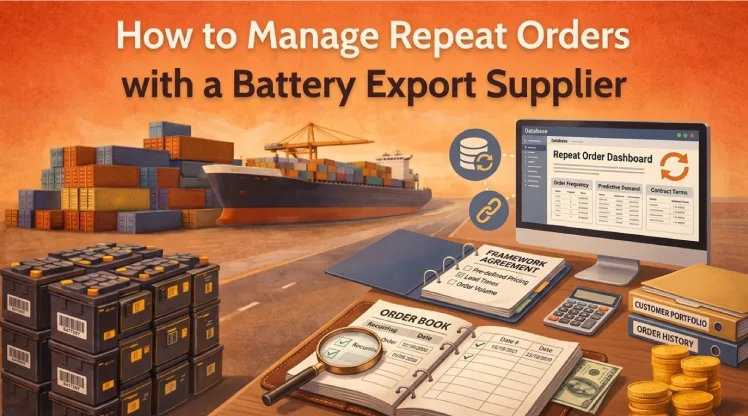
Managing repeat orders with a battery export supplier requires a structured approach, focused on demand forecasting, SKU optimization, MOQ alignment, payment terms, and production planning. When done right, businesses can streamline repeat battery imports, reduce costs, and build a reliable long-term battery supply partnership.
Key Takeaways
- Focus on optimization, not repetition, and use past data to improve each order.
- Forecast demand accurately to prevent stockouts and overstocking.
- Refine SKU mix based on performance to boost turnover and margins.
- Align MOQ with reorder cycles for better cash flow and container efficiency.
- Consistent orders help secure better terms and a stronger long-term battery supply partnership.
- Plan production early and track lead times to avoid delays and disruptions.
- Avoid data gaps and cost miscalculations for efficient repeat battery imports.
The first order with a supplier tests reliability, but repeat orders drive profitability. With the right system in place, businesses can reduce costs, improve inventory planning, and streamline operations.
For companies handling repeat battery imports, consistency is critical. Poor planning leads to stockouts, excess inventory, and cash flow pressure, while a structured approach creates a stable supply chain and strengthens long-term supplier relationships.
This guide explains how to manage repeat orders efficiently using a practical, data-driven approach.
What is the Best Way to Manage Repeat Orders with a Battery Export Supplier?
Managing repeat orders involves forecasting demand, optimizing SKU mix, aligning MOQ with reorder cycles, improving payment terms, and coordinating production schedules to ensure consistent supply and cost efficiency.
Why Repeat Orders Require a Different Strategy Than First Orders
Repeat orders are not just a continuation of the first purchase; they require a shift in strategy.
- The focus moves from supplier evaluation to operational efficiency
- Decisions are based on real sales and shipment data
- Pricing and payment terms become more flexible
- Planning becomes proactive rather than reactive
| Factor | First Order | Repeat Orders |
| Focus | Supplier validation | Cost & efficiency |
| Pricing | Fixed | Negotiable over time |
| Planning | Basic | Data-driven |
This shift is what separates occasional buyers from professional importers.
Forecasting Demand Before Placing Repeat Orders
Accurate forecasting is the foundation of successful repeat orders.
Key factors to consider:
- Seasonal demand: Battery demand often peaks in extreme weather (summer and winter)
- Sales velocity: Identify fast-moving and slow-moving SKUs
- Regional trends: Different markets have different consumption patterns
- Safety stock: Maintain a buffer of 2–4 weeks to avoid stockouts
A simple way to estimate demand:
Forecast demand = Average monthly sales × (lead time + buffer period)
If you’re planning shipments at scale, demand forecasting should also align with container utilization. A detailed breakdown of this can be found in How to Plan a Full Container Load of Car Batteries, which explains how forecasting directly impacts shipment efficiency.
For a deeper understanding of seasonal fluctuations, you can also refer to How to Forecast Seasonal Demand in the Automotive Battery Market, especially if your sales vary across regions.
Optimizing SKU Mix in Repeat Shipments
One of the biggest advantages of repeat orders is the ability to refine your product mix.
Instead of repeating the same shipment, use past data to improve it:
- Increase allocation for high-demand SKUs
- Reduce or eliminate slow-moving products
- Maintain a balanced mix for seasonal items
- Avoid niche SKUs unless demand is proven
| SKU Category | Previous Shipment | Optimized Shipment | Action |
| Fast-moving | 40% | 55% | Increase |
| Slow-moving | 30% | 15% | Reduce |
| Seasonal | 30% | 30% | Maintain |
Optimizing SKU mix also improves container efficiency. If you want to understand how SKU planning ties into shipment structure, you must read “How to Plan a Full Container Load of Car Batteries” as it provides a practical framework for balancing volume and demand.
Aligning MOQ with Reorder Cycles
Minimum Order Quantity (MOQ) can directly impact inventory and working capital.
To manage it effectively:
- Plan orders around full container loads (FCL) whenever possible
- Match MOQ with your actual sales cycle
- Avoid ordering excess stock just to meet supplier requirements
For most importers:
- Ideal reorder cycle: every 30–60 days
This balance ensures:
- Faster capital rotation
- Lower storage costs
- Reduced risk of unsold inventory
A deeper understanding of MOQ dynamics can help prevent overstocking and improve capital rotation. Understanding the Minimum Order Quantity (MOQ) for Bulk Battery Supply explains how MOQ decisions impact both inventory and cash flow.
Managing Payment Terms for Repeat Orders
Payment terms often improve with consistency and trust.
Typical progression:
- First order: Higher advance payment
- Repeat orders: Reduced advance + better credit terms
Common structures:
- TT (Telegraphic Transfer): Faster and commonly used
- LC (Letter of Credit): Safer for larger or high-risk transactions
Over time, many buyers reduce advance payments from around 30% to 10–20%, improving cash flow and flexibility.
If you’re evaluating which structure works best for your business, Why Payment Terms Matter in International Battery Trade provides a detailed comparison of payment strategies and their impact on risk and cash flow.
Monitoring Lead Time and Production Scheduling
Timely delivery depends on proactive coordination.
Best practices:
- Book production slots early during peak seasons
- Confirm dispatch timelines in advance
- Track potential delays such as port congestion
- Plan orders at least 2–4 weeks before stockout risk
Lead time is closely linked to import planning. If you’re sourcing from India, How to Import Automotive Batteries in Bulk from India outlines how production timelines, shipping schedules, and documentation affect delivery reliability.
Building a Long-Term Battery Supply Partnership
Successful repeat orders are built on strong supplier relationships.
To develop a reliable long-term battery supply partnership:
- Maintain clear and consistent communication
- Review supplier performance regularly
- Discuss pricing transparently
- Focus on reliability rather than short-term cost savings
Long-term partnerships often lead to:
- Better pricing stability
- Priority production scheduling
- More flexible terms
This is where repeat orders turn into strategic advantage.
7 Costly Mistakes in Repeat Battery Orders
Avoiding these common mistakes can save high costs:
- Reordering without analyzing sales data
- Ignoring seasonal demand fluctuations
- Keeping the same SKU mix every time
- Overstocking slow-moving products
- Not renegotiating payment terms
- Ignoring currency exchange impact
- Failing to update landed cost calculations
Many importers underestimate the impact of total cost. If you want to calculate your true profitability, you must read “ How to Calculate Landed Cost for Imported Car Batteries.”
Expert Tips to Optimize Repeat Battery Imports
To improve efficiency in repeat battery imports, consider these practical strategies:
- Track SKU-level performance regularly
- Maintain a rolling 2–3 month demand forecast
- Standardize reorder cycles
- Evaluate supplier performance using clear metrics
- Lock pricing for high-volume SKUs when possible
These steps help create a more predictable and scalable procurement system.
Conclusion
Managing repeat orders with a battery export supplier is not just about placing the same order again, it requires planning, data analysis, and coordination. Businesses that forecast demand accurately, optimize SKU mix, and align order cycles with market needs can significantly improve profitability.
Over time, strong supplier relationships and consistent processes turn repeat orders into a stable and scalable supply system, creating long-term operational and financial advantages.
Frequently Asked Questions
Most importers reorder every 30–60 days, depending on demand, lead time, and inventory turnover.
Yes, suppliers typically offer better terms after consistent repeat orders and a proven payment history.
No. SKU mix should be adjusted based on sales performance and changing demand patterns.
By removing slow-moving SKUs, forecasting demand accurately, and maintaining balanced reorder cycles.