

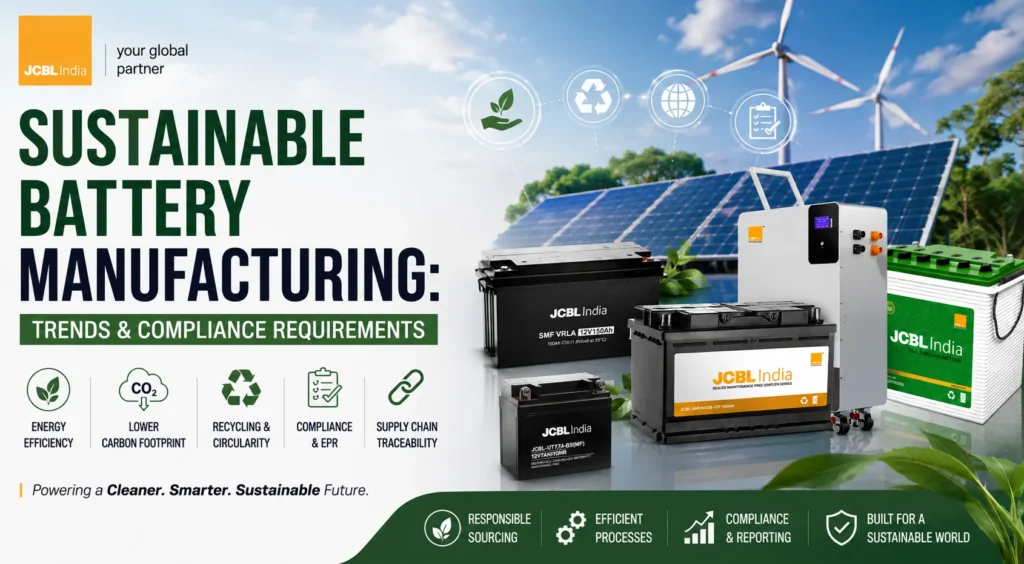
Sustainable battery manufacturing is the production of batteries with greater energy and material efficiency, lower waste and emissions, responsible sourcing, recycling, and compliance across the battery lifecycle. As battery demand grows across electric vehicles, energy storage and industrial applications, sustainability is becoming increasingly relevant to manufacturing efficiency, regulatory compliance and market access.
For Indian battery manufacturers, the Battery Waste Management Rules, 2022 establish Extended Producer Responsibility (EPR) obligations covering battery waste. For companies serving international markets, regulations such as the EU Batteries Regulation add requirements related to carbon footprint, recycled content, traceability, and supply chain due diligence.
What Is Sustainable Battery Manufacturing?
Sustainable battery manufacturing means producing batteries while minimizing resource use, waste, and environmental impact without compromising product quality, safety, or performance.
It covers:
- Energy-efficient manufacturing
- Material and process efficiency
- Lower-carbon production
- Responsible raw-material sourcing
- Waste reduction and recycling
- Battery traceability
- End-of-life management
- Sustainability and compliance reporting
For manufacturers, sustainability is therefore not limited to renewable electricity. It involves how materials are sourced, batteries are manufactured, waste is managed, and lifecycle information is documented.
Why Sustainable Battery Manufacturing Matters
Battery manufacturers are facing two parallel changes: growing demand for batteries and increasing expectations around environmental performance and compliance.
Sustainability can affect manufacturers through:
- Operating costs: Energy and material efficiency can reduce resource consumption.
- Regulatory requirements: EPR, recycling, and sustainability rules are becoming more structured.
- Customer requirements: OEMs and B2B customers may request environmental and supply-chain information.
- Export access: International markets can require product-level sustainability information.
- Supply-chain resilience: Better traceability improves visibility into critical materials and suppliers.
The result is a shift from treating sustainability as a standalone initiative to integrating it into manufacturing, procurement, quality, and compliance systems.
6 Key Trends in Sustainable Battery Manufacturing
1. Energy-Efficient Battery Production
Battery manufacturing can involve energy-intensive processes, making energy management an important sustainability and cost consideration.
Manufacturers can focus on:
- Monitoring energy consumption by production process
- Identifying high-energy operations
- Improving equipment and process efficiency
- Reducing avoidable production losses
- Increasing the use of lower-carbon electricity where practical
- Measuring energy consumption against production output
For B2B manufacturers, energy intensity per unit of production or battery capacity can provide a more useful operational metric than total plant energy consumption alone.
2. Carbon-Footprint Measurement
Carbon-footprint measurement is becoming increasingly important, particularly for manufacturers supplying global markets.
The EU Batteries Regulation establishes carbon-footprint requirements for specified battery categories, with calculations linked to the battery model and manufacturing plant. Its methodology considers factors including the bill of materials, energy, and auxiliary materials used during manufacturing.
For manufacturers, this increases the importance of collecting reliable data across the following:
Raw materials → manufacturing → energy use → logistics → end-of-life
The focus is moving from broad claims about being “green” to measurable and documented environmental performance.
3. Recycled Materials and Circular Manufacturing
Battery manufacturing is increasingly moving toward a circular model in which valuable materials are recovered and returned to productive use.
Manufacturers can support circularity by:
- Reducing manufacturing scrap
- Recovering usable materials
- Using eligible recycled materials
- Designing processes that support material recovery
- Working with registered recyclers
- Considering refurbishment or repurposing where technically appropriate
In India, the Battery Waste Management Rules require producers to meet EPR obligations and mandate minimum use of domestically recycled materials in manufacturing new batteries from FY 2027–28 onwards.
4. Supply-Chain Traceability
Sustainable battery manufacturing increasingly depends on knowing where critical raw materials come from and how they move through the supply chain.
Manufacturers should strengthen:
- Supplier documentation
- Raw-material records
- Chain-of-custody information
- Supplier assessments
- Risk-management processes
- Traceability systems
This is particularly important for export-oriented manufacturers. The EU Batteries Regulation includes due diligence requirements involving supply chain controls and traceability for specified raw materials.
5. Digital Sustainability Data
Sustainability reporting is becoming increasingly data-driven.
Digital manufacturing and traceability systems can help manufacturers monitor the following:
- Energy consumption
- Material usage
- Production waste
- Emissions
- Recycling data
- Supplier information
- Product lifecycle information
Reliable data can also simplify compliance reporting, customer audits and carbon-footprint calculations.
6. Battery Recycling and End-of-Life Integration
Recycling is becoming an increasingly important part of the battery manufacturing value chain.
Rather than treating end-of-life management as a separate activity, manufacturers can integrate it into lifecycle planning through the following:
- Collection networks
- Authorized recycling partnerships
- Material recovery
- Battery identification and traceability
- Refurbishment or repurposing where appropriate
This supports the transition from a linear “produce-use-dispose” model toward a more circular battery value chain.
Battery Manufacturing Compliance Requirements
Battery manufacturing compliance requirements depend on the country, battery type, application, business role, and target market. For Indian battery manufacturers, the two key regulatory frameworks are India’s Battery Waste Management Rules, 2022, and the EU Batteries Regulation for companies supplying the European market.
India: Battery Waste Management Rules, 2022
India’s Battery Waste Management Rules, 2022, apply to all types of batteries, including EV, automotive, industrial, and portable batteries. The framework is based on Extended Producer Responsibility (EPR), making producers, including importers, responsible for the environmentally sound management of waste batteries.
Key compliance requirements include the following:
- Producer registration with the applicable authority
- EPR compliance and fulfillment of applicable obligations
- Collection and recycling/refurbishment of waste batteries
- EPR certificate management
- Regulatory reporting and record-keeping
- Use of recycled/recovered materials where applicable
- Environmentally sound battery-waste management
The Central Pollution Control Board (CPCB) provides an online battery EPR system for producer and recycler/refurbisher registration, EPR certificate processes, and related reporting.
Since the rules have been amended after their introduction, including amendments notified in 2023 and 2024, manufacturers should check the latest applicable requirements rather than relying only on the original 2022 notification.
EU: Battery Sustainability and Compliance Requirements
Indian battery manufacturers exporting to the European Union must also consider the EU Batteries Regulation, which introduces requirements covering battery sustainability, carbon footprint, recycled materials, and supply-chain transparency.
Key compliance areas include the following:
- Carbon-footprint declarations and performance requirements
- Recycled-content information
- Supply-chain due diligence
- Material and battery traceability
- Extended producer responsibility
- Battery information and labelling
For covered batteries, the EU framework also requires information on recovered cobalt, lithium, nickel, and lead, with relevant recycled-content requirements applying progressively from 2028.
For Indian battery exporters, sustainability compliance is increasingly a market-access consideration, not just an environmental responsibility. Manufacturers supplying the EU should therefore assess applicable requirements early and maintain reliable production, material, and supply-chain data.
India vs EU: Battery Sustainability Requirements
| Area | India | European Union |
| Core framework | Battery Waste Management Rules, 2022 | EU Batteries Regulation |
| EPR | Yes | Yes |
| Recycling | Collection and recycling/refurbishment obligations | Lifecycle waste-management requirements |
| Recycled materials | Minimum domestic recycled-material requirements from FY 2027–28 | Recycled-content documentation and requirements |
| Carbon footprint | Relevant to sustainability and export readiness | Specific carbon-footprint requirements for covered batteries |
| Supply-chain due diligence | Requirements depend on applicable Indian regulations | Specific requirements for covered raw materials |
| Traceability | Increasingly important for EPR and supply-chain management | Explicit requirements in relevant areas |
Key Challenges in Sustainable Battery Manufacturing
Manufacturers may face several practical challenges:
- High energy requirements in certain production processes
- Cost of improving equipment and manufacturing efficiency
- Availability and consistency of recycled materials
- Complex critical-material supply chains
- Data gaps in carbon-footprint calculations
- Increasing regulatory and reporting requirements
The solution is not to treat every sustainability issue separately. Manufacturers can build a more effective system by connecting production data, procurement, recycling, traceability, and compliance.
What Should Battery Manufacturers Prioritize Next?
A practical framework is
Measure → Reduce → Source → Recover → Trace → Report
- Measure: Track energy, material use, waste, and relevant emissions.
- Reduce: Improve processes with high energy consumption or material losses.
- Source: Strengthen supplier qualification and raw-material traceability.
- Recover: Build reliable collection, recycling, and refurbishment partnerships.
- Trace: Maintain records across raw materials, production, and battery lifecycle stages.
- Report: Keep sustainability and compliance information accurate, documented, and auditable.
Conclusion
Sustainable battery manufacturing is becoming a combination of operational efficiency, circularity, traceability, and regulatory readiness.
For Indian battery manufacturers, EPR, recycling, and recycled-material requirements are increasingly important. For companies targeting international markets, carbon-footprint data, recycled-content information, and supply-chain due diligence can also influence market access and customer requirements.
Manufacturers that build measurable sustainability practices and reliable compliance systems into their operations will be better positioned to respond to changing regulations and increasingly demanding B2B supply chains.
FAQs
Sustainable battery manufacturing means producing batteries with greater energy and material efficiency while reducing waste and environmental impact, supporting responsible sourcing and recycling, and meeting applicable regulatory requirements.
The major trends include energy-efficient production, carbon-footprint measurement, recycled materials, circular manufacturing, supply-chain traceability, digital sustainability data, and stronger integration of battery recycling into the product lifecycle.
Extended Producer Responsibility (EPR) makes battery producers, including importers, responsible for the environmentally sound management of waste batteries. India’s Battery Waste Management Rules establish obligations relating to collection and recycling/refurbishment, registration, reporting, and EPR certificates.
Manufacturers can focus on energy efficiency, reducing material losses, improving production processes, using lower-carbon electricity where practical, and collecting reliable data across relevant stages of the battery lifecycle.
Supply-chain traceability helps manufacturers document raw-material sources, identify supply-chain risks, support regulatory compliance, and provide reliable information to customers and authorities.
It is increasingly relevant to EPR compliance, recycling, recycled-material requirements, resource efficiency, and access to international markets. Indian manufacturers supplying global customers may also need to provide more detailed sustainability and supply-chain information.