

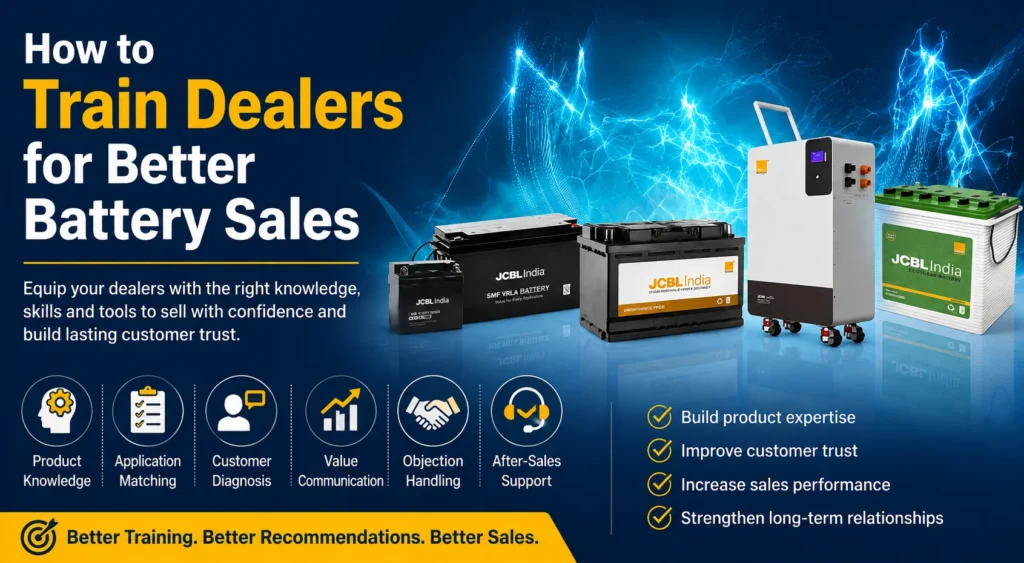
To train dealers for better battery sales, manufacturers and distributors should build training around six capabilities: product knowledge, application matching, customer diagnosis, value communication, objection handling, and after-sales support. Combine technical training with sales role-play, practical product resources, competency assessments, and ongoing performance reviews. The objective is not simply to teach dealers about batteries, but to help them make accurate, application-appropriate recommendations with confidence.
What Should Battery Dealers Be Trained On?
A strong battery dealer training program should teach dealers to:
- Understand key battery technologies and specifications
- Identify the requirements of different applications
- Ask the right questions before recommending a product
- Explain product value using verified information
- Handle price and product-comparison objections
- Understand warranty and after-sales processes
- Recognize when a technical issue requires escalation
A useful training framework is:
PRODUCT → APPLICATION → DIAGNOSIS → RECOMMENDATION → OBJECTION → FOLLOW-UP
Each stage develops a different dealer capability.
Build a High-Performing Battery Dealer Training Program
A high-performing battery dealer training program should combine technical knowledge, application expertise, sales skills, practical resources, continuous learning, and measurable performance. The following ten areas provide a structured approach to developing dealer capability.
1. Build Product Knowledge First
Dealers need practical knowledge of battery technology, specifications, application requirements, charging, operating conditions, warranty terms, and handling guidelines. The focus should be on understanding which specifications influence product selection, where to find verified information, and when to involve the manufacturer’s technical team.
As battery portfolios expand into newer technologies, technical training becomes increasingly important. ARAI’s industry programs, for example, cover lithium-ion batteries, battery management systems (BMS), battery testing, thermal management, and EV high-voltage safety.
2. Train Dealers to Match Batteries to Applications
Dealers should follow a consistent selection process:
Identify the application → verify requirements → check compatibility → recommend the appropriate battery.
Depending on the application, this may involve checking the vehicle or equipment, existing battery specifications, electrical requirements, operating conditions, and manufacturer recommendations. This helps prevent recommendations based solely on price, familiarity, or the previously installed battery.
3. Teach Dealers to Diagnose Before Recommending
Dealers should understand the customer’s requirements before suggesting a product.
Training can focus on questions such as:
- What vehicle or equipment is the battery for?
- What battery is currently installed?
- What problem is the customer experiencing?
- How is the application used?
- Are there unusual operating conditions?
This shifts the sales conversation from “Which battery do you want?” to “What does your application require?”
Teach Dealers to Sell Value, Not Just Price
Dealers should be able to explain product value using verified information, including application suitability, specifications, warranty coverage, technical support, availability, and service requirements.
A simple comparison framework is:
Price → Specifications → Suitability → Warranty → Support
Manufacturers should ensure dealers use approved product information and avoid unsupported claims about service life, savings, or performance.
4. Train Dealers to Handle Objections With Evidence
Dealers should be prepared for common concerns about price, competing brands, compatibility, service life, and warranty.
| Customer concern | Dealer response |
| “This battery is expensive.” | Explain relevant specifications, suitability, warranty, and support. |
| “Another brand is cheaper.” | Compare verified specifications and applicable warranty terms. |
| “How long will it last?” | Explain that service life varies with product and operating conditions; use verified data. |
| “Will it fit?” | Verify compatibility before confirming. |
| “What if there is a problem?” | Explain the applicable warranty and service process. |
The objective is to provide fact-based responses rather than pressure customers into a purchase.
5. Give Dealers Tools They Can Use During a Sale
Dealers should have quick access to accurate, current information. A practical toolkit can include:
- Product catalogues
- Application guides
- Specification sheets
- Product comparison tools
- Warranty documentation
- Installation and handling instructions
- Troubleshooting guides
- FAQs
- Technical escalation contacts
- Digital training resources
These resources should remain aligned with the manufacturer’s latest product documentation.
6. Use Role-Play to Test Dealer Readiness
Role-play allows manufacturers to test whether dealers can apply their knowledge in realistic situations. Scenarios can include price comparisons, compatibility questions, fleet requirements, warranty concerns, and battery-related problems.
Assess whether the dealer can:
Ask → Diagnose → Recommend → Explain → Handle objections → Escalate when necessary.
This provides a more practical assessment than training attendance alone.
7. Use a Dealer Competency Checklist
A dealer should demonstrate that they can:
- Explain key product specifications
- Identify application requirements
- Verify compatibility
- Recommend products using verified information
- Handle common objections
- Explain warranty procedures
- Use manufacturer resources
- Recognize when technical support is required
The same checklist can support onboarding, certification, and refresher training.
8. Make Training Continuous
Dealer training should continue beyond initial onboarding.
A simple model is:
Onboarding: Product portfolio, applications, sales process, and warranty basics.
Product updates: New products, specification changes, and revised application information.
Refresher training: Common mistakes, customer questions, and identified knowledge gaps.
Continuous learning is particularly relevant as battery technologies evolve. ARAI’s training programs include areas such as Li-ion batteries and BMS, EV high-voltage safety, and battery thermal management.
9. Measure Dealer Capability and Commercial Performance
Training should be evaluated using both competency and business indicators, such as:
- Product knowledge assessment scores
- Training completion
- Sales conversion
- Product mix
- Repeat orders
- Average order value
- Warranty or return patterns
- Technical escalation frequency
- Dealer or territory-level sales performance
These metrics should help identify training gaps rather than automatically attributing sales changes to training. For example, frequent technical escalations may indicate a need for stronger application training, while recurring warranty questions may signal documentation or process gaps.
The Complete Battery Dealer Training Framework
A scalable dealer program can follow this sequence:
Learn → Apply → Diagnose → Practice → Assess → Refresh → Measure
| Stage | What the dealer develops |
| Learn | Product and technical knowledge |
| Apply | Application and compatibility skills |
| Diagnose | Customer needs-assessment skills |
| Practice | Real-world sales and objection handling |
| Assess | Demonstrated product and sales competency |
| Refresh | Updated knowledge and product information |
| Measure | Capability and commercial performance data |
Common Mistakes to Avoid
Avoid building dealer training around:
- Product specifications alone
- Price-focused selling
- Generic sales techniques without application knowledge
- Outdated product information
- One-time training sessions
- Unverified performance claims
- Training attendance without competency assessment
- Technical information that dealers cannot easily access
Conclusion
Better battery sales start with better-equipped dealers. The strongest dealer programs combine technical knowledge with application-based selection, customer diagnosis, value communication and practical sales training.
For battery manufacturers and distributors, the goal is not simply to make dealers more knowledgeable. It is to make them more capable of identifying customer requirements, recommending the appropriate battery, communicating its value accurately and supporting the customer after the sale.
A structured Learn → Apply → Diagnose → Practice → Assess → Refresh → Measure framework provides a practical foundation for building dealer capability and creating a more consistent B2B sales experience across the distribution network.
FAQs
Train dealers in product knowledge, application matching, customer needs assessment, value-based selling, objection handling, and warranty support. Use role-play, sales resources, assessments, and refresher training.
Battery dealership profitability depends on factors such as sales volume, product margins, operating costs, inventory management, market demand, and after-sales support. Profitability varies by market, product category, and dealership model.
Dealers should identify the application, verify required specifications, confirm compatibility, consider operating conditions, and recommend the appropriate battery using verified manufacturer information.
Dealers should compare specifications, application suitability, warranty coverage, service support, and other verified value factors rather than competing on price alone.
Improve product and sales training, provide easy-to-use sales resources, strengthen application-based selling, support dealers with marketing and technical assistance, and track sales data to identify performance gaps.