

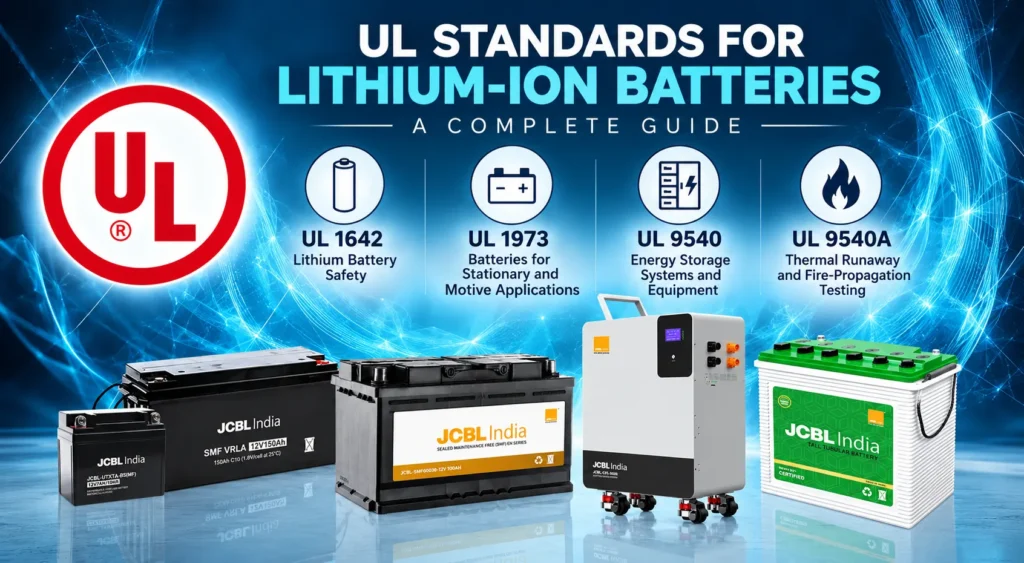
Lithium-ion batteries are used in consumer products, industrial equipment, electric vehicles, backup power, and battery energy storage systems (BESS). As battery applications expand, manufacturers, OEMs, importers, and system integrators need to understand which safety standards apply to their products.
There is no single UL standard for every lithium-ion battery. The applicable standard depends on the product, intended application, and evaluation level. Key standards include UL 1642, UL 1973, UL 9540, and UL 9540A, while other standards apply to specific products such as electric-vehicle batteries.
What Are the Main UL Standards for Lithium-Ion Batteries?
| UL Standard | Primary Focus | Typical Application |
| UL 1642 | Lithium battery safety | Lithium cells and batteries |
| UL 1973 | Battery safety for stationary and motive auxiliary applications | Stationary energy storage and auxiliary power |
| UL 9540 | Energy storage system safety | Complete ESS/BESS |
| UL 9540A | Thermal runaway and fire-propagation testing | Battery energy storage systems |
These standards operate at different levels and are not interchangeable. A battery-level evaluation does not automatically establish compliance for a complete energy-storage system.
What Are UL Standards for Lithium-Ion Batteries?
UL standards establish technical requirements or test methods used to evaluate product safety. For lithium-ion batteries, these requirements address hazards that can arise from electrical, mechanical, and thermal conditions.
The applicable UL standard depends on factors such as:
- Battery or system design
- Intended application
- Cell, battery, module, or system configuration
- Installation environment
- Applicable codes and regulatory requirements
For B2B buyers, identifying the correct standard early can help define testing, certification, and documentation requirements.
UL 1642: Lithium Battery Safety Standard
UL 1642 is the primary UL standard specifically covering lithium batteries used as power sources in products. Its scope includes primary and rechargeable lithium batteries and can cover batteries consisting of one or multiple cells. The requirements are intended to reduce the risk of fire or explosion associated with lithium batteries.
UL 1642 evaluates battery behavior under specified conditions, including applicable electrical, mechanical, and thermal stresses.
The current listing is UL 1642, Edition 6, published September 29, 2020, with the latest revision dated October 12, 2022.
What does UL 1642 cover?
UL 1642 focuses on the battery itself. Importantly, UL states that the final acceptability of a battery depends on its use in the complete product and the requirements applicable to that product.
Therefore, a supplier should not treat UL 1642 as a universal certification covering every finished product containing a lithium-ion battery.
UL 1973: Batteries for Stationary and Motive Auxiliary Power
UL 1973 covers batteries used in stationary and motive auxiliary power applications. It is particularly relevant to industrial and stationary energy-storage applications. UL Solutions identifies UL 1973 as one of the key battery standards referenced within broader ESS certification.
Typical applications can include:
- Stationary energy storage
- Backup and auxiliary power
- Industrial battery systems
- Battery systems incorporated into larger energy-storage equipment
UL 1642 vs. UL 1973
The key distinction is scope and application.
UL 1642 focuses on lithium batteries, while UL 1973 addresses batteries intended for specified stationary and motive auxiliary power applications.
For manufacturers and OEMs, the appropriate standard should therefore be determined from the product’s intended use rather than its lithium-ion chemistry alone.
UL 9540: Energy Storage Systems and Equipment
UL 9540 is the system-level safety standard for energy storage systems and equipment.
It covers ESS technologies intended to receive and store energy and later provide electrical energy to loads or an electric power system. The standard can address the complete system, including functions such as charging and discharging, protection, controls, and communications.
This makes UL 9540 particularly relevant to battery energy storage systems (BESS) used with applications such as renewable energy, backup power and grid-connected storage.
The current standard is UL 9540, Edition 3, published June 28, 2023, with a revision dated March 7, 2025.
Why is UL 9540 different from UL 1642?
UL 1642 evaluates lithium batteries, whereas UL 9540 addresses the energy-storage system as a complete configuration.
An ESS can contain batteries along with power conversion equipment, controls, protective functions, enclosures, and other components. System-level evaluation therefore involves considerations that go beyond individual battery safety.
UL 9540A: Thermal Runaway and Fire Propagation Testing
UL 9540A is a test method for evaluating thermal runaway fire propagation in battery energy storage systems. It is not simply another battery product standard.
Thermal runaway can result in rapid temperature increases and the release of heat and gases. UL 9540A provides a standardized methodology for evaluating the resulting fire and explosion hazards in applicable BESS configurations. The resulting data can support decisions related to installation instructions, separation distances, and fire/explosion protection.
Testing can examine behavior at different levels, including:
- Cell level
- Module level
- Unit level
- Installation level
What is the current UL 9540A edition?
UL 9540A Edition 6 was published on March 13, 2026. The sixth edition revised installation-level testing for large-scale fire evaluation.
UL Solutions also notes that adoption of the 2026 edition of NFPA 855 will take time and that an effective date of January 1, 2027, has been established for UL 9540A Edition 6. Projects should therefore confirm which edition and testing pathway apply to their specific compliance strategy.
UL 1642 vs. UL 1973 vs. UL 9540 vs. UL 9540A
| Standard | Evaluation Level | Main Purpose |
| UL 1642 | Cell/battery | Lithium battery safety |
| UL 1973 | Battery | Stationary and motive auxiliary applications |
| UL 9540 | Complete ESS | Energy-storage system safety |
| UL 9540A | Test method | Thermal runaway and fire propagation |
A useful way to remember the distinction is:
UL 1642 → battery
UL 1973 → application-specific battery
UL 9540 → complete energy-storage system
UL 9540A → thermal runaway/fire testing
UL Solutions describes UL 9540 as the foundational product-safety standard for ESSs, while UL 9540A provides a standardized method for evaluating thermal runaway and fire behavior.
Other UL Standards for Specific Lithium-Ion Battery Applications
UL 1642, UL 1973, UL 9540, and UL 9540A do not cover every lithium-ion battery application.
Depending on the finished product, other standards may apply. Examples include:
- UL 2580: Batteries for use in electric vehicles
- UL 2054: Household and commercial batteries
- UL 2272: Electrical systems for personal e-mobility devices
UL Solutions also identifies standards such as UL 2743 for portable power packs and UL 1989 for standby batteries.
The correct standard should therefore be selected based on the finished product and intended use, not simply because the battery uses lithium-ion chemistry.
What Tests Are Used for Lithium-Ion Battery Safety?
The exact test program depends on the applicable standard and product design. Depending on the evaluation, testing can examine:
- Electrical abuse conditions
- Short-circuit conditions
- Abnormal charging or discharging
- Mechanical stress
- Temperature-related conditions
- Thermal behavior
- Fire and explosion hazards
- Thermal runaway and propagation
The purpose is to understand how a battery or system responds not only during normal operation but also under specified abnormal or hazardous conditions.
UL Standard vs. UL Certification: What Is the Difference?
A UL standard defines requirements or test methods used to evaluate a product or technology.
UL certification or evaluation refers to the assessment of a specific product against applicable requirements.
This distinction matters when sourcing lithium-ion batteries. A supplier saying that a product is “designed to UL standards” is not necessarily making the same claim as a supplier providing formal certification or evaluation documentation.
For procurement, ask for the relevant documentation and verify:
- Applicable UL standard
- Edition and revision
- Product or model covered
- Certification/evaluation status
- Scope of the certification
How Do You Determine Which UL Standard Applies?
Use this process:
- Identify the product: Is it a cell, battery, module, pack or complete ESS?
- Identify the application: Is it for consumer electronics, industrial equipment, electric vehicles, stationary storage or another application?
- Determine the evaluation level: Battery-level and system-level requirements are different.
- Identify applicable UL standards: Depending on the application, this may include UL 1642, UL 1973, UL 9540, UL 9540A or another product-specific standard.
- Check local requirements: UL standards do not replace applicable electrical, fire, building, or installation requirements. BESS projects may also involve requirements from standards and codes such as NFPA 855, NFPA 70, and the International Fire Code.
- Confirm the current requirements: Standards and editions can change, so manufacturers and integrators should verify current requirements with the relevant certification or testing organization before finalizing a product or project.
Conclusion
UL standards for lithium-ion batteries depend on what is being evaluated and where the battery will be used. UL 1642 addresses lithium batteries, UL 1973 covers batteries for specified stationary and motive auxiliary applications, UL 9540 addresses complete energy-storage systems, and UL 9540A evaluates thermal runaway and fire propagation in BESS applications.
For manufacturers, OEMs, importers and system integrators, identifying the applicable standard early can simplify testing and certification planning. Because standards, editions and local requirements can change, always verify the current requirements for the specific product and market before proceeding with certification or deployment.
FAQs
UL 1642 is the UL standard specifically covering lithium batteries, while other UL standards apply according to the battery’s application and system configuration.
Not necessarily. The applicable standard depends on the battery’s intended use, product configuration and applicable certification requirements.
UL 1642 covers lithium batteries, while UL 1973 addresses batteries for specified stationary and motive auxiliary power applications.
UL 9540 evaluates energy-storage systems and equipment at the system level.
UL 9540A evaluates thermal runaway and fire-propagation behavior in battery energy-storage systems.
No. UL 9540 is a product-safety standard for energy-storage systems; UL 9540A is a test method for evaluating thermal runaway fire propagation.