

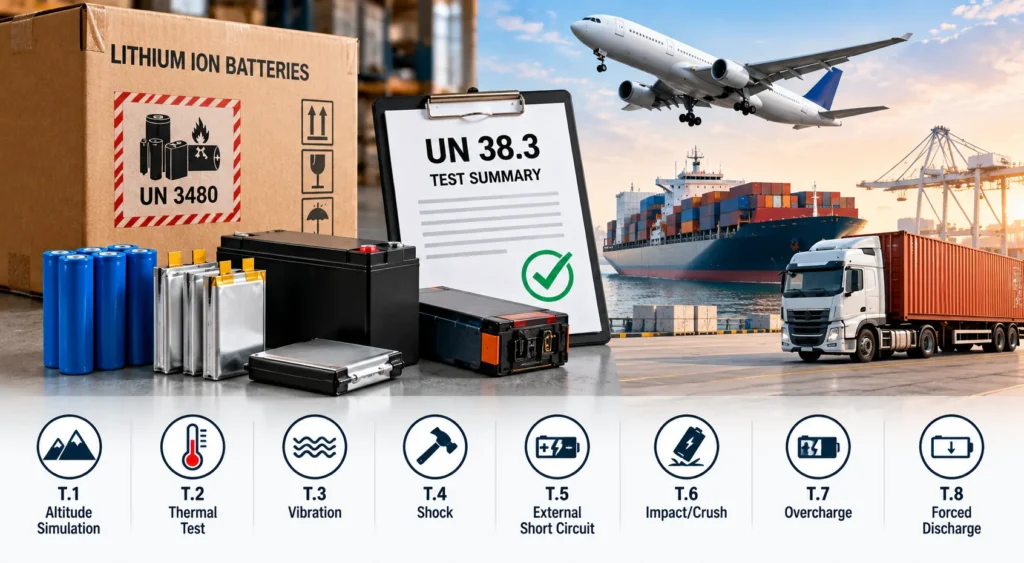
Lithium batteries are widely used in electronics, electric vehicles, energy storage systems, medical equipment, and industrial products. But transporting them safely requires more than simply packaging the battery correctly.
UN 38.3 is the key testing framework used to determine whether a lithium cell or battery type can withstand conditions that may occur during transportation. It forms part of Part III, subsection 38.3 of the UN Manual of Tests and Criteria. The current UN framework is Revision 8 with Amendment 1 (2025).
For battery manufacturers, exporters, importers, OEMs, and distributors, understanding UN 38.3 is essential for preparing batteries for compliant transportation.
What Is UN 38.3?
UN 38.3 is a set of tests for lithium cells and batteries designed to evaluate their ability to withstand transportation-related conditions.
The tests examine how a battery responds to factors such as changes in air pressure, temperature cycling, vibration, shock, external short circuits, and certain electrical or mechanical abuse conditions.
UN 38.3 is part of the UN Manual of Tests and Criteria, rather than a standalone battery certification scheme. Passing the applicable tests demonstrates that the tested cell or battery type has met the relevant requirements of subsection 38.3.
UN 38.3 testing is an important part of lithium battery transport compliance, but it does not replace separate requirements for classification, packaging, marking, labelling, and shipping documentation.
Why Is UN 38.3 Important for Battery Transportation?
Lithium batteries contain stored energy and can create transportation hazards if they are damaged, short-circuited, overheated, or otherwise compromised.
UN 38.3 testing subjects battery types to controlled conditions intended to represent stresses that may occur during transportation. This provides evidence that the tested design can withstand the specified conditions without creating unacceptable safety problems.
For businesses, UN 38.3 compliance is important because:
- Battery products may need to meet applicable transport requirements before shipment.
- Customers and logistics providers may request evidence of compliance.
- Manufacturers and distributors must make the required test summary available.
- Incorrect or incomplete transport compliance can lead to shipment delays or rejection.
- Additional requirements may apply depending on the transport mode, destination, carrier, and battery configuration.
What Tests Are Included in UN 38.3?
UN 38.3 includes a series of tests that assess different transportation-related stresses.
| Test | What it evaluates |
| T.1 – Altitude Simulation | Battery response to reduced air pressure |
| T.2 – Thermal Test | Performance through temperature changes |
| T.3 – Vibration | Resistance to vibration during transportation |
| T.4 – Shock | Resistance to mechanical shock |
| T.5 – External Short Circuit | Response to an external short-circuit condition |
| T.6 – Impact/Crush | Mechanical resistance of applicable cells |
| T.7 – Overcharge | Response of applicable rechargeable batteries to overcharging |
| T.8 – Forced Discharge | Response of applicable cells to forced discharge |
The exact testing requirements depend on the type and configuration of the lithium cell or battery. Therefore, businesses should not assume that every battery undergoes every test under identical conditions.
The UN Manual is the authoritative reference for the applicable test procedures and criteria. Its latest published framework is Rev.8/Amend.1, issued in 2025.
Which Batteries Require UN 38.3 Testing?
UN 38.3 applies to relevant lithium cells and batteries covered by the applicable transport provisions.
This can include:
- Lithium-ion cells and batteries
- Lithium-metal cells and batteries
- Cells shipped separately
- Batteries shipped separately
- Batteries packed with equipment
- Batteries contained in equipment
The important point for manufacturers is that testing applies to a particular cell or battery type. A battery should not automatically be treated as compliant simply because another battery from the same manufacturer has passed UN 38.3.
Design changes can also affect whether a product remains the same tested type. The UN requirements address changes that may materially affect test results, including specified changes involving the cathode, anode, or electrolyte.
What Is a UN 38.3 Test Summary?
A UN 38.3 Test Summary is the document that provides information demonstrating that the applicable cell or battery type has successfully met the relevant UN 38.3 testing requirements.
It is important to distinguish a test summary from the underlying laboratory test report. The test summary contains specified information about the manufacturer, product or battery type, testing, and applicable results.
Manufacturers and subsequent distributors are required to make the applicable test summary available under the relevant transport requirements. IATA’s current lithium-battery guidance also provides examples of UN 38.3 test summaries.
For B2B buyers, requesting the relevant test summary from the battery manufacturer or distributor is therefore an important part of supplier and shipping due diligence.
Does UN 38.3 Testing Mean a Battery Is Ready to Ship?
No. Passing UN 38.3 does not, by itself, mean that a battery can be shipped without meeting other transport requirements.
UN 38.3 focuses on the testing of the battery or cell type. Actual shipment can involve additional requirements covering:
- Dangerous-goods classification
- Correct UN number
- Packaging
- Marks and labels
- Shipping documentation
- State-of-charge requirements where applicable
- Mode-specific regulations
- Carrier or airline restrictions
- Country or state variations
For example, IATA’s dangerous-goods rules place responsibility for correct classification on the shipper, while airlines and states can impose additional restrictions or variations.
Therefore, a manufacturer may have a valid UN 38.3 test summary and still need to meet additional requirements before a particular shipment is accepted.
What Should Battery Manufacturers Check Before Shipping?
A practical UN 38.3 compliance workflow should include:
- Identify the exact cell or battery type.
- Determine which UN 38.3 tests apply.
- Complete the required testing using the applicable UN requirements.
- Maintain the relevant test documentation and test summary.
- Check whether product or design changes affect the tested type.
- Determine the applicable transport classification and UN number.
- Verify packaging, marking, labelling, and documentation requirements.
- Check additional requirements for the selected transport mode and carrier.
This approach helps manufacturers and exporters treat transportation compliance as part of product and supply-chain management, not a last-minute shipping step.
What Happens If a Battery Design Changes?
A significant design change should not automatically be assumed to fall under an existing UN 38.3 test result.
The UN testing framework contains provisions for determining when a modified cell or battery should be treated as a new type. Changes to materials or construction that can materially affect test results may trigger the need for the applicable tests to be performed again.
For OEMs and battery manufacturers, this makes change control important. Review changes to cell chemistry, components, configuration, or other characteristics for their potential effect on the existing UN 38.3 test status.
UN 38.3 Compliance Checklist
Before shipping lithium batteries internationally, businesses should verify:
- The exact battery type has undergone the applicable UN 38.3 testing.
- The relevant test summary is available.
- Product changes have been assessed.
- The correct dangerous-goods classification has been established.
- Packaging requirements have been confirmed.
- Required marks and labels are applied.
- Shipping documentation is complete.
- The requirements of the selected transport mode and carrier have been checked.
Conclusion
UN 38.3 is a fundamental transportation-safety requirement for lithium cells and batteries. Its tests are designed to evaluate whether a particular battery type can withstand specified stresses associated with transportation.
For manufacturers, exporters, OEMs, and distributors, compliance should go beyond simply obtaining a test report. The business should maintain the appropriate UN 38.3 Test Summary, control product changes, and separately verify the classification, packaging, marking, labelling, documentation, and mode-specific requirements applicable to each shipment.
Following this structured approach helps businesses support safer battery transportation while reducing avoidable compliance and logistics risks.
FAQs
Applicable lithium cells and batteries must meet the relevant UN 38.3 testing requirements before transportation where required by the applicable dangerous-goods provisions. The exact requirements depend on the battery and shipment.
Not in the usual sense. UN 38.3 is a testing requirement within the UN Manual of Tests and Criteria. A test report or test summary provides evidence that the applicable tests have been completed successfully.
The framework evaluates battery response to transportation-related stresses including altitude simulation, temperature cycling, vibration, shock, external short circuit, and applicable impact/crush, overcharge, and forced-discharge conditions.
It is a standardized summary containing information demonstrating that the applicable cell or battery type has met the relevant UN 38.3 testing requirements. Manufacturers and subsequent distributors must make the required summary available under applicable transport rules.
No. UN 38.3 primarily concerns testing the cell or battery type. Packaging, marking, labelling, classification, and shipping documentation are separate aspects of dangerous-goods transport compliance.
Not every change automatically requires complete retesting. However, changes that create a new battery type or could materially affect test results may require the applicable UN 38.3 tests to be performed again.