

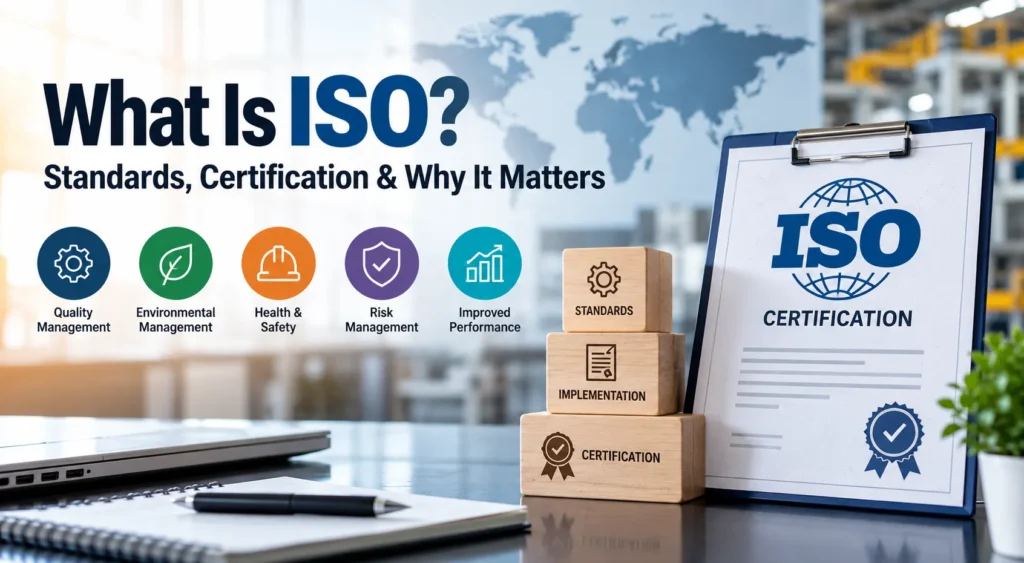
ISO, or the International Organization for Standardization, develops international standards that help organizations establish consistent processes, manage risks, improve performance, and meet defined requirements.
ISO standards are used across manufacturing, engineering, healthcare, technology, food, construction, energy, and many other sectors. For businesses, understanding the difference between an ISO standard, implementation, certification, and accreditation is important because these terms describe different parts of the conformity-assessment process.
For manufacturers, including businesses in the battery industry, ISO standards can provide structured frameworks for quality, environmental management, workplace safety, and energy management.
What Is ISO?
ISO is an independent international organization that develops and publishes international standards through consensus among experts from its member countries.
An ISO standard may provide requirements, specifications, guidelines, or principles for a product, service, process, or management system.
In simple terms, ISO develops internationally agreed standards that help organizations work in a consistent, controlled, and systematic way.
ISO standards cover areas such as:
- Quality management
- Environmental management
- Occupational health and safety
- Information security
- Food safety
- Energy management
What Is an ISO Standard?
An ISO standard is a documented set of requirements, specifications, guidelines, or principles for a defined subject.
Businesses can use standards to establish processes, assign responsibilities, monitor performance, manage risks, and improve operations.
However, not every ISO standard is a certification standard.
For example, ISO 9000 provides quality-management fundamentals and vocabulary, while ISO 9001 specifies requirements for a quality management system and is the certifiable standard in the ISO 9000 family.
What Is ISO Certification?
ISO certification is an independent assessment of whether an organization’s specified management system conforms to the requirements of a particular ISO standard.
For example, an organization can implement ISO 9001 and have its quality management system audited by an independent certification body. If the applicable requirements are met, the certification body can issue a certificate.
Does ISO Issue Certificates?
No. ISO does not perform certification or issue ISO certificates.
ISO develops and publishes standards. Independent certification bodies conduct audits and issue certificates when an organization demonstrates conformity with the applicable standard.
Therefore, saying a company is “ISO certified by ISO” is inaccurate. More precise wording identifies the standard and certification body.
ISO Standard vs. ISO Certification
An ISO standard and ISO certification are related but different.
| ISO Standard | ISO Certification |
| Defines requirements, specifications, or guidance | Provides independent confirmation of conformity |
| Developed and published by ISO | Conducted by an independent certification body |
| Can be implemented without certification | Requires an external conformity assessment |
| Provides a framework for a process or management system | Provides documented evidence that the requirements were assessed |
Implementing an ISO standard does not automatically make an organization ISO certified.
What Does an ISO Certificate Prove?
An ISO certificate shows that a certification body has assessed an organization’s specified management system against the requirements of the stated standard and within the stated scope.
It does not automatically mean that:
- Every product made by the company is ISO certified
- Every business activity is covered
- ISO has approved the company
- The organization is certified to every ISO standard
- Activities outside the certification scope are covered
For B2B procurement, buyers should therefore review the standard, certification scope, certification body, validity, and applicable accreditation when evaluating an ISO certificate.
Common ISO Standards for Businesses
Different ISO standards address different organizational needs.
| ISO Standard | Main Focus | Typical Relevance |
| ISO 9001:2026 | Quality management | Manufacturing, suppliers, and service organizations |
| ISO 14001:2026 | Environmental management | Organizations managing environmental impacts |
| ISO 45001:2018 | Occupational health and safety | Organizations managing workplace risks |
| ISO/IEC 27001 | Information security | Organizations managing information-security risks |
| ISO 22000 | Food safety | Organizations across the food chain |
| ISO 50001:2018 | Energy management | Organizations seeking systematic energy management |
The appropriate standard depends on an organization’s activities, risks, customer requirements, contractual obligations, and business objectives.
What Is ISO 9001:2026?
ISO 9001:2026 is the current edition of ISO’s quality management system standard. It was published on 16 September 2026, replacing ISO 9001:2015.
ISO 9001:2026 specifies requirements for establishing, implementing, maintaining, and continually improving a quality management system. ISO states that the standard is applicable to organizations of different sizes and sectors.
Certification to ISO 9001 is possible, but certification itself is not mandatory under the standard.
How Does ISO Certification Work?
The certification process generally involves these steps:
- Identify the applicable standard: Determine which ISO standard matches the organization’s activities and requirements.
- Implement the requirements: Establish relevant processes, controls, responsibilities, documentation, and monitoring.
- Conduct internal audits: Check whether the management system is implemented and operating as intended.
- Undergo an external audit: An independent certification body assesses conformity with the selected standard.
- Address nonconformities: Correct any identified nonconformities through the certification process.
- Receive certification: The certification body issues the certificate when applicable requirements have been met.
- Maintain the system: Continue monitoring, auditing, reviewing, and improving the management system.
The exact certification arrangements depend on the applicable standard and conformity-assessment process.
Why Does ISO Certification Matter to Businesses?
ISO certification can be relevant when customers, contracts, tenders, or supply-chain requirements ask for evidence of a defined management system.
Its practical value can include:
- Process consistency: Establishes defined processes and controls.
- Supplier qualification: May form part of B2B supplier evaluation.
- Customer confidence: Provides independent evidence that a specified management system has been assessed.
- Risk management: Creates structured processes for identifying and addressing relevant risks.
- Continual improvement: Uses audits, monitoring, corrective actions, and reviews to improve the management system.
- International business: Provides a commonly recognized framework that can support customer and supply-chain requirements.
However, ISO certification does not automatically guarantee product quality, regulatory compliance, product safety, or market access. Its relevance depends on the specific standard, certification scope, industry, and requirements of the customer or market.
Why Is ISO Important in the Battery Industry?
The battery industry involves complex manufacturing processes, controlled materials, testing, quality requirements, environmental considerations, and increasingly interconnected supply chains.
In this environment, management-system standards can help organizations establish consistent processes and controls across their operations.
For example, ISO standards can support battery businesses in the following areas:
1. Quality Management
ISO 9001 provides a framework for managing quality processes. For battery manufacturers and suppliers, this can support controlled production processes, monitoring, corrective actions, customer requirements, and continual improvement.
This is particularly relevant where battery products or components must be manufactured consistently across production batches.
2. Environmental Management
Battery manufacturing involves environmental considerations related to materials, energy use, emissions, waste, and resource management.
ISO 14001 provides a framework for establishing and continually improving an environmental management system.
It can therefore be relevant to battery manufacturers seeking a systematic approach to managing their environmental responsibilities.
3. Occupational Health and Safety
Battery manufacturing facilities may involve industrial equipment, chemicals, electrical systems, thermal processes, and other workplace hazards.
ISO 45001 provides requirements for an occupational health and safety management system and a framework for managing workplace risks.
4. Energy Management
Battery production can involve energy-intensive manufacturing and processing operations.
ISO 50001 provides a framework for organizations to establish, implement, maintain, and improve an energy management system. It can be relevant where systematic energy performance management is part of an organization’s objectives.
5. B2B Supplier Requirements
For battery manufacturers, component suppliers, and other businesses in the battery supply chain, ISO certification may also become part of customer qualification, supplier evaluation, tenders, or contractual requirements.
Buyers can use the certificate and its scope as one part of evaluating a supplier’s management-system controls. It should not, however, be treated as proof that every product or component supplied by the company meets a particular technical specification.
Which ISO Standards Are Relevant to Battery Businesses?
There is no single ISO standard that every battery company must obtain.
The relevant standards depend on the organization’s activities and requirements.
For example:
- ISO 9001: Quality management
- ISO 14001: Environmental management
- ISO 45001: Occupational health and safety
- ISO 50001: Energy management
- ISO/IEC 17025: Competence of testing and calibration laboratories, where applicable
A battery manufacturer may use one or several of these standards depending on its operations, customer requirements, risks, and business objectives.
Is ISO Certification Mandatory?
ISO certification is not universally mandatory.
Whether certification is required depends on applicable laws, regulations, customer requirements, contracts, tenders, industry expectations, supplier qualification criteria, or target-market requirements.
This distinction is particularly important in the battery industry because ISO certification and product-specific regulatory or technical requirements are not the same thing. A company may need to meet separate product, safety, transport, environmental, or market-access requirements in addition to any management-system certification.
ISO Certification vs. Accreditation
Certification assesses whether an organization’s management system conforms to a specified standard.
Accreditation assesses the competence of a conformity-assessment body, such as a certification body.
The relationship can be summarized as:
Organization → Certification body → Certification
Certification body → Accreditation body → Accreditation
When an ISO certificate is important for B2B procurement or international supply, buyers may therefore check whether the certification body has appropriate accreditation and whether the accreditation covers the relevant certification activity.
How Should a Business Choose an ISO Certification Body?
Businesses seeking certification should consider:
- Whether the certification body is appropriately accredited
- Its competence and experience with the relevant industry
- The scope of its certification activities
- Customer or market recognition
- Applicable conformity-assessment requirements
For battery manufacturers, it is also important to ensure that the certification scope accurately covers the relevant activities and sites.
Conclusion
ISO develops international standards that provide structured requirements, specifications, or guidance for organizations across industries. ISO certification is a separate conformity-assessment process conducted by independent certification bodies.
For battery businesses, ISO standards can provide useful management frameworks for quality, environmental management, workplace safety, energy management, and supplier requirements. The appropriate standard depends on the organization’s activities and objectives.
ISO certification should also be viewed as one part of a broader quality, compliance, and supply-chain framework, rather than as a guarantee that a battery or battery component meets every technical or regulatory requirement.
FAQs
ISO refers to the International Organization for Standardization, which develops and publishes international standards.
An ISO standard is an internationally agreed set of requirements, specifications, guidelines, or principles for a defined product, service, process, or management system.
No. ISO develops and publishes standards. Independent certification bodies conduct certification audits and issue certificates.
Yes. ISO 9001 provides a quality management framework that can help battery manufacturers establish consistent processes, monitor performance, manage nonconformities, and continually improve their quality management system.
Depending on their activities, battery businesses may consider ISO 9001 for quality, ISO 14001 for environmental management, ISO 45001 for occupational health and safety, and ISO 50001 for energy management.
Not universally. Whether certification is required depends on applicable regulations, customer requirements, contracts, tenders, supplier qualification criteria, and target-market requirements.