

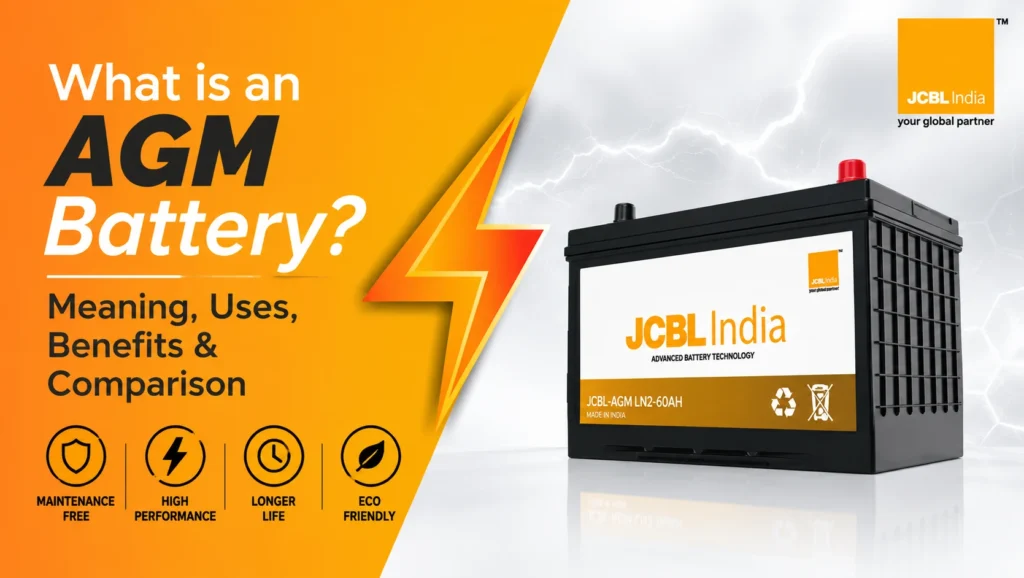
An AGM battery (Absorbent Glass Mat battery) is a sealed lead-acid battery in which the electrolyte is absorbed in fiberglass mats, making it spill-proof, maintenance-free, and highly resistant to vibration. It is widely used in modern vehicles and backup power systems for reliable performance.
In simple terms, an AGM battery is a safer and more advanced version of a traditional lead-acid battery that requires no maintenance.
- Sealed and spill-proof design
- Maintenance-free operation
- High vibration resistance
- Faster charging capability
- Suitable for modern vehicles and power systems
AGM batteries are widely used in modern vehicles and industrial systems because they offer reliable performance, low maintenance, and improved durability. Unlike traditional flooded batteries, AGM batteries do not require water top-ups and provide better resistance to leakage and vibration.
AGM Battery Construction and Design
An AGM battery is a type of sealed lead-acid battery designed to improve safety and reduce maintenance compared to conventional batteries. This technology was introduced to overcome issues such as electrolyte leakage and frequent maintenance in traditional flooded batteries.
Inside an AGM battery, the electrolyte is absorbed into thin fiberglass mats (AGM separators) placed between the positive and negative plates. This design keeps the electrolyte fixed in place and prevents any free movement of liquid inside the battery.
Because of this construction:
- The battery is completely spill-proof
- It can operate safely even at slight angles
- It offers higher mechanical strength
- It has excellent vibration resistance
AGM batteries fall under Valve Regulated Lead Acid (VRLA) batteries, meaning they are sealed and designed to recombine gases internally, preventing gas release under normal conditions.
How Does an AGM Battery Work?
AGM batteries operate using an absorbed electrolyte system instead of free-flowing liquid. The electrolyte is held within fiberglass mats, ensuring even distribution across the battery plates.
This results in:
- No leakage or spillage
- Reduced internal corrosion
- Better resistance to shocks and vibrations
Since AGM batteries are sealed, there is no evaporation of water, eliminating the need for regular maintenance. However, they are sensitive to charging voltage, so proper charging is essential to maintain battery life.e highly charging-sensitive; therefore, the charging voltage matters if the battery life is to be extended.
AGM vs Standard (Flooded) Battery
AGM batteries are often compared with traditional flooded lead-acid batteries. Below is a high-level comparison to understand the basic differences:
| Feature | AGM Battery | Standard (Flooded) Battery |
| Electrolyte | Absorbed in glass mat | Free-flowing liquid |
| Spill Risk | Spill-proof | Risk of leakage |
| Maintenance | Maintenance-free | Requires water top-ups |
| Vibration Resistance | High | Moderate |
| Charging Speed | Faster | Slower |
| Installation Flexibility | More flexible | Upright position preferred |
AGM batteries offer better durability, faster charging, and low maintenance compared to flooded batteries, making them ideal for modern applications.
For a detailed comparison, see our AGM vs standard battery comparison.
AGM vs Gel vs Lead-Acid vs Lithium
- Standard Lead-Acid (Flooded): Low cost but requires maintenance
- Gel Batteries: Good for deep discharge but sensitive to charging
- AGM Batteries: Balanced performance, safety, and durability
- Lithium Batteries: Lightweight and high performance but expensive
AGM batteries sit between traditional lead-acid and lithium batteries, offering a balance of cost, performance, and reliability.
Advantages and Disadvantages of AGM Batteries
AGM batteries are designed for performance, but they are not without limitations.
Advantages
- Maintenance-free operation
- Spill-proof and leak-resistant
- High vibration resistance
- Faster charging and better power output
- Longer lifespan than flooded batteries
Disadvantages
- Higher upfront cost
- Sensitive to overcharging
- Requires compatible chargers
- Heavier than lithium batteries
In a B2B setup, AGM batteries are preferred where reliability and less downtime are of greater value than the initial cost.
Common Applications of AGM Batteries
AGM batteries are used in various applications ranging from automotive to industrial uses as well as auxiliary power sources. These applications include:
- Start-stop vehicles
- SUVs and luxury cars
- Commercial vehicles
- Power backup systems
- Industrial and mobility applications where vibration resistance is essential
Their ability to deliver consistent power makes them suitable for modern electrical systems.
Do You Need an AGM Battery?
An AGM battery is not a universal battery that can be used in place of every other battery. The decision to use an AGM battery may depend on:
- Vehicle or System Electrical Requirements
- Compatibility and specification
- Usage patterns and operational conditions
Cars with start-stop technology or heavy accessory-carrying currents require batteries with high AGM technology. But it is always important to choose batteries based on technology rather than trends. For guidance on selection and purchase, see our AGM battery buying guide.
AGM Battery Charging & Maintenance Basics
Though AGM batteries are maintenance-free regarding water top-up, they require proper charging. Here are some of the important things to remember:
- Use Chargers that work with AGM batteries
- Try to avoid the tendency to overcharge the battery, which affects the
- Adhere to the recommended voltage ranges
Conclusion
AGM batteries constitute a drastic innovation for lead-acid batteries. Due to their closed structure, high-power density, simplicity, and lower maintenance requirements, these batteries can be effectively applied for usage in various applications involving autos.
For businesses in search of reliable batteries, JCBL India Batteries provides various types of batteries designed for the automobile industry as well as the industrial sector, taking into consideration their growing requirements. To deliver quality, they provide businesses with power solutions for their needs.
Frequently Asked Questions
An AGM battery is an absorbed glass mat battery, which is also known as the sealed lead-acid battery because the electrolyte is absorbed into the glass mat, making the battery spill-proof and maintenance-free.
Yes, the AGM battery is a part of the lead-acid battery series, but is a modern version.
AGM batteries have better durability, faster charging rates, and require lower maintenance costs compared to flooded batteries.
They can, but provided that AGM charging requirements are supported in the vehicle or system.
AGM Batteries are widely employed in start-stop applications, luxury cars, commercial vehicles, and auxiliary power applications.