

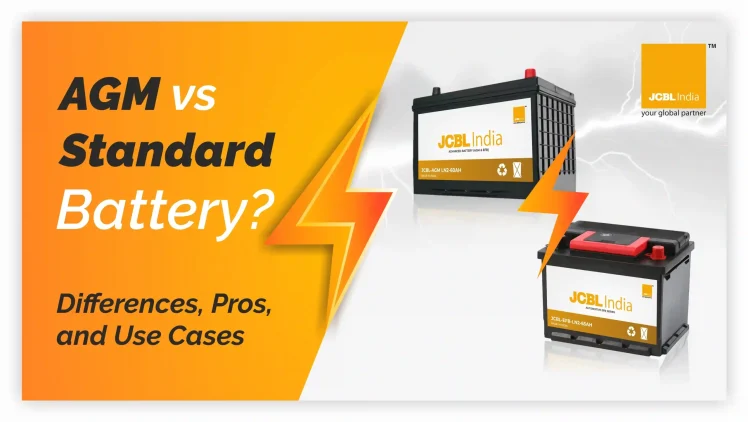
Choosing the appropriate battery for use in a car is a very important process for car owners, fleet managers, and OEM customers. With advancements in vehicle technology, AGM or conventional batteries have been a topic of growing importance, more so when it comes to cars with start-stop systems as well as electrically demanding applications.
Both types of batteries have the same basic application, which is the function of storing energy as well as the ability to start an engine. However, their internal workings, performances, and applications differ considerably. This guide will make the differences clear to help you make the best choice.
What Is a Standard (Flooded) Battery?
A standard battery, commonly known as a flooded lead-acid battery, is the most traditional form of automotive energy storage. It uses lead plates submerged in a liquid electrolyte composed of sulfuric acid and water. This liquid electrolyte freely moves within the battery casing.
Because of this design, acid movement can occur during vibration or tilting, which may impact long-term durability. Standard batteries also need some kind of maintenance, like checking the electrolyte level and proper ventilation for the escape of gas generated during the charging process.
Such batteries are mainly used in conventional vehicles and have lower electric loads. Because of their design and lower costs, they can be considered fit for the intended task. To gain some insight into differences in battery technology, a brief overview of the fundamentals of an AGM battery shall be considered in the comparative study.
What Is an AGM Battery?
The Absorbent Glass Mat, or AGM battery is an improved type of lead-acid battery, which has the electrolyte retained by absorbent glass mats positioned between the plates.
The absence of free-flowing electrolyte, as seen in traditional batteries, results in a spill-proof and shock-resistant AGM battery.
AGM batteries have the ability to supply high power, rapid recharge times, and deep discharging, making these batteries appropriate for the high electrical power needs of modern cars. To understand how AGM batteries are built and how they work, refer to our detailed AGM battery basics guide.
AGM vs Standard Battery – Comparison Table
| Feature | AGM Battery | Standard (Flooded) Battery |
| Charging | Faster, requires precise voltage | Slower, more tolerant |
| Maintenance | Completely maintenance-free | Requires periodic checks |
| Cost | Higher initial investment | Lower upfront cost |
| Lifespan | Longer operational life | Shorter service life |
| Start-stop Compatibility | Fully compatible | Not suitable |
Charging Differences Between AGM and Standard Batteries
Charging requirements are one of the major technical distinctions when comparing AGM vs. standard battery performance. The AGM batteries are voltage-sensitive and must be charged within a narrow voltage range. Incorrect charging—especially overcharging—can permanently damage the absorbed electrolyte mats and reduce service life.
Standard batteries are more forgiving but charge less efficiently and are prone to sulfation if left undercharged for extended periods.
Charging an AGM battery with a conventional charger can result in thermal overstress, loss of capacity, or early failure. Because of this, smart chargers featuring specific AGM charging profiles are highly recommended. Guidelines to the best practice are available on AGM Battery Charging.
Which Battery Is Better for Your Vehicle?
The choice between an AGM and a standard battery should be based on the type of vehicle, usage pattern, and electrical demand.
- Daily use vehicles with simple systems: A conventional flooded battery, on its part, provides adequate performance for those vehicles without start-stop technology or with fewer advanced electronics at a much lower cost.
- Stop-start and modern vehicles: AGM batteries are required on vehicles with start-stop systems, advanced infotainment, telematics, or safety electronics. These systems work under the principle of frequent engine restarts and stable power delivery, supported exactly by AGM technology.
With the start-stop vehicles, the selection of an AGM battery by the specification of the OEM will ensure the required reliability, efficiency, and conformance to modern automotive standards.
Conclusion: Making the Right Battery Choice
In fact, the comparison of AGM vs. standard battery has to do with application needs rather than just price consideration. For now, the standard batteries are practical for simple vehicles, while AGM batteries are necessary for modern high-demand automotive systems, especially in start-stop and commercial applications.
As vehicle technology continues to advance, the need to partner with a trusted and technically capable battery manufacturer becomes more significant. JCBL India brings in engineering expertise, stringent quality standards, and application-focused solutions to meet the emerging requirements of OEMs, fleet operators, and distributors spread across the country.
If you’re considering start-stop or commercial automotive battery solutions, get in touch with JCBL India to discuss solid, performance-oriented AGM battery solutions for long-term value and operational efficiency.
Frequently Asked Questions (FAQs)
The main difference between AGM and standard batteries lies in their internal construction. AGM batteries use absorbent glass mats to hold the electrolyte, making them sealed, spill-proof, and vibration-resistant. Standard batteries contain free-flowing liquid electrolyte, require ventilation, and are more susceptible to wear under high electrical loads.
Yes, AGM batteries can replace standard flooded batteries if the vehicle and charging system support AGM technology. AGM batteries are often used as upgrades due to their higher durability, faster recharge capability, and longer service life. However, replacing a standard battery with AGM may require recalibration of the vehicle’s battery management system (BMS) in modern cars.
No, AGM and standard batteries should not use the same charger. AGM batteries require a precise, controlled charging voltage and are best charged using smart chargers with AGM-specific modes. Using a conventional charger designed for flooded batteries can lead to overcharging, heat buildup, and reduced AGM battery lifespan.
AGM batteries are worth the extra cost for vehicles with start-stop systems, high electrical demand, or frequent short trips. Their longer lifespan, improved charge acceptance, and reduced risk of failure often result in a lower total cost of ownership compared to standard batteries in demanding applications.
AGM batteries are the better choice for start-stop vehicles. These systems require batteries that can handle frequent engine restarts, rapid energy recovery, and stable power delivery. Standard flooded batteries are not designed for such repeated cycling and can fail prematurely in start-stop applications.