

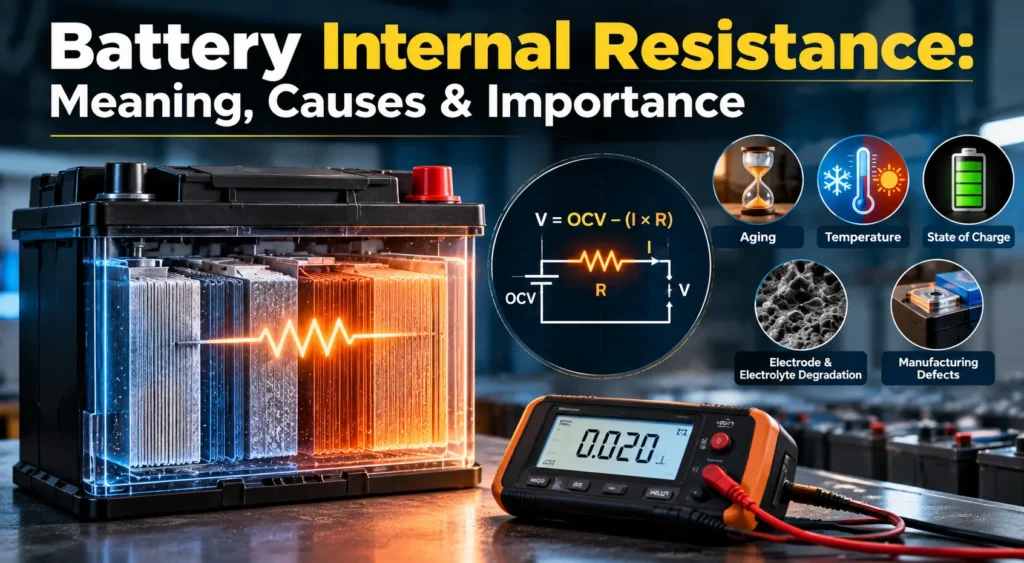
Battery internal resistance is the opposition to current flow within a battery. It affects terminal voltage, power delivery, energy efficiency, and heat generation during operation. Higher internal resistance can cause a greater voltage drop under load, making it harder for a battery to meet high-current demands.
For battery manufacturers, engineers, and quality control teams, understanding internal resistance is important for evaluating cell performance, identifying abnormal readings, and monitoring battery degradation.
What Is Battery Internal Resistance?
Battery internal resistance is the effective resistance within a cell arising from its materials, electrical contacts, and electrochemical processes. It is measured in ohms (Ω) or milliohms (mΩ).
Unlike external resistance, which comes from cables, connectors, and connected equipment, internal resistance originates within the battery. It reflects contributions from electronic conduction, ion transport through the electrolyte, and electrochemical reactions at the electrodes.
For comparable batteries operating under the same conditions, lower internal resistance generally means less voltage drop and lower resistive losses at a given current.
How Does Battery Internal Resistance Work?
When a battery supplies current, its terminal voltage differs from its open-circuit voltage because of internal voltage losses.
A simplified model describes this relationship as:
V = OCV − (I × R)
Where:
- V = terminal voltage under load
- OCV = open-circuit voltage
- I = discharge current
- R = effective internal resistance
Example: A battery with an effective internal resistance of 20 mΩ (0.02 Ω) supplies a current of 10 A.
Voltage drop = Current × Resistance
Voltage drop = 10 × 0.02 = 0.2 V
The terminal voltage is therefore approximately 0.2 V below the open-circuit voltage under the simplified model.
Internal resistance also contributes to heat generation. The resistive power loss can be estimated using:
P = I²R
This relationship shows why high current and high resistance can increase internal heating. Actual battery behavior also depends on electrochemical polarization and operating conditions.
What Causes Battery Internal Resistance to Increase?
Battery internal resistance varies with operating conditions, battery design, and age. The main factors include:
1. Battery Aging
Repeated charge and discharge cycles can change electrode materials and the interfaces between electrodes and electrolyte. These changes may impede electrochemical reactions, increasing resistance over time.
2. Temperature
Low temperatures generally increase internal resistance in many battery chemistries because ion transport and electrochemical reactions become slower. High temperatures may reduce measured resistance under some conditions but can accelerate long-term degradation.
3. State of charge
Internal resistance can change with the battery’s state of charge (SoC). The relationship depends on chemistry, cell design, temperature, and the measurement method. Resistance comparisons are therefore more meaningful when batteries are tested at similar charge levels.
4. Electrode and electrolyte degradation
Changes in electrode surfaces, electrolyte properties, and internal interfaces can hinder ion movement or charge transfer. These changes may increase resistance and reduce power performance.
5. Manufacturing defects or physical damage
Variations in materials, internal contacts, or cell construction can produce differences in resistance between cells. Physical damage or internal degradation may also cause abnormal readings that require further investigation.
Important distinction: Corroded terminals, loose connections, and damaged cables add resistance to the overall electrical path, but they do not necessarily indicate high internal resistance within the cell itself.
Why Is Battery Internal Resistance Important?
Internal resistance matters because it affects how efficiently and reliably a battery supplies electrical power.
- Power delivery: Higher resistance causes a larger voltage drop under load, potentially limiting the power available to connected equipment.
- Energy efficiency: Resistive losses convert some electrical energy into heat instead of delivering it to the load.
- Thermal performance: Increased internal heating can raise cooling requirements and contribute to degradation.
- Condition monitoring: A sustained increase in resistance may indicate aging or abnormal cell behavior when assessed alongside other measurements.
These effects are particularly relevant to electric vehicles, industrial equipment, backup power systems, and battery energy storage systems, where reliable power delivery is essential.
How Does High Internal Resistance Affect Battery Performance?
High internal resistance can reduce a battery’s ability to supply power, even when it retains usable capacity.
| Effect | Practical impact |
| Greater voltage drop | Terminal voltage may fall below equipment operating limits. |
| Increased heat generation | More energy is dissipated inside the battery. |
| Reduced power capability | The battery may struggle to meet peak-current demands. |
| Lower efficiency | More energy is lost as heat during current flow. |
| Rising resistance over time | May indicate degradation or an emerging cell abnormality. |
Internal resistance and capacity are different parameters. Capacity indicates how much charge a battery can deliver under specified conditions, while internal resistance helps describe its response to current. A battery can retain substantial capacity while experiencing reduced power performance.
How Is Battery Internal Resistance Measured?
Battery internal resistance is measured using DC or AC methods, while electrochemical impedance spectroscopy (EIS) provides a more detailed analysis of its frequency-dependent electrical behavior.
1. DC Internal Resistance (DCIR)
DCIR is estimated by applying a controlled current pulse and measuring the resulting voltage change.
Formula: R = ΔV ÷ ΔI
Here, ΔV is the voltage change, and ΔI is the current change. For example, a 0.1 V change at 5 A gives an estimated resistance of 20 mΩ (0.1 ÷ 5 = 0.02 Ω).
Results depend on test duration, temperature, state of charge, and measurement conditions.
2. AC Internal Resistance
AC testing applies a small alternating current at a specified frequency and measures the voltage response. The result reflects the battery’s impedance at that frequency and is not directly interchangeable with DCIR.
3. Electrochemical Impedance Spectroscopy (EIS)
EIS measures a battery’s electrical response across multiple frequencies, helping engineers investigate processes such as charge transfer and ion transport. It requires specialized equipment and expertise to interpret.
Testing considerations: Maintain consistent temperature and state of charge, use an appropriate measurement method, and follow manufacturer specifications. Relevant IEC 61960-series standards cover specified categories of secondary lithium cells and batteries. For coin-type lithium cells and batteries, see IEC 61960-4:2024.
What Is a Good Internal Resistance for a Battery?
There is no universal internal resistance value that defines a good battery. Acceptable values depend on battery chemistry, capacity, design, temperature, state of charge, and measurement method.
For example, 20 mΩ may be acceptable for one cell but unsuitable for another. Manufacturers and testing teams should compare readings against the relevant manufacturer’s specifications or an established baseline for the same battery model.
For lifecycle monitoring, a consistent increase in resistance may be more informative than a single reading. However, resistance alone cannot establish the battery’s complete state of health. Capacity, voltage behavior, temperature, and other relevant measurements should also be considered.
Why Is Internal Resistance Important in Battery Manufacturing?
Internal resistance testing supports several battery manufacturing and engineering activities.
- Cell quality control: Comparing readings across production batches helps identify cells that fall outside specified resistance limits.
- Cell matching and pack assembly: Resistance measurements help assess consistency when selecting cells for battery packs. Capacity, voltage, and other relevant parameters must also be evaluated.
- Performance validation: Controlled testing helps verify whether cells meet specified power-related requirements.
- Lifecycle assessment: Tracking resistance during cycling and ageing tests helps engineers evaluate changes in cell performance over time.
For battery manufacturers, OEMs, and energy storage developers, internal resistance is most useful as part of a broader quality assurance and validation process, rather than as a standalone measure of battery quality.
Conclusion
Battery internal resistance influences voltage delivery, power capability, energy efficiency, and heat generation. Measuring it helps engineers and manufacturers evaluate cell consistency, investigate performance issues, and monitor changes during battery aging.
For meaningful results, resistance measurements should be taken under controlled conditions and interpreted alongside capacity, voltage, temperature, and manufacturer specifications. This approach supports more reliable battery quality control, performance validation, and lifecycle assessment.
FAQs
A battery experiences a greater voltage drop and more resistive heating at the same current. Its ability to supply high power may decrease, while a sustained rise in resistance can indicate aging or abnormal cell behavior.
Not necessarily. The reading must be assessed against the battery’s specifications and test conditions. High resistance may indicate degradation, but capacity, voltage, temperature, and other diagnostic results are also needed to evaluate battery condition.
Resistance caused by internal aging or material degradation generally cannot be reversed through routine charging. However, correcting a poor external connection or testing under appropriate temperature conditions may improve the measured result. Follow the manufacturer’s guidance before attempting any intervention.
Internal resistance describes the resistive opposition to current flow. Impedance describes the broader opposition to alternating current and includes frequency-dependent effects. AC resistance measurements approximate impedance under specified test conditions.