

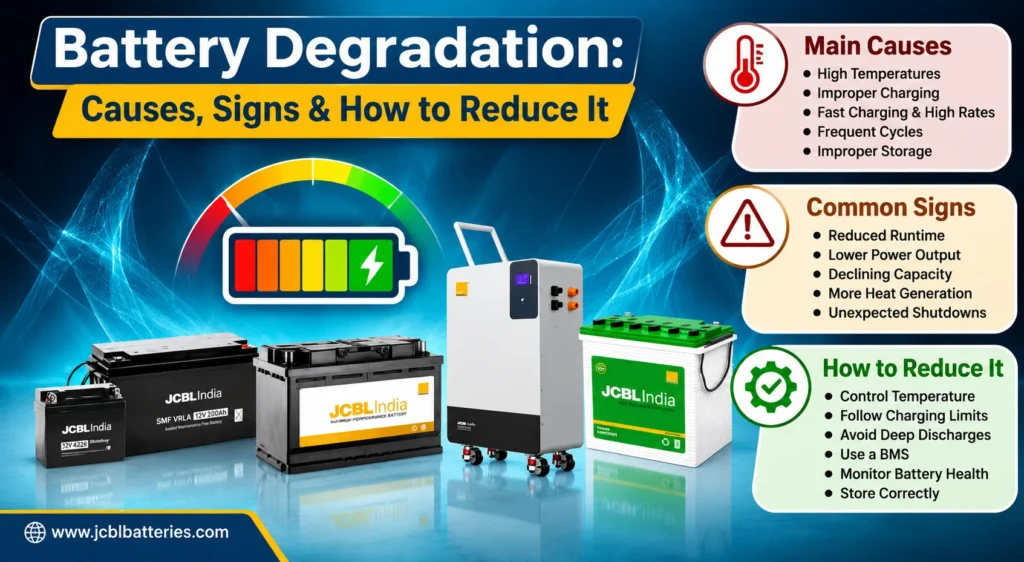
Battery degradation is the gradual loss of a battery’s usable capacity and power capability over time. It results from chemical and physical changes within battery cells, influenced by temperature, charging conditions, usage patterns, and storage. Although degradation cannot be eliminated, proper battery management and regular health monitoring can help slow deterioration, extend service life, and maintain reliable performance.
What Is Battery Degradation?
Battery degradation is the deterioration of a battery’s ability to store energy (its battery energy capacity) and deliver power compared with its original condition.
It typically involves two changes:
1. Capacity Loss
The battery stores less energy, reducing its runtime or backup duration.
2. Increased Internal Resistance
The battery experiences greater voltage drop under load, potentially reducing power output and increasing heat generation.
Battery degradation occurs through cycle aging, caused by charging and discharging, and calendar aging, which happens over time even when the battery is not in use.
What Causes Battery Degradation?
The main causes of battery degradation are temperature extremes, unsuitable charging conditions, repeated cycling, and improper storage. Their effects vary by battery chemistry and design.
1. High Operating Temperatures
Excessive heat accelerates unwanted chemical reactions inside battery cells, contributing to capacity loss and increased internal resistance. Inadequate thermal management can shorten battery life, particularly in electric vehicles, industrial equipment, and energy storage systems.
2. Improper Charging and Discharging
Repeated deep discharges and prolonged exposure to an unsuitable state of charge can accelerate aging in many battery types. For lithium-ion batteries, charging outside the recommended voltage limits can increase degradation. Follow the battery manufacturer’s specified operating range.
Learn more about the effects of battery over-discharging and its impact on battery performance and service life.
3. Fast Charging and High Discharge Rates
High charging currents can increase heat generation and electrochemical stress. Under certain conditions, fast charging can also cause lithium plating in lithium-ion batteries, contributing to capacity loss and potential safety risks. The impact depends on cell design, temperature, and charging rate.
NREL’s battery research discusses how fast charging, heat, and battery life relate.
4. Frequent Charge-Discharge Cycles
Repeated cycling gradually wears down battery materials. Deeper discharges can accelerate degradation in many chemistries, although the effect depends on the battery type and operating conditions. Battery cycle life should therefore be evaluated using the manufacturer’s specified test conditions rather than cycle count alone.
5. Improper Storage Conditions
Batteries continue to age during storage. High temperatures and unsuitable storage charge levels can accelerate deterioration. Follow chemistry-specific recommendations for storage temperature, state of charge, and periodic inspection.
What Are the Signs of Battery Degradation?
Common signs of battery degradation include:
1. Reduced Runtime
The battery requires more frequent charging or provides less backup time.
2. Lower Power Output
Equipment experiences voltage drops or reduced performance under load.
3. Declining Measured Capacity
Testing shows less usable energy than the original or reference value.
4. Increased Heat Generation
The battery becomes unusually warm under comparable operating conditions.
5. Unexpected Shutdowns
Equipment switches off under load despite a remaining charge indication.
These symptoms do not always confirm degradation. Faulty connections, charging equipment, temperature conditions, and control-system problems can produce similar effects. Swelling, leakage, or unusual overheating requires prompt attention and handling according to the manufacturer’s safety instructions.
How to Reduce Battery Degradation
You cannot eliminate battery aging, but the following measures can help slow it down:
1. Control Operating Temperature
Use suitable cooling, ventilation, or thermal management to keep the battery within its specified temperature range.
2. Follow Recommended Charging Limits
Use compatible chargers and manufacturer-approved charging profiles. Avoid unsuitable voltage levels and prolonged exposure to damaging states of charge.
3. Avoid Unnecessary Deep Discharges
Operate within the recommended state-of-charge range wherever practical.
4. Manage Charging and Discharge Rates
Keep current levels within specified limits, particularly under demanding operating conditions.
5. Use a Properly Configured Battery Management System
A BMS monitors parameters such as battery voltage, current, and temperature and can provide protective controls and cell balancing where supported.
6. Monitor Battery Health
Track battery capacity, internal resistance, temperature, and operating history to identify deterioration early.
7. Store Batteries Correctly
Follow manufacturer guidance on storage charge levels, temperature, and inspection intervals.
These practices help reduce avoidable stress; they do not reverse established battery degradation. Always follow battery chemistry-specific operating and maintenance recommendations.
How Does Battery Degradation Affect Industrial and Commercial Applications?
For businesses using electric vehicles, industrial equipment, backup power, or stationary energy storage, battery degradation can affect operating costs and system reliability.
| Battery Health Indicator | Potential Impact | Business Relevance |
| Declining usable capacity | Shorter runtime or backup duration | May require operational adjustments |
| Rising internal resistance | Greater voltage drop or heat under load | Can affect power delivery |
| Increasing temperature under comparable loads | Possible thermal or electrical issue | May require investigation |
| Declining performance over time | Reduced ability to meet operating requirements | Informs maintenance and replacement planning |
These indicators must be interpreted against a suitable baseline and the battery manufacturer’s specifications.
For battery manufacturers and OEMs, degradation management begins with selecting appropriate cell chemistry, designing effective thermal management, configuring operating limits, and validating performance under realistic duty cycles. For operators, health monitoring and maintenance records help inform replacement schedules, warranty assessments, and lifecycle cost planning.
How Can Battery Degradation Be Measured?
Battery degradation can be assessed through several complementary methods:
1. Capacity Testing
Battery capacity testing measures usable energy under defined test conditions and compares it with a suitable reference value.
2. Internal Resistance or Impedance Testing
Identifies changes that may affect power delivery and heat generation.
3. State of Health (SOH) Monitoring
Estimates battery condition relative to its original or reference performance.
4. Battery Management System Data
Helps track voltage, temperature, current, and operating history where these measurements are available.
No single measurement provides a complete assessment for every battery. Combining consistent performance tests with operating data gives a more reliable basis for maintenance and replacement decisions.
The National Renewable Energy Laboratory’s battery lifespan research discusses battery diagnostics, degradation prediction, and lifetime optimization.
Conclusion
Battery degradation gradually reduces usable capacity or power capability, affecting battery performance and service life. Appropriate thermal management, charging controls, correct storage, and regular health monitoring can help slow deterioration.
For businesses, these practices support reliable operation, informed maintenance planning, and better control of battery lifecycle costs.
Frequently Asked Questions (FAQs)
1. What causes battery degradation?
Battery degradation results from chemical and physical aging influenced by temperature, charging conditions, operating voltage, charge-discharge cycles, and storage. The dominant factors depend on battery chemistry and usage.
2. How can battery degradation be reduced?
Maintain recommended operating temperatures, follow approved charging limits, avoid unsuitable discharge and storage conditions, and monitor battery health regularly.
3. What are the early signs of battery degradation?
Reduced runtime, declining measured capacity, increased internal resistance, and lower power output can indicate degradation. Testing helps distinguish actual deterioration from other faults.
4. Does fast charging damage batteries?
Fast charging can accelerate degradation when it causes excessive heat or electrochemical stress. Its impact depends on battery design, chemistry, temperature, and whether the charging rate stays within specified limits.
5. How do you measure battery degradation?
Compare measured capacity, internal resistance or impedance, and state-of-health estimates against an appropriate baseline using consistent test conditions.
6. Can a battery management system prevent battery degradation?
A BMS can help slow avoidable degradation by controlling damaging operating conditions and balancing cells where supported. It cannot prevent all chemical aging or reverse existing damage.