

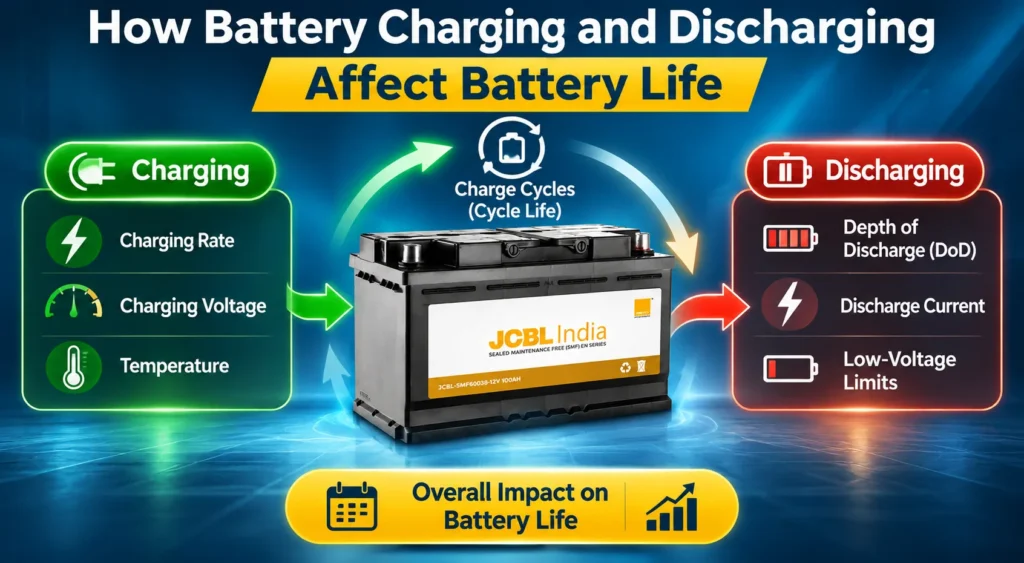
Battery charging and discharging are two essential processes that directly influence battery performance, efficiency, and overall lifespan. Every time a battery stores or releases electrical energy, chemical reactions take place inside its cells. Over time, these processes contribute to natural battery ageing.
Understanding how charging habits, discharge depth, operating temperature, and charging speed affect battery health can help businesses, equipment operators, and battery users improve service life and maintain reliable performance.
How Do Battery Charging and Discharging Work?
A battery stores electrical energy through electrochemical reactions and releases that energy when connected to an electrical load. Charging and discharging involve opposite chemical processes inside the battery cells.
Charging: During charging, an external power source supplies electrical energy to the battery. This energy drives chemical reactions that restore the battery’s stored energy.
Discharging: During discharging, the battery supplies electrical energy to connected equipment. Chemical energy stored inside the cells is converted into electrical energy.
These processes repeat throughout the battery’s operating life. However, factors such as excessive heat, incorrect charging voltage, high current, and deep discharging can accelerate battery degradation.
How Does Charging Affect Battery Life?
Charging conditions play an important role in determining how quickly a battery ages. Incorrect charging practices can increase internal stress, reduce capacity, and shorten the battery’s usable lifespan.
1. Charging Rate and Current
Charging rate refers to how quickly electrical energy is supplied to a battery. Excessively high charging current can generate additional heat and place stress on battery cells.
Using the charging current recommended by the battery manufacturer helps maintain efficient charging and supports longer battery life.
2. Charging Voltage
Every battery chemistry has a specified charging voltage range. Applying voltage above the recommended limit can cause overcharging, excessive heat, and chemical degradation.
A compatible charger and properly configured battery management system (BMS) help maintain safe charging conditions.
3. Charging Temperature
Temperature significantly influences battery charging performance. High temperatures can accelerate chemical ageing, while charging at very low temperatures can create additional risks for certain battery chemistries.
Maintaining the manufacturer’s recommended temperature range helps protect battery health and charging efficiency.
How Does Discharging Affect Battery Life?
Discharging is a normal part of battery operation, but the depth and speed of discharge can influence battery degradation. Repeatedly operating a battery under unsuitable discharge conditions may reduce its overall service life.
1. Depth of Discharge (DoD)
Depth of Discharge (DoD) represents the percentage of a battery’s capacity that has been used. For example, if a battery with a rated capacity of 100 Ah supplies 50 Ah, its DoD is 50%.
Repeated deep discharging generally reduces the number of charge cycles available from many battery types. Operating within the recommended DoD range can help extend battery life.
2. Deep Discharging
Deep discharging occurs when a battery is drained to a very low state of charge. Repeatedly discharging below the manufacturer’s recommended limit can increase internal stress and may cause permanent capacity loss.
Battery protection systems help prevent excessive discharge by disconnecting the load when the battery reaches its specified low-voltage threshold.
3. Discharge Rate
Discharge rate indicates how quickly a battery supplies electrical current to connected equipment. High discharge currents can increase internal heating and voltage drop.
Choosing a battery with suitable discharge-current ratings for the application helps maintain reliable operation and reduce unnecessary stress.
What Is the Relationship Between Charge Cycles and Battery Life?
A charge cycle represents the use of an amount of energy equivalent to 100% of a battery’s rated capacity. It does not necessarily mean that the battery must be charged from 0% to 100% in one session.
Example of a Battery Charge Cycle
Suppose a battery is discharged by 50% and then recharged. Later, it is discharged by another 50%. Together, these two discharge periods represent approximately one full equivalent cycle.
Battery cycle life refers to the number of charge-discharge cycles a battery can complete before its capacity falls to a specified level under defined testing conditions.
Battery cycle life varies depending on chemistry, operating temperature, charging conditions, discharge depth, and application requirements. You can also read our detailed guide on battery cycle life to understand how it is measured.
Factors That Affect Battery Lifespan
Several operating and environmental factors influence how long a battery can deliver reliable performance.
| Factor | Effect on Battery Life |
| Charging Current and Voltage | Incorrect charging parameters can accelerate battery degradation. |
| Depth of Discharge | Deeper discharge generally reduces the number of available charge cycles. |
| Operating Temperature | Excessive heat can accelerate battery ageing. |
| State of Charge During Storage | Prolonged storage at unsuitable charge levels can affect battery health. |
| Battery Chemistry | Different battery chemistries have different charging requirements and cycle-life characteristics. |
| Protection and Maintenance | Proper battery management and maintenance help support longer service life. |
How to Extend Battery Life Through Proper Charging and Discharging
Following suitable charging and discharging practices can help reduce unnecessary battery stress and maintain long-term performance.
- Use a compatible charger: Always use a charger designed for the battery’s chemistry, voltage, and capacity.
- Avoid excessive charging current: Follow the recommended charging current specified by the manufacturer.
- Prevent deep discharging: Avoid regularly draining the battery below its recommended discharge limit.
- Control operating temperature: Keep batteries within their recommended charging and operating temperature ranges.
- Use a battery management system: For compatible battery systems, a BMS helps monitor voltage, current, and temperature while providing protection against unsafe operating conditions.
- Follow proper storage practices: Store batteries under the recommended temperature and state-of-charge conditions.
- Monitor battery performance: Periodically check battery condition, voltage, and capacity to identify performance changes.
For industrial and commercial applications, follow the battery manufacturer’s charging profile, discharge limits, and maintenance recommendations. These specifications may differ depending on battery chemistry and system design.
Why Proper Charging and Discharging Matter in Industrial Applications
Industrial batteries are used in applications where consistent power delivery and operational reliability are important. These include backup power systems, telecommunications equipment, material handling equipment, renewable energy storage, and industrial machinery.
Improper charging or repeated deep discharging can lead to reduced battery capacity, increased maintenance requirements, and unexpected downtime. Following suitable operating practices helps businesses improve battery utilisation and manage replacement costs.
For example, batteries used in residential energy storage systems need to manage repeated charging and discharging cycles while maintaining reliable energy supply. Selecting the right battery technology and following its operating specifications are important for long-term performance.
Explore our range of lithium-ion battery solutions for different energy storage and power applications.
Conclusion
Battery charging and discharging have a direct influence on battery performance, capacity retention, and overall lifespan. Factors such as charging current, voltage, depth of discharge, temperature, and battery management practices determine how effectively a battery performs over time.
By following manufacturer-recommended charging and discharging limits, avoiding excessive heat, and using appropriate protection systems, businesses and battery users can support longer battery life and more reliable operation.
Frequently Asked Questions (FAQs)
1. Does charging and discharging reduce battery life?
Yes. Battery charging and discharging involve chemical reactions that contribute to gradual ageing. However, proper charging conditions, controlled discharge depth, and suitable operating temperatures help reduce degradation.
2. Does frequent charging damage a battery?
Frequent charging does not necessarily damage a battery. The impact depends on battery chemistry, charging voltage, current, and temperature. Using a compatible charger and following manufacturer recommendations helps maintain battery health.
3. Does deep discharging shorten battery life?
Repeated deep discharging can shorten the lifespan of many battery types. Operating within the recommended depth-of-discharge limits helps preserve battery capacity and cycle life.
4. Is slow charging better for battery health?
Charging at a suitable, manufacturer-recommended rate can help reduce heat generation and battery stress. However, the ideal charging speed depends on the battery chemistry and its specified charging limits.
5. How can businesses extend industrial battery life?
Businesses can extend industrial battery life by using compatible chargers, avoiding excessive charging and discharging, controlling operating temperatures, maintaining suitable storage conditions, and monitoring battery performance regularly.