

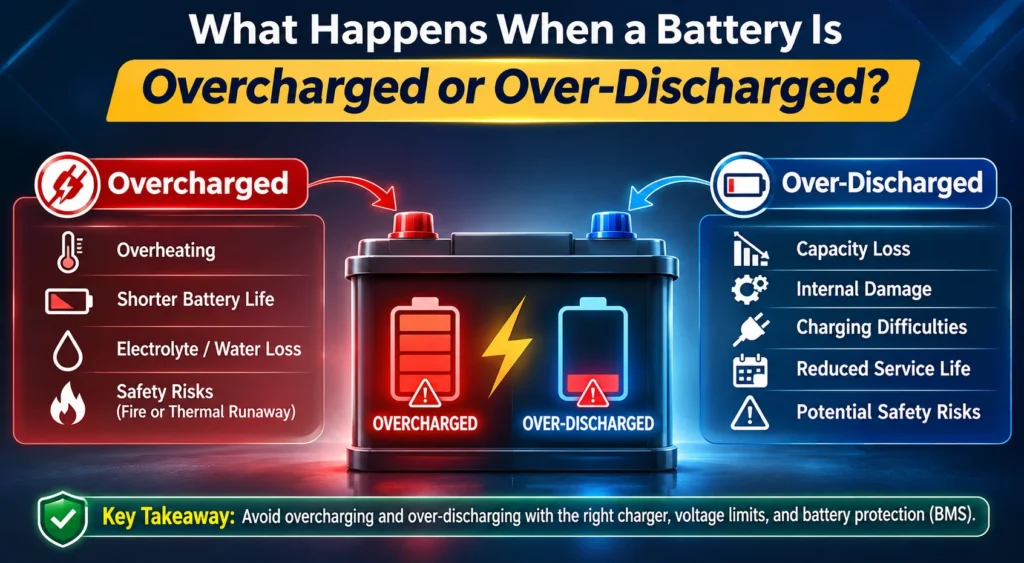
Battery overcharging and over-discharging can reduce battery life, damage internal components, and create safety risks. Both conditions occur when a battery operates outside its specified charging or discharging limits.
Overcharging happens when a battery receives more charging voltage or energy than recommended, while over-discharging occurs when its voltage falls below the manufacturer’s minimum discharge limit. Understanding these conditions can help businesses, battery users, and equipment operators protect battery performance and improve service life.
What Happens When a Battery Is Overcharged?
Battery overcharging occurs when a battery continues receiving electrical energy beyond its recommended charging voltage or charging limits. This can generate excessive heat, accelerate chemical degradation, and reduce the battery’s overall service life.
1. Battery Overheating
Excessive charging voltage or current can increase internal heat generation. If the temperature rises beyond the recommended operating range, battery components may deteriorate more quickly.
2. Reduced Battery Lifespan
Repeated overcharging can accelerate chemical ageing and reduce the battery’s ability to retain energy. Over time, this may lead to reduced capacity and shorter service life.
3. Electrolyte Loss
In flooded lead-acid batteries, excessive charging can increase gassing and water consumption. In sealed VRLA batteries, excessive heat and charging stress can contribute to electrolyte loss and drying.
4. Potential Safety Hazards
Severe overcharging can damage battery cells and create hazardous conditions. In lithium-ion batteries, overcharging can increase the risk of thermal runaway, fire, or cell rupture if protective systems fail.
Common Causes of Battery Overcharging
- Using an incompatible or incorrect battery charger.
- Incorrect charger voltage settings.
- Faulty charge controllers or charging circuits.
- Malfunctioning battery management systems (BMS).
- Excessive continuous or float charging voltage.
What Happens When a Battery Is Over-Discharged?
Battery over-discharging occurs when a battery continues supplying power after its voltage falls below the manufacturer’s specified minimum discharge limit. This condition can cause capacity loss, internal damage, and difficulty recharging the battery.
1. Permanent Capacity Loss
Repeatedly discharging a battery below its recommended voltage limit can reduce its ability to store energy. This may result in lower usable capacity and reduced operating time.
2. Internal Battery Damage
Excessive discharge can affect the internal electrochemical components of a battery. It may also increase internal resistance, reducing overall efficiency and performance.
3. Charging Difficulties
Some batteries, particularly lithium-ion batteries, may become difficult or unsafe to recharge after falling below their specified minimum voltage. Certain battery protection systems may prevent charging under these conditions.
4. Reduced Service Life
Repeated over-discharging can accelerate battery degradation and reduce the number of usable charge cycles. Prolonged storage in a deeply discharged condition can further increase the risk of damage.
Common Causes of Battery Over-Discharging
- Equipment continuing to draw power below the battery’s cutoff voltage.
- Excessive electrical loads.
- Prolonged storage without charge monitoring.
- Parasitic power consumption when equipment is switched off.
- Failed or incorrectly configured low-voltage protection.
Battery Overcharging vs. Over-Discharging: Key Differences
Both conditions can damage a battery, but they occur under different operating circumstances and require different preventive measures.
| Factor | Overcharging | Over-Discharging |
| Meaning | Charging beyond specified limits. | Discharging below the minimum voltage limit. |
| Common Cause | Incorrect charging voltage or failed charging controls. | Excessive discharge or continued power consumption. |
| Main Effects | Heat generation, chemical degradation, and potential safety hazards. | Capacity loss, internal damage, and charging difficulties. |
| Battery Impact | Reduced lifespan and possible cell damage. | Reduced capacity and fewer usable charge cycles. |
| Prevention | Compatible chargers and proper charge control. | Low-voltage cutoff and discharge monitoring. |
How Overcharging and Over-Discharging Affect Different Battery Types
The effects of overcharging and over-discharging vary depending on battery chemistry, construction, and protection systems.
1. Lithium-Ion Batteries
Overcharging: Charging a lithium-ion battery beyond its specified voltage limit can accelerate chemical degradation and increase internal temperature. Severe overcharging can create a risk of thermal runaway and fire.
Over-discharging: Discharging below the specified minimum voltage can damage internal battery materials and may make the battery unsafe or difficult to recharge.
A battery management system (BMS) monitors parameters such as voltage and temperature and helps control charging and discharging. Its protection effectiveness depends on the system’s design and condition.
2. Lead-Acid Batteries
Overcharging: Excessive charging can increase gassing and water loss in flooded lead-acid batteries. In VRLA batteries, excessive heat and charging stress can cause drying and reduced capacity.
Over-discharging: Deep discharge can make lead-acid batteries difficult to recharge and may cause internal damage. Prolonged storage in a discharged condition can lead to sulphation, reducing battery performance and service life.
How to Prevent Battery Overcharging and Over-Discharging
Following proper charging and discharging practices can help protect battery components, maintain performance, and reduce the risk of premature battery failure.
1. Use a Compatible Battery Charger
Always select a charger designed for the battery’s chemistry, voltage, and capacity. Incorrect chargers can cause improper charging conditions.
2. Maintain Correct Charging Voltage
Follow the manufacturer’s recommended charging voltage and current limits. Proper charging settings help prevent excessive heat and unnecessary battery stress.
3. Use a Battery Management System
For compatible battery systems, a BMS helps monitor voltage, current, and temperature. It can provide protection against unsafe charging and discharging conditions.
4. Install Low-Voltage Protection
Low-voltage disconnect systems help prevent batteries from continuing to discharge below their specified voltage limits.
5. Monitor Battery Voltage and Temperature
Regular monitoring helps identify abnormal operating conditions, excessive heat, and voltage changes before they cause serious battery problems.
6. Follow Proper Storage and Maintenance Practices
Store batteries under the manufacturer’s recommended temperature and charge conditions. Periodic inspection and maintenance can help identify potential problems.
Battery charging and discharging limits vary by chemistry, capacity, and design. Always follow the manufacturer’s specifications instead of applying the same voltage or charging settings to every battery type.
Why Battery Protection Matters in Industrial Applications
Industrial batteries are used in backup power systems, telecommunications equipment, renewable energy storage, material handling equipment, and other applications where reliable power delivery is essential.
Overcharging and over-discharging can reduce battery capacity, increase maintenance requirements, and cause unexpected equipment downtime. Proper battery selection, charging controls, and protection systems help businesses maintain reliable battery operation.
Explore our range of lithium-ion batteries and learn more about battery solutions for different industrial and energy storage applications.
Conclusion
Battery overcharging and over-discharging are two common operating conditions that can negatively affect battery performance, capacity, and service life. Overcharging can cause excessive heat and chemical degradation, while over-discharging can result in capacity loss, internal damage, and charging difficulties.
Using compatible chargers, maintaining recommended voltage limits, monitoring battery conditions, and installing suitable protection systems can help prevent these problems. Following manufacturer-recommended operating practices is essential for maintaining battery safety and long-term performance.
For reliable battery performance, choose suitable battery solutions from an experienced battery manufacturer and follow the recommended operating specifications.
Frequently Asked Questions (FAQs)
1. Can an overcharged battery be damaged permanently?
Yes. Severe or repeated overcharging can cause permanent battery damage, reduce capacity, and shorten service life. The extent of damage depends on battery chemistry and the severity of overcharging.
2. Can an over-discharged battery be recharged?
It depends on the battery type and how far its voltage has fallen below the recommended limit. Some batteries may recover, while others can suffer permanent damage or become unsafe to recharge.
3. Is battery overcharging dangerous?
Yes. Overcharging can cause excessive heat, electrolyte loss, and internal damage. In severe cases, certain battery types, particularly lithium-ion batteries, may face thermal runaway and fire risks.
4. Does over-discharging reduce battery life?
Yes. Repeated over-discharging can cause capacity loss, internal damage, and reduced cycle life. Operating within the manufacturer’s recommended discharge limits helps protect battery health.
5. Can a battery management system prevent overcharging and over-discharging?
A properly designed and functioning BMS can help protect compatible batteries by monitoring voltage, current, and temperature. However, its effectiveness depends on the system design, configuration, and condition.
6. How can you tell if a battery has been overcharged or over-discharged?
Possible signs include unusual heating, swelling, leakage, reduced capacity, abnormal voltage readings, or difficulty recharging. These signs can vary by battery chemistry. A qualified inspection may be needed to confirm the cause.