

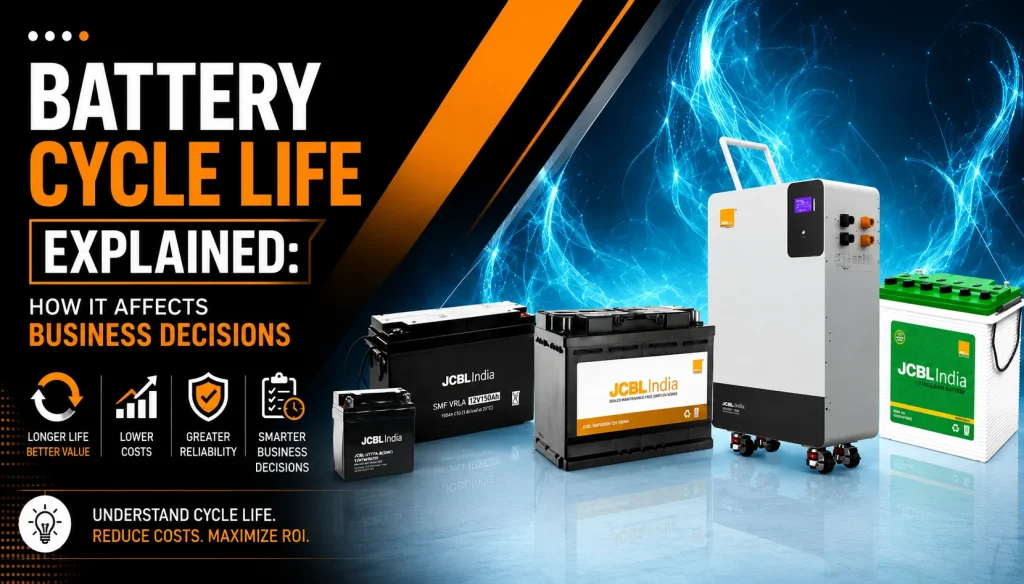
When evaluating batteries for energy storage systems, backup power infrastructure, electric vehicle fleets, or industrial equipment, many businesses focus on upfront purchase costs. While price is important, it does not provide a complete picture of a battery’s long-term value.
Battery cycle life is one of the most important metrics for assessing operational costs, replacement planning, system reliability, and return on investment (ROI). A battery that lasts longer often delivers lower lifecycle costs, even if its initial purchase price is higher.
This guide explains battery cycle life, how it is measured, and why it should play a central role in business purchasing decisions.
What Is Battery Cycle Life?
Battery cycle life is the number of complete charge and discharge cycles a battery can perform before its capacity falls to a specified level, typically 80% of its original capacity.
In practical terms, cycle life indicates how many times a battery can be used and recharged before its performance declines significantly.
For example, if a battery is rated for 4,000 cycles, it can typically complete around 4,000 charge-discharge cycles before reaching its end-of-life performance threshold.
Why is battery cycle life important?
Battery cycle life directly affects replacement frequency, operating costs, equipment uptime, and total cost of ownership. Batteries with longer cycle life generally require fewer replacements, helping businesses reduce long-term expenses and improve ROI.
How Battery Cycle Life Is Measured
Manufacturers determine cycle life through repeated charge and discharge testing under controlled conditions. Testing continues until the battery reaches a predefined capacity retention level, most commonly 80%.
The final cycle-life rating is influenced by several operating factors.
Depth of Discharge (DoD)
Depth of Discharge refers to how much of a battery’s stored energy is used during each cycle.
| Depth of Discharge | Impact on Cycle Life |
| 100% DoD | Shorter cycle life |
| 80% DoD | Moderate cycle life |
| 50% DoD | Longer cycle life |
In general, shallower discharge cycles place less stress on battery cells and support longer operational life.
Temperature Conditions
Battery performance is highly sensitive to temperature. Excessive heat can accelerate degradation, while extremely cold conditions may temporarily reduce efficiency and available capacity.
Charging Practices
Charging speed, voltage management, and battery management systems (BMS) can all influence long-term battery health and cycle-life performance.
Battery Cycle Life vs Battery Lifespan
Although often used interchangeably, cycle life and lifespan measure different aspects of battery performance.
| Battery Cycle Life | Battery Lifespan |
| Number of charge-discharge cycles | Total years of operation |
| Usage-based metric | Time-based metric |
| Influenced by operating patterns | Influenced by aging and environmental conditions |
| Measures durability under use | Measures overall service life |
A battery can have a high cycle-life rating while still experiencing gradual aging over time.
Understanding both metrics helps businesses make more informed investment decisions.
Why Battery Cycle Life Matters for Businesses
Battery cycle life is not simply a technical specification. It is a financial metric that influences long-term operating costs and asset performance.
- Lower Total Cost of Ownership (TCO)
Businesses often compare batteries based on purchase price alone. However, the true cost of a battery includes:
- Initial acquisition cost
- Replacement expenses
- Labor and installation costs
- Maintenance requirements
- Downtime and productivity losses
A battery with a longer cycle life may cost more initially but can significantly reduce overall ownership costs throughout its service period.
- More Predictable Replacement Planning
Unexpected battery failures can disrupt operations and create unplanned expenses.
Longer-lasting batteries allow businesses to forecast replacement schedules more accurately, improving budget planning and asset management.
- Improved Operational Reliability
Applications that rely on daily or frequent battery cycling benefit greatly from higher cycle-life ratings.
Examples include:
- Energy storage systems (ESS)
- Solar energy storage installations
- Electric vehicle fleets
- Forklifts and warehouse equipment
- Telecom backup systems
- Uninterruptible power supply (UPS) systems
In these applications, battery replacement frequency can have a direct impact on operational continuity.
How to Calculate the Real Cost of a Battery
One of the most effective ways to evaluate battery value is by calculating cost per cycle.
Cost Per Cycle Formula
Cost Per Cycle = Total Battery Cost / Expected Cycle Life
Example Comparison
| Battery Type | Purchase Cost | Expected Cycle Life | Cost Per Cycle |
| Lead-Acid Battery | $500 | 500 Cycles | $1.00 |
| LiFePO4 Battery | $1,500 | 5,000 Cycles | $0.30 |
Although the LiFePO4 battery costs three times more initially, its cost per cycle is significantly lower.
This illustrates why businesses should evaluate batteries based on lifecycle economics rather than upfront price alone.
Key Takeaway: A common procurement mistake is selecting the lowest-cost battery without considering how often it will need replacement. In many applications, cost per cycle provides a more accurate measure of long-term value than purchase price.
Battery Cycle Life in Common Business Applications
The importance of cycle life varies depending on how a battery is used.
- Energy Storage Systems
Grid-connected and renewable energy storage systems often cycle daily. Higher cycle life can improve project economics and reduce replacement costs over the life of the system.
- Electric Vehicle Fleets
Fleet operators must manage battery replacement expenses across multiple vehicles. Longer cycle life can help lower operating costs and extend asset utilization.
- Material Handling Equipment
Forklifts and warehouse vehicles frequently undergo repeated charging and discharging. Batteries with higher cycle-life ratings can help reduce maintenance disruptions.
- Telecom Infrastructure
Telecom backup systems require dependable energy storage to support network continuity. Longer-lasting batteries help reduce maintenance interventions and improve reliability.
- UPS and Backup Power Systems
Businesses that depend on uninterrupted power benefit from batteries capable of maintaining performance over extended operating periods.
Factors That Influence Battery Cycle Life
Several variables affect how long a battery can maintain its performance.
| Factor | Impact on Cycle Life |
| Battery Chemistry | Different technologies offer different cycle-life capabilities |
| Depth of Discharge | Deeper discharges typically shorten cycle life |
| Operating Temperature | Extreme temperatures accelerate degradation |
| Charging Practices | Improper charging increases battery stress |
| System Design | Poor energy management can reduce battery longevity |
Which Battery Type Typically Offers the Longest Cycle Life?
While actual performance varies by manufacturer and operating conditions, lithium iron phosphate (LiFePO4) batteries are widely recognized for offering some of the highest cycle-life ratings among commercially available battery technologies.
| Battery Technology | Typical Cycle Life Range* |
| Lead-Acid | 300–1,000 Cycles |
| AGM | 500–1,200 Cycles |
| Lithium-Ion | 1,000–4,000 Cycles |
| LiFePO4 | 3,000–10,000+ Cycles |
*Actual results depend on operating conditions, charging methods, temperature, and system design.
Conclusion
Battery cycle life is more than a technical performance indicator—it is a critical business metric that influences total cost of ownership, replacement planning, operational reliability, and long-term return on investment. Businesses that evaluate batteries solely on purchase price risk overlooking substantial lifecycle costs. By comparing cycle-life ratings, calculating cost per cycle, and understanding real-world operating conditions, decision-makers can make more informed investments and achieve greater long-term value from their battery systems.
When comparing battery solutions, the best choice is not always the least expensive option upfront. In many cases, the battery that delivers the lowest cost per cycle and the longest service life provides the strongest business value over time.
At JCBL India Batteries, we understand the importance of long-lasting, high-performance energy solutions for modern businesses. Our advanced battery technologies are engineered to deliver dependable performance, optimized cycle life, and lower total ownership costs, helping organizations maximize efficiency and achieve long-term operational reliability.
FAQs
A good battery cycle life depends on the battery technology and application. For many business applications, a cycle life of 2,000 to 5,000 cycles is considered strong, while advanced LiFePO4 batteries can often exceed 6,000 cycles under optimal operating conditions.
Battery cycle life directly impacts replacement frequency and long-term operating costs. Batteries with higher cycle-life ratings typically require fewer replacements, helping businesses reduce maintenance expenses, downtime, and overall total cost of ownership (TCO).
Among commercially available battery technologies, LiFePO4 (Lithium Iron Phosphate) batteries generally offer some of the longest cycle-life ratings. Depending on operating conditions, they can deliver between 3,000 and 10,000+ charge-discharge cycles.
Not necessarily. While premium batteries often provide longer cycle life, businesses should compare cost per cycle rather than purchase price alone. A higher-priced battery may offer better long-term value if it lasts significantly longer and reduces replacement costs.
Several factors can shorten battery cycle life, including deep discharges, excessive heat, improper charging practices, frequent fast charging, and operating the battery outside its recommended conditions. Proper battery management can help maximize cycle-life performance.