

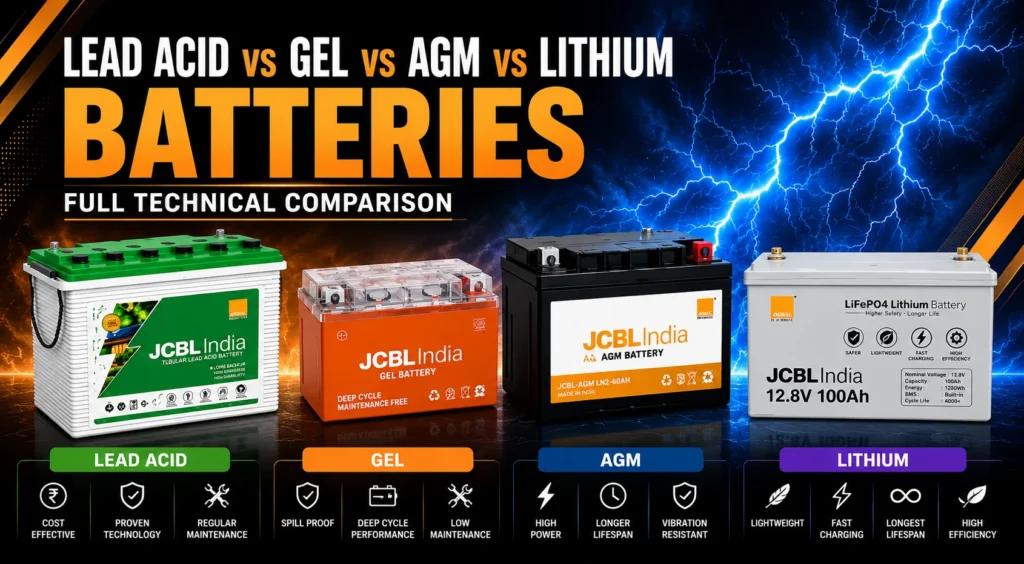
Choosing the right battery is not just about price. The battery you select affects backup time, charging speed, lifespan, maintenance requirements, and long-term costs.
The four most common battery types used in solar systems, inverters, UPS systems, telecom applications, RVs, marine systems, and energy storage are Lead Acid, Gel, AGM, and Lithium batteries.
So, which one is best?
Lithium batteries offer the longest lifespan, fastest charging, highest efficiency, and lowest lifetime cost. AGM batteries are a reliable maintenance-free option for backup power, while traditional Lead Acid batteries remain the most affordable upfront.
Let’s compare them side by side.
Lead Acid vs Gel vs AGM vs Lithium: Quick Comparison
| Feature | Lead Acid | Gel | AGM | Lithium |
| Lifespan | 300–500 cycles | 500–1,000 cycles | 600–1,200 cycles | 3,000–8,000+ cycles |
| Maintenance | Required | None | None | None |
| Charging Speed | Slow | Moderate | Fast | Fastest |
| Efficiency | 70–80% | 80–85% | 85–90% | 95–99% |
| Weight | Heavy | Heavy | Heavy | Lightweight |
| Usable Capacity | Low | Medium | Medium | High |
| Upfront Cost | Lowest | Medium | Medium-High | Highest |
| Long-Term Value | Low | Good | Good | Best |
Understanding the Different Battery Types
- Lead Acid Battery
Lead-acid batteries use liquid electrolyte and are one of the oldest rechargeable battery technologies. They are widely used in backup power systems because of their low upfront cost, but require regular maintenance and have a shorter lifespan than newer battery technologies.
Best for: Budget-conscious users and occasional backup applications.
- Gel Battery
Gel batteries are sealed lead-acid batteries that use a gel-based electrolyte instead of liquid acid. They require no routine maintenance and are designed for applications that involve regular charging and discharging.
Best for: Deep-cycle systems and moderate renewable energy applications.
- AGM Battery
AGM (Absorbent Glass Mat) batteries are sealed lead-acid batteries that use fiberglass mats to hold the electrolyte. They are maintenance-free, charge faster than conventional lead-acid batteries, and are commonly used in backup power systems.
Best for: UPS systems, inverters, telecom backup, and standby power.
- Lithium Battery
Lithium batteries, particularly LiFePO4 batteries, represent the latest battery technology for energy storage. They offer longer lifespan, faster charging, higher efficiency, and greater usable capacity than lead-acid batteries.
Best for: Solar storage, frequent power backup, telecom systems, RVs, and long-term energy storage.
Which Battery Lasts the Longest?
Battery lifespan is typically measured in charge-discharge cycles.
| Battery Type | Typical Cycle Life |
| Lead Acid | 300–500 |
| Gel | 500–1,000 |
| AGM | 600–1,200 |
| Lithium | 3,000–8,000+ |
A lithium battery can often last 5–10 times longer than a traditional lead-acid battery.
For applications such as solar energy storage, where batteries cycle daily, lifespan becomes one of the most important factors when evaluating long-term costs.
Which Battery Provides More Usable Power?
Not all battery capacity can be used safely.
Lead-acid batteries should typically not be discharged below 50% of their rated capacity, whereas lithium batteries can safely use most of their stored energy.
For example:
- A 100 Ah Lead Acid battery provides roughly 50 Ah of usable capacity.
- A 100 Ah Lithium battery can provide 80–100 Ah of usable capacity.
This means lithium batteries deliver more usable power from the same rated capacity.
Which Battery Charges Faster?
Charging speed matters when sunlight hours are limited or power outages occur frequently.
Fastest to slowest charging:
- Lithium
- AGM
- Gel
- Lead Acid
Lithium batteries can accept higher charging currents and reach full charge much faster than lead-acid technologies.
Faster charging allows batteries to recover more quickly after a power outage and helps solar systems store more energy during limited sunlight hours.
Which Battery Is Most Efficient?
Efficiency determines how much energy is lost during charging and discharging.
| Battery Type | Efficiency |
| Lead Acid | 70–80% |
| Gel | 80–85% |
| AGM | 85–90% |
| Lithium | 95–99% |
Higher efficiency means lower energy losses, better system performance, and reduced electricity costs over time.
This is one reason lithium batteries are increasingly used in solar and renewable energy systems.
Which Battery Requires the Least Maintenance?
Maintenance requirements can significantly impact the overall cost and convenience of owning a battery.
Flooded Lead Acid batteries require regular upkeep because they contain liquid electrolyte. Users may need to check electrolyte levels, refill distilled water, clean terminals, and perform routine inspections.
Gel, AGM, and Lithium batteries are sealed systems that do not require water refilling or electrolyte checks during normal operation.
| Battery Type | Maintenance Level |
| Lead Acid | High |
| Gel | Low |
| AGM | Low |
| Lithium | Very Low |
Lithium batteries require the least maintenance. Most modern lithium batteries include a built-in Battery Management System (BMS) that helps monitor charging, discharging, temperature, and voltage automatically.
Best Battery for Different Applications
| Application | Recommended Battery |
| Solar Energy Storage | Lithium |
| Inverter & UPS Systems | AGM or Lithium |
| Telecom Backup | Lithium |
| RV & Marine Applications | Lithium |
| Budget Backup Power | Lead Acid |
Lithium batteries are generally the preferred choice for solar, telecom, RV, and energy storage applications because of their long lifespan, high efficiency, and fast-charging capabilities.
For UPS and inverter systems, AGM batteries remain a popular option due to their lower upfront cost, while lithium batteries provide better long-term value.
When keeping initial investment low is the primary goal, traditional Lead Acid batteries remain the most economical choice.
Conclusion
The right battery ultimately depends on your budget, application, and performance expectations. Traditional Lead Acid batteries remain a practical choice for users seeking the lowest upfront cost, while Gel batteries are better suited for maintenance-free deep-cycle applications. AGM batteries offer a reliable balance of performance and convenience, making them a popular option for inverters, UPSs, and backup power systems. However, if you prioritize long lifespan, fast charging, high efficiency, and low long-term ownership costs, Lithium (LiFePO₄) batteries are the strongest overall choice. For most modern solar, telecom, RV, and energy storage applications, lithium batteries deliver the best combination of performance, reliability, and long-term value.
FAQs
Lithium batteries typically last between 3,000 and 8,000+ charge cycles, making them the longest-lasting option among lead-acid, Gel, AGM, and Lithium batteries.
Yes. AGM batteries are maintenance-free, charge faster, and generally last longer than traditional flooded lead-acid batteries.
Lithium batteries offer longer lifespan, higher efficiency, faster charging, and greater usable capacity. However, AGM batteries have a lower upfront cost.
Lithium batteries are generally the preferred choice for solar energy storage because of their high efficiency, long lifespan, and deep discharge capability.
Lithium batteries use advanced battery chemistry and built-in Battery Management Systems (BMS), which increase upfront cost but also improve lifespan, efficiency, and overall performance.