

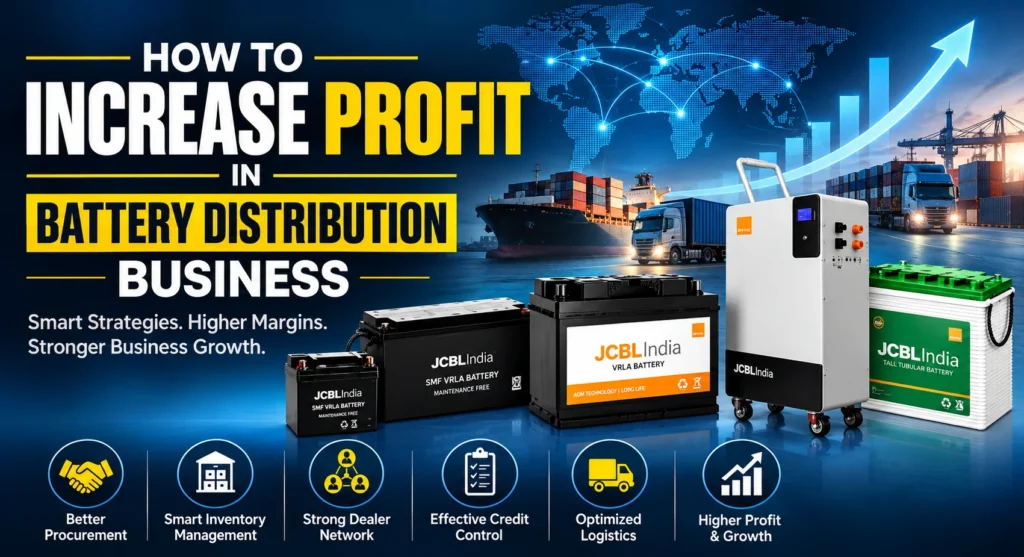
To increase profit in a battery distribution business, focus on improving procurement rates, increasing inventory turnover, expanding dealer networks, strengthening credit control, and prioritizing high-margin segments such as inverters, EVs, and solar batteries. While many distributors focus on increasing sales, sustainable profitability comes from buying smarter, moving stock faster, and reducing operational inefficiencies. This guide covers the most effective strategies to improve margins, cash flow, and overall business profitability.
How Profit Works in Battery Distribution
Profit is a result of multiple controlled variables rather than a fixed margin.
Core Profit Equation
Net Profit = (Selling Price – Purchase Cost) × Volume – (Logistics + Credit Loss + Holding Cost)
Key Profit Drivers
- Procurement pricing power
- Inventory rotation speed
- Dealer network strength
- Credit recovery efficiency
- Logistics cost per unit
Even small improvements (1–3%) in any of these factors significantly impact annual profitability due to high turnover volumes.
Key Strategies to Increase Profit in Battery Distribution Business
Increasing profit in battery distribution requires optimizing every stage of the business, from procurement and inventory management to dealer expansion and cash flow control. The following strategies have the biggest impact on improving margins and building a more profitable distribution operation.
1. Optimize Procurement Costs
Procurement is often the biggest profit lever in battery distribution because it directly affects your margin on every unit sold. The lower your acquisition cost, the higher your profitability without increasing sales volume.
To improve procurement efficiency:
- Establish direct sourcing relationships with OEMs or authorized distributors
- Negotiate slab-based pricing contracts to secure better rates at higher volumes
- Lock quarterly or annual pricing agreements where possible
- Consolidate purchases with fewer suppliers to strengthen bargaining power
Even a small reduction in procurement cost per battery can significantly increase annual profits at scale.
2. Focus on High-Margin Battery Categories
Not every battery contributes equally to profitability. Successful distributors prioritize products that offer a balance of healthy margins, consistent demand, and strong replacement cycles.
High-potential categories include:
- Inverter batteries
- EV batteries
- Solar batteries
- Premium tubular batteries
Rather than chasing high-ticket products, focus on batteries that sell frequently and generate recurring demand.
3. Improve Inventory Turnover
Inventory that sits in the warehouse for too long ties up working capital and reduces profitability. The goal is not simply to stock more products but to stock the right products.
Key inventory management practices include:
- Categorizing SKUs as fast, medium, and slow movers
- Maintaining optimal inventory levels based on demand patterns
- Using demand-based replenishment instead of bulk purchasing
- Removing consistently slow-moving products
Faster inventory turnover improves cash flow and increases the return generated from invested capital.
4. Expand and Strengthen Your Dealer Network
A strong dealer network increases sales opportunities while reducing dependence on a small number of customers.
To grow your distribution reach:
- Expand into Tier-2 and Tier-3 markets
- Build relationships with electricians, mechanics, and service centers
- Offer performance-based incentives to high-performing dealers
- Create territory-based distribution strategies to avoid channel conflicts
A larger and more active dealer network creates a stronger foundation for long-term revenue growth.
5. Reduce Logistics Costs
Transportation and warehousing costs can quietly erode margins if not managed effectively.
Consider strategies such as:
- Consolidating deliveries into larger shipments
- Optimizing delivery routes
- Establishing regional distribution hubs
- Negotiating long-term transportation contracts
Reducing logistics costs improves profitability without affecting customer pricing.
6. Strengthen Credit Control and Cash Flow Management
Many battery distributors generate strong sales but struggle with profitability because of delayed payments and poor credit management.
A disciplined credit policy should include:
- Dealer-specific credit limits
- Regular payment monitoring
- Incentives for early payments
- Prompt action on overdue accounts
Better cash flow reduces financial risk and ensures capital is available for growth opportunities.
7. Use Demand Forecasting to Improve Stock Planning
Accurate forecasting helps distributors maintain product availability without overstocking.
Monitor factors such as:
- Seasonal demand fluctuations
- Regional buying patterns
- Product replacement cycles
- SKU-level sales performance
Better forecasting reduces dead stock while ensuring high-demand products remain available.
8. Create Additional Value Beyond Product Supply
Distributors that provide support services often build stronger dealer relationships and increase repeat business.
Examples include:
- Warranty assistance
- Installation support coordination
- Technical training for dealers
- Priority delivery services
These value-added services can help differentiate your business in a competitive market.
9. Diversify Your Product Portfolio
Relying too heavily on a single battery brand can expose your business to supply disruptions and pricing pressure.
A diversified portfolio allows you to:
- Serve different customer segments
- Improve procurement flexibility
- Reduce supplier dependency
- Strengthen negotiating power
This creates greater stability and protects profitability over the long term.
10. Expand into Underserved Markets
Many distributors focus on highly competitive regions while overlooking smaller markets with strong growth potential.
Look for opportunities in:
- Emerging districts and towns
- Rapidly growing semi-urban areas
- Markets with limited distributor presence
Establishing a strong position early can lead to higher market share and sustainable profit growth.
Common Profit Killers in Battery Distribution
Avoid these structural inefficiencies:
- Overstocking based on discounts instead of demand
- Weak or inconsistent credit enforcement
- Ignoring the logistics cost per unit
- Lack of SKU-level performance tracking
- Overdependence on a single supplier or brand
Conclusion
Increasing profit in the battery distribution business is fundamentally about operational control, not just higher sales. The most successful distributors focus on procurement efficiency, fast inventory cycles, disciplined credit systems, and strong regional dealer networks.
When these systems work together, profitability improves steadily and sustainably, even in highly competitive markets.
FAQs
Profit margins vary based on the battery category, supplier agreements, and operating efficiency. Distributors that optimize procurement, inventory turnover, and logistics typically achieve higher margins than those relying solely on sales volume.
Procurement cost is often the biggest profit driver. Securing better pricing from manufacturers or authorized suppliers directly improves margins on every battery sold.
Inverter batteries, EV batteries, solar batteries, and premium tubular batteries generally offer strong profit potential due to growing demand, higher margins, and recurring replacement cycles.
Battery distributors can improve cash flow by reducing inventory holding periods, enforcing credit limits, shortening payment cycles, and actively monitoring overdue accounts.
The most common mistakes include overstocking slow-moving products, weak credit control, poor demand forecasting, high logistics costs, and excessive dependence on a single supplier or brand.