

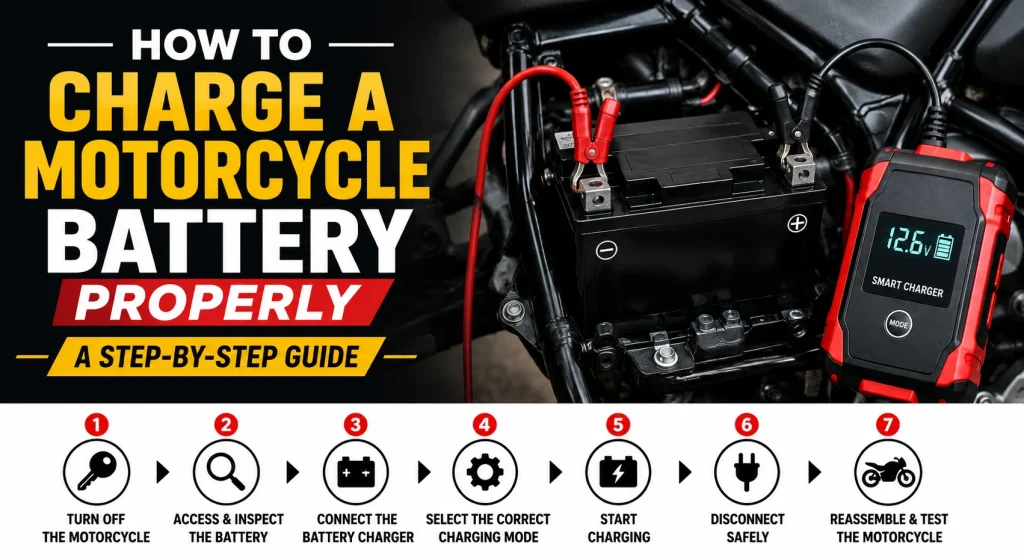
A discharged motorcycle battery can leave you stranded and affect the performance of your bike. Whether your motorcycle has been sitting unused, struggling to start, or showing signs of a weak battery, charging it correctly is essential for restoring power and maximizing battery life.
This guide explains how to charge a motorcycle battery properly, the tools you’ll need, charging times, safety precautions, and common mistakes to avoid.
Quick Answer: How Do You Charge a Motorcycle Battery Properly?
To charge a motorcycle battery properly:
- Turn off the motorcycle and remove the key.
- Access the battery and inspect it for damage.
- Connect the charger to the battery terminals correctly.
- Select the appropriate charging mode.
- Allow the battery to charge fully.
- Turn off the charger and disconnect it safely.
- Reinstall any covers and test the motorcycle.
Using a compatible motorcycle battery charger and avoiding overcharging are the most important factors in maintaining battery performance and lifespan.
What You’ll Need Before Charging
Before starting, gather the following:
- Motorcycle battery charger or smart charger
- Safety gloves
- Safety glasses
- Clean and dry workspace
A smart charger is generally recommended because it automatically regulates charging current and helps prevent overcharging.
Step-by-Step: How to Charge a Motorcycle Battery Properly
Step 1: Turn Off the Motorcycle
Switch off the ignition and remove the key. Ensure all lights, accessories, and electronic components are turned off before connecting the charger.
This helps prevent electrical issues and ensures the battery receives the full charging current.
Step 2: Access and Inspect the Battery
Locate the motorcycle battery, which is commonly positioned beneath the seat or behind a side panel.
Before charging, inspect the battery for:
- Cracks in the casing
- Corrosion on terminals
- Swelling or deformation
- Leaks or damage
Do not attempt to charge a damaged battery. If the battery shows any of these signs, replacement may be necessary.
Step 3: Connect the Battery Charger
Connect the charger leads in the correct order:
- Attach the red clamp to the positive (+) terminal.
- Attach the black clamp to the negative (-) terminal.
Make sure both connections are secure before powering on the charger.
Incorrect terminal connections can damage both the battery and charger, so always verify polarity before proceeding.
Step 4: Select the Correct Charging Mode
Most modern chargers include charging modes for different battery types.
Select the mode recommended for your battery. Charging requirements may vary between lead-acid, AGM, gel, and lithium motorcycle batteries.
If you’re unsure, consult the battery manufacturer’s specifications before charging.
Step 5: Start Charging
Turn on the charger and begin the charging process.
Allow the battery to charge until the charger indicates that charging is complete. Smart chargers automatically reduce charging current as the battery approaches full capacity.
Avoid interrupting the charging cycle unnecessarily, as incomplete charging can reduce battery performance over time.
Step 6: Disconnect the Charger Safely
Once charging is complete:
- Turn off the charger.
- Remove the black clamp from the negative terminal.
- Remove the red clamp from the positive terminal.
Disconnecting in this order helps reduce the risk of accidental short circuits.
Step 7: Reassemble and Test the Motorcycle
Reinstall any covers, panels, or seats that were removed to access the battery.
Start the motorcycle and confirm that the battery is supplying adequate power. The engine should crank normally without hesitation.
How Long Does It Take to Charge a Motorcycle Battery?
Motorcycle battery charging time depends on several factors, including battery capacity, state of charge, and charger output.
In most cases, a motorcycle battery takes between 2 and 12 hours to charge fully.
A battery that is only partially discharged may require significantly less time, while a deeply discharged battery may need a longer charging cycle.
Using a smart charger is the safest approach because it automatically manages charging speed and reduces the risk of overcharging.
Can You Charge a Motorcycle Battery Without Removing It?
Yes. In most motorcycles, the battery can be charged while remaining installed in the bike.
Before charging an installed battery:
- Turn off the ignition.
- Ensure all electrical accessories are off.
- Follow the charger manufacturer’s instructions.
- Verify that the battery and wiring are in good condition.
Many motorcycle owners routinely charge batteries in place using smart chargers and battery maintainers.
However, if the motorcycle manufacturer recommends removing the battery before charging, follow those instructions.
Motorcycle Battery Charging Safety Tips
Safety should always be a priority when charging any battery.
Follow these best practices:
- Charge the battery in a dry, well-ventilated area.
- Wear appropriate eye and hand protection.
- Keep sparks, flames, and smoking materials away from the battery.
- Use a charger designed for motorcycle batteries.
- Verify positive and negative terminal connections before switching on the charger.
- Stop charging immediately if the battery becomes excessively hot, leaks, or swells.
Proper charging practices help protect both the battery and the motorcycle’s electrical system.
Common Mistakes to Avoid When Charging a Motorcycle Battery
Many battery failures occur because of improper charging procedures.
- Using the Wrong Charger: Not all chargers are suitable for motorcycle batteries. Using an incompatible charger can result in improper charging and reduced battery life.
- Reversing Terminal Connections: Connecting positive and negative terminals incorrectly can damage the charger, battery, and electrical components. Always double-check connections before starting the charging process.
- Overcharging the Battery: Overcharging generates excess heat and may shorten battery life. A smart charger helps prevent this issue by automatically stopping or reducing charging current when the battery is fully charged.
- Charging a Damaged Battery: Cracked, leaking, or swollen batteries should not be charged. Continuing to charge a damaged battery may create safety risks and lead to complete battery failure.
- Ignoring Manufacturer Recommendations: Battery and charger manufacturers provide charging specifications for a reason. Following these recommendations helps ensure safe and effective charging.
Conclusion
Knowing how to charge a motorcycle battery properly helps maintain reliable starting power, improve battery performance, and extend battery life. The process is straightforward: turn off the motorcycle, connect a compatible charger correctly, select the proper charging mode, allow the battery to charge fully, and disconnect the charger safely.
By following the correct charging procedure, using a suitable charger, and avoiding common mistakes such as overcharging or incorrect terminal connections, you can keep your motorcycle battery in optimal condition and reduce the likelihood of unexpected starting problems.
FAQs
A motorcycle battery should be charged whenever it becomes discharged or after long periods of inactivity. Motorcycles that are stored for weeks or months often benefit from periodic charging or the use of a battery maintainer.
In many cases, yes. A deeply discharged battery can often be restored through proper charging. However, if the battery has suffered internal damage or has reached the end of its service life, charging may not restore normal performance.
Only if the charger supports motorcycle batteries and provides an appropriate charging rate. Chargers designed specifically for motorcycles are generally the safest option.
Overcharging can cause excessive heat, reduce battery lifespan, damage internal components, and affect overall performance. Using a smart charger helps prevent overcharging.
Yes. Smart chargers automatically regulate charging current, monitor battery condition, and reduce the risk of overcharging, making them one of the safest options for motorcycle battery charging.