

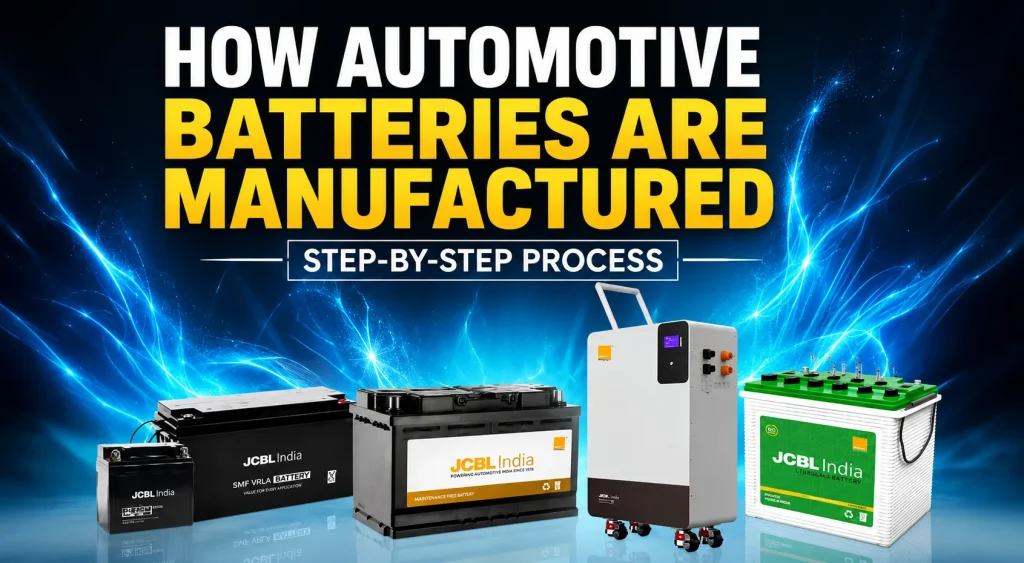
Automotive batteries power the electrical systems that start, light, and support modern vehicles. While the finished product appears simple from the outside, its manufacturing process involves a series of tightly controlled production stages designed to ensure consistent performance, durability, and safety. Every step, from selecting raw materials to activating the battery plates, directly influences the battery’s efficiency and service life.
This guide explains the automotive battery manufacturing process step by step, focusing on the production of conventional lead-acid automotive batteries used in most passenger and commercial vehicles.
How Are Automotive Batteries Manufactured?
Automotive batteries are manufactured through a carefully controlled production process that transforms raw materials into reliable power sources for vehicles. Each stage is designed to ensure consistent quality, electrical performance, and durability before the battery reaches the market.
Step 1: Raw Material Selection and Inspection
The manufacturing process begins with sourcing and inspecting high-quality raw materials. Every material is tested to ensure it meets the required specifications before entering production.
Key materials include the following:
- Lead and lead alloys
- Lead oxide
- Sulfuric acid
- Polypropylene battery cases
- Polyethylene or AGM separators
- Battery terminals and connectors
Why it matters: High-quality raw materials reduce manufacturing defects and improve battery reliability.
Step 2: Lead Smelting and Alloy Preparation
Lead ingots are melted in controlled furnaces and combined with alloying elements such as calcium, tin, or antimony. The resulting alloy provides the strength and conductivity needed for battery grids.
Key highlights:
- Produces durable lead alloys
- Improves corrosion resistance
- Ensures consistent electrical conductivity
Step 3: Grid Manufacturing
The molten alloy is cast into positive and negative battery grids using automated casting systems. These grids act as the structural framework that supports the active material and conducts electricity.
Process includes:
- Grid casting
- Cooling and trimming
- Dimensional inspection
- Quality verification
Why it matters: Uniform grids improve electrical efficiency and battery performance.
Step 4: Active Material Preparation
Manufacturers prepare the active paste by mixing lead oxide with sulfuric acid, water, and specialized additives. Separate formulations are created for positive and negative plates.
Key objectives:
- Create a uniform paste mixture
- Maintain precise ingredient ratios
- Optimize battery capacity and charge acceptance
Step 5: Battery Plate Pasting
The active paste is applied evenly to the lead grids using automated pasting machines. Excess material is removed to maintain consistent plate dimensions.
Quality checks include:
- Paste density
- Plate thickness
- Surface uniformity
- Adhesion strength
Why it matters: Uniform plates help deliver balanced electrical performance across all battery cells.
Step 6: Plate Curing and Drying
Pasted plates are transferred to curing chambers where temperature and humidity are carefully controlled. This process strengthens the bond between the active material and the grid.
During curing:
- The paste hardens
- Chemical bonding improves
- Plate strength increases
- Moisture levels stabilize
Step 7: Plate Formation (Initial Charging)
The cured plates undergo controlled electrical charging to activate the lead compounds and develop their electrochemical properties. This is one of the most important stages of battery manufacturing.
Formation helps to:
- Activate positive and negative plates
- Improve charge acceptance
- Develop the battery’s rated capacity
- Ensure consistent performance
Step 8: Battery Assembly
The activated plates are assembled with separators to form battery cells. These cells are then connected in series to achieve the required battery voltage.
Assembly involves:
- Plate stacking
- Separator insertion
- Cell grouping
- Precision terminal welding
Why it matters: Accurate assembly ensures efficient current flow and reliable battery operation.
Step 9: Container and Cover Sealing
The assembled cells are placed inside a durable polypropylene container, and the cover is permanently sealed using heat or ultrasonic welding.
Benefits of proper sealing:
- Prevents electrolyte leakage
- Protects internal components
- Enhances battery safety
- Improves durability
Step 10: Electrolyte Filling
Each battery is filled with a precisely measured amount of diluted sulfuric acid using automated filling equipment.
Key focus areas:
- Accurate electrolyte volume
- Controlled acid concentration
- Safe handling procedures
- Consistent filling quality
Step 11: Final Formation Charging and Aging
After assembly, the battery undergoes a final charging cycle followed by an aging period to stabilize its electrochemical performance.
Manufacturers monitor:
- Voltage stability
- Charging efficiency
- Capacity development
- Temperature
- Overall battery performance
Step 12: Quality Testing and Inspection
Before shipment, every battery undergoes rigorous quality testing to verify performance, safety, and reliability.
Common tests include:
- Voltage testing
- Capacity verification
- Leak testing
- Internal resistance measurement
- High-rate discharge testing
- Visual inspection
Why it matters: Comprehensive testing ensures only batteries that meet quality standards reach customers.
Step 13: Labeling, Packaging, and Dispatch
After passing all inspections, batteries are labeled, packaged, and prepared for safe transportation.
Final steps include:
- Product labeling
- Batch and traceability coding
- Safety markings
- Protective packaging
- Shipment preparation
Result: The finished automotive battery is ready for distribution to OEMs, distributors, and global markets while maintaining quality throughout the supply chain.
How Manufacturers Maintain Consistent Battery Quality
Producing automotive batteries at scale requires more than automated equipment; it demands continuous monitoring throughout the manufacturing process.
Leading manufacturers maintain consistency by combining:
- Automated production lines with precision-controlled machinery
- Incoming inspection of raw materials
- Process monitoring at every manufacturing stage
- Standardized operating procedures
- Regular equipment calibration
- Comprehensive final product testing
- Batch traceability for quality management
This integrated approach helps manufacturers deliver batteries with consistent performance while supporting reliable production across high-volume manufacturing facilities.
Quality Standards Followed in Automotive Battery Manufacturing
Automotive battery manufacturers typically implement internationally recognized quality management systems to improve manufacturing consistency and product reliability.
Common standards include:
- ISO 9001 for quality management systems
- IATF 16949, the global quality management standard for the automotive industry
- Environmental management practices aligned with ISO 14001
- Occupational health and safety systems such as ISO 45001
Many manufacturers also conduct internal validation tests to verify that batteries meet their own performance and safety requirements before shipment.
Following recognized manufacturing standards supports consistent production while meeting the quality expectations of automotive OEMs, distributors, and global buyers.
Conclusion
Automotive battery manufacturing is a carefully controlled process where every production stage contributes to the quality of the finished product. From selecting high-purity raw materials and manufacturing precision grids to assembling battery cells, filling electrolytes, and conducting comprehensive quality inspections, each step is designed to deliver reliable and consistent performance.
As vehicle technology continues to evolve, manufacturers are increasingly adopting automated production systems, advanced quality management practices, and internationally recognized standards to improve manufacturing efficiency while meeting the expectations of OEMs and global markets. Understanding this step-by-step process provides valuable insight into the engineering precision behind every automotive battery that powers today’s vehicles.
FAQs
Automotive batteries are primarily manufactured using lead or lead alloys, lead oxide, sulfuric acid, separators, polypropylene battery cases, and terminal components. Each material plays a specific role in the battery’s structure and electrochemical performance.
The manufacturing timeline varies depending on the production method and battery design. Processes such as plate curing, formation charging, quality testing, and aging require controlled conditions, making battery production a multi-stage process rather than a single-day operation.
Formation charging activates the battery plates by converting inactive lead compounds into electrochemically active materials. This step helps establish the battery’s capacity, charging characteristics, and overall performance.
Manufacturers typically perform voltage, capacity, discharge, leak, internal resistance, and visual inspections to verify that every battery meets predefined quality specifications before packaging.
Automotive batteries are widely used in passenger cars, commercial vehicles, agricultural equipment, construction machinery, material handling equipment, and backup power applications, depending on the battery type and design.