

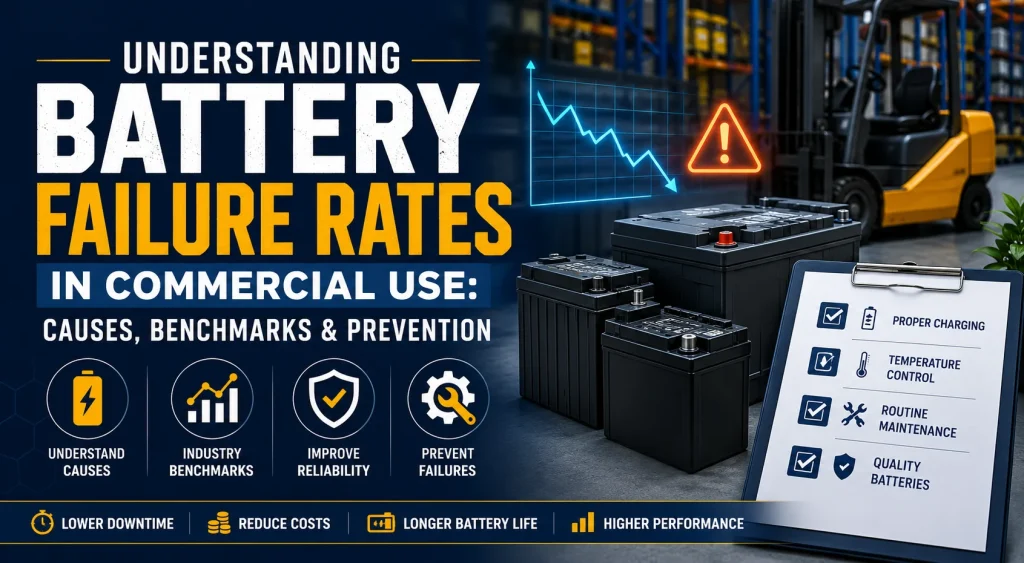
Commercial batteries power forklifts, backup power systems, telecom infrastructure, material handling equipment, electric utility vehicles, renewable energy storage, and industrial machinery. When a battery fails earlier than expected, the consequences extend beyond replacement costs—they can result in equipment downtime, disrupted operations, missed production targets, and higher maintenance expenses.
Understanding battery failure rates helps procurement teams, facility managers, OEMs, and fleet operators make informed decisions about battery selection, maintenance, and lifecycle planning. This guide explains what battery failure rates mean, the factors that influence them, and practical strategies businesses can use to improve reliability and reduce total ownership costs.
What Is Battery Failure Rate?
Battery failure rate is the percentage of batteries that fail to perform as intended within a defined operating period due to manufacturing defects, aging, improper use, environmental conditions, or wear.
Battery Failure Rate Formula
Battery Failure Rate (%) = (Number of Failed Batteries ÷ Total Batteries Installed) × 100
Example:
If a warehouse operates 500 industrial batteries and 15 fail within one year, the battery failure rate is:
(15 ÷ 500) × 100 = 3%
Monitoring this metric enables businesses to identify reliability trends, forecast replacement needs, improve maintenance schedules, and evaluate supplier performance.
Why Battery Failure Rates Matter in Commercial Applications
In commercial environments, battery reliability directly affects operational efficiency and long-term costs.
Key reasons to monitor battery failure rates include the following:
- Reducing unexpected equipment downtime
- Improving productivity across operations
- Lowering maintenance and replacement expenses
- Supporting warranty and supplier performance evaluations
- Enhancing workplace safety
- Improving lifecycle cost forecasting
- Optimizing preventive maintenance programs
Industries such as logistics, manufacturing, warehousing, renewable energy, mining, healthcare, and telecommunications rely heavily on dependable battery performance to maintain continuous operations.
Common Causes of Battery Failure in Commercial Use
Battery failures rarely occur without warning. Most result from preventable operational or environmental factors.
1. Deep Discharge
Allowing batteries to discharge beyond their recommended depth repeatedly accelerates internal chemical degradation and permanently reduces capacity.
This is especially common in:
- Forklift batteries
- Electric industrial vehicles
- Solar energy storage systems
2. Overcharging
Charging beyond recommended voltage generates excessive heat and damages battery cells.
Overcharging may cause:
- Capacity loss
- Shortened cycle life
- Increased internal resistance
- Electrolyte degradation in lead-acid batteries
Modern smart chargers and Battery Management Systems (BMS) help minimize this risk.
3. High Operating Temperatures
Heat is one of the leading causes of premature battery aging.
Consistently operating batteries above recommended temperatures can:
- Speed up chemical reactions
- Increase water loss in flooded batteries
- Accelerate lithium-ion cell degradation
- Reduce overall service life
Proper ventilation and temperature-controlled charging environments help improve reliability.
4. Improper Charging Practices
Incorrect charging habits significantly increase failure rates.
Common mistakes include:
- Using incompatible chargers
- Frequently interrupting charging cycles
- Charging partially damaged batteries
- Ignoring manufacturer charging recommendations
Following the correct charging profile for the battery chemistry is essential.
5. Aging and Cycle Fatigue
Every battery has a finite number of charge-discharge cycles.
Over time:
- Capacity gradually decreases
- Internal resistance increases
- Runtime becomes shorter
- Failure probability rises
Commercial maintenance programs should monitor batteries nearing the end of their expected cycle life.
6. Manufacturing Defects
Although modern quality control has significantly reduced defects, occasional issues may still occur due to:
- Internal cell contamination
- Faulty welds
- Material inconsistencies
- Separator damage
Working with manufacturers that implement rigorous quality testing and traceability helps minimize these risks.
7. Poor Maintenance
Maintenance remains a major contributor to battery failures, particularly for lead-acid batteries.
Neglected maintenance may include:
- Low electrolyte levels
- Dirty terminals
- Corrosion buildup
- Loose cable connections
- Inadequate equalization charging
Routine inspections can prevent many avoidable failures.
8. Vibration and Physical Damage
Commercial equipment operating in construction, mining, agriculture, and transportation exposes batteries to constant vibration and mechanical stress.
Physical damage can result in:
- Internal short circuits
- Cracked casings
- Loose connectors
- Reduced battery life
Proper mounting and vibration-resistant battery designs improve durability.
Battery Failure Trends by Battery Type
| Battery Type | Typical Commercial Service Life* | Common Failure Causes | Reliability Considerations |
| Flooded Lead-Acid | 3–6 years | Poor maintenance, sulfation, overcharging | Requires regular maintenance |
| AGM | 4–7 years | Heat, overcharging | Lower maintenance than flooded batteries |
| Gel | 4–8 years | Incorrect charging voltage | Performs well in deep-cycle applications |
| Lithium-ion | 8–15 years | High temperatures, improper charging | High cycle life with integrated BMS |
| LiFePO₄ | 10–15+ years | Extreme misuse, poor charging systems | Excellent thermal stability and long lifecycle |
*Actual lifespan depends on operating conditions, charging practices, maintenance, and application.
Factors That Influence Commercial Battery Failure Rates
Several operational conditions determine how long commercial batteries last.
1. Operating Temperature
Extreme heat accelerates degradation, while extremely cold temperatures temporarily reduce available capacity. Maintaining batteries within their recommended operating range improves performance and longevity.
2. Charge and Discharge Cycles
Frequent cycling gradually wears battery cells. Selecting a battery with an appropriate cycle-life rating for the intended application is essential.
3. Depth of Discharge (DoD)
Deeper discharge cycles generally shorten battery life. Operating within the manufacturer’s recommended DoD helps extend service life.
4. Storage Conditions
Long-term storage without periodic charging can cause self-discharge and irreversible damage, particularly in lead-acid batteries.
5. Charging Equipment
Using chargers designed for the battery’s chemistry and voltage profile ensures efficient charging while minimizing stress on the cells.
6. Maintenance Practices
Routine inspections, cleaning, performance testing, and scheduled servicing help detect issues before they result in unexpected failures.
Early Warning Signs of Battery Failure
Recognizing early symptoms allows businesses to replace or repair batteries before they disrupt operations.
Watch for:
- Reduced operating runtime
- Longer charging times
- Voltage instability
- Excessive heat during charging or use
- Swollen battery casing
- Corroded terminals
- Frequent equipment shutdowns
- Declining capacity
- Increased maintenance requirements
Battery health monitoring systems can detect many of these issues before they become critical.
How Businesses Can Reduce Battery Failure Rates
Reducing battery failures requires a combination of quality equipment, proper maintenance, and informed operational practices.
- Choose the Right Battery Chemistry: Select a battery technology that matches the operating environment, duty cycle, temperature range, and charging schedule.
- Follow Manufacturer Charging Recommendations: Avoid overcharging, deep discharge, and incompatible charging equipment.
- Monitor Battery Health: Use Battery Management Systems (BMS), voltage monitoring, capacity testing, and maintenance records to identify performance issues early.
- Implement Preventive Maintenance: Regular inspections help detect corrosion, damaged cables, electrolyte issues, and abnormal temperature increases before they cause failures.
- Control Operating Temperatures: Provide adequate ventilation and avoid exposing batteries to prolonged extreme heat whenever possible.
- Train Equipment Operators: Proper handling, charging, and storage practices reduce avoidable battery damage and improve lifespan.
- Source Batteries from Reputable Manufacturers: Choose suppliers with strong quality control processes, documented testing procedures, industry certifications, technical support, and comprehensive warranty programs.
Battery Testing Methods Used to Predict Failure
Commercial maintenance teams commonly use the following diagnostic methods:
- Capacity Testing: Measures available battery capacity compared to its rated capacity.
- Internal Resistance Testing: Detects increasing resistance associated with aging cells.
- Voltage Testing: Identifies abnormal voltage drops under load.
- Load Testing: Evaluates battery performance during actual operating conditions.
- Thermal Monitoring: Detects overheating and potential cell failures.
- Impedance Testing: Helps identify deteriorating battery health before complete failure.
Using these methods as part of a preventive maintenance program reduces unexpected downtime.
Industries That Closely Monitor Battery Failure Rates
Battery reliability is critical across multiple commercial sectors.
| Industry | Why Battery Reliability Matters |
| Warehousing | Keeps forklifts and material handling equipment operational |
| Logistics | Supports uninterrupted fleet operations |
| Manufacturing | Prevents production downtime |
| Telecommunications | Maintains backup power during outages |
| Renewable Energy | Ensures reliable energy storage performance |
| Healthcare | Supports emergency and critical power systems |
| Mining & Construction | Improves equipment availability in demanding environments |
Best Practices for Selecting Commercial Batteries
When evaluating batteries for commercial applications, consider the following:
- Expected cycle life
- Application-specific battery chemistry
- Operating temperature range
- Required maintenance level
- Warranty coverage
- Safety certifications
- Manufacturer quality standards
- Technical support availability
- Compatibility with charging infrastructure
- Total cost of ownership rather than purchase price alone
Selecting batteries based on lifecycle performance instead of initial cost often delivers better long-term value.
Conclusion
Battery failure rates are one of the most valuable indicators of commercial battery reliability and operational efficiency. By understanding the primary causes of battery failure, monitoring battery health, implementing preventive maintenance, and selecting batteries designed for specific operating conditions, businesses can significantly reduce downtime and extend service life.
Rather than focusing solely on purchase price, organizations should evaluate battery performance based on lifecycle cost, reliability, maintenance requirements, and supplier quality. A proactive battery management strategy not only lowers replacement costs but also supports safer, more productive, and more dependable commercial operations.
FAQs
There is no universal failure rate because it varies by battery chemistry, operating environment, maintenance quality, and application. Businesses should benchmark performance against manufacturer specifications and historical operational data.
The most common causes include deep discharge, overcharging, excessive heat, poor maintenance, improper charging equipment, aging, vibration, and manufacturing defects.
Lithium Iron Phosphate (LiFePO₄) batteries typically provide one of the longest service lives in commercial applications when properly managed, thanks to their high cycle life and thermal stability.
Yes. Capacity testing, internal resistance measurements, voltage analysis, thermal monitoring, and Battery Management Systems can identify early signs of degradation before complete failure occurs.
Inspection frequency depends on the application and manufacturer’s recommendations. High-demand operations often benefit from routine visual inspections, periodic performance testing, and scheduled preventive maintenance.