

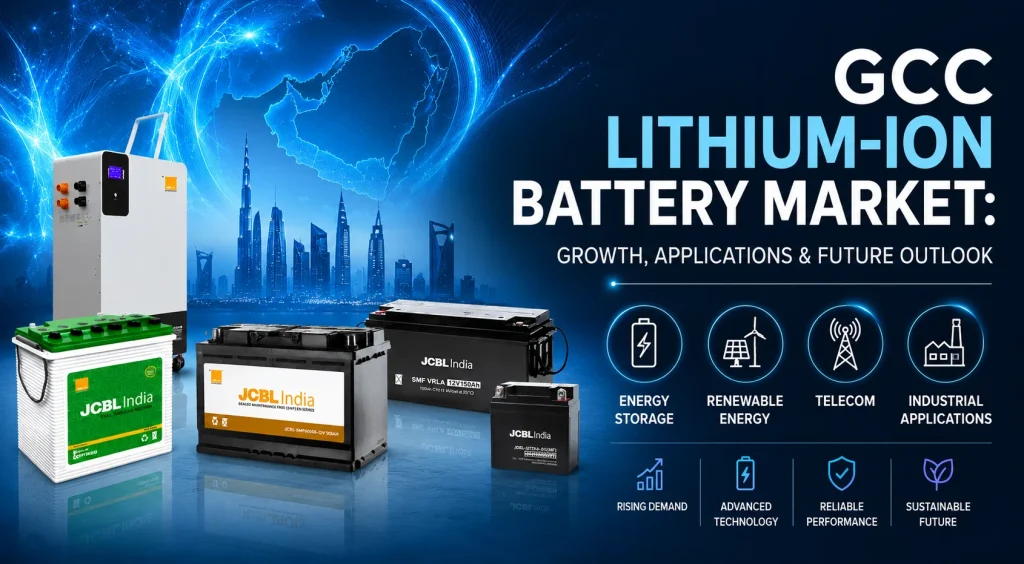
The GCC Lithium-Ion Battery Market is expanding rapidly as countries across the Gulf Cooperation Council accelerate investments in renewable energy, Battery Energy Storage Systems (BESS), smart grids, and critical infrastructure. Growing demand from utilities, telecom networks, data centers, and industrial sectors is driving widespread adoption of lithium-ion batteries to improve energy reliability and support the region’s clean energy transition. Backed by government initiatives such as Saudi Vision 2030 and the UAE Energy Strategy 2050, the GCC is emerging as a key growth hub within the broader Middle East Lithium-Ion Battery Market.
GCC Lithium-Ion Battery Market Overview
The GCC Lithium-Ion Battery Market comprises the manufacturing, supply, deployment, and adoption of lithium-ion batteries across Saudi Arabia, the UAE, Qatar, Oman, Kuwait, and Bahrain. These batteries are widely used in utility-scale energy storage, renewable energy projects, telecommunications, industrial operations, commercial facilities, and mission-critical backup power applications.
Unlike mature markets where electric vehicles account for a significant share of battery demand, the GCC market is primarily driven by stationary energy storage. Governments and utilities are investing heavily in Battery Energy Storage Systems (BESS) to improve grid reliability, manage peak electricity demand, and maximize the use of renewable energy generated from solar and wind projects.
This shift aligns with regional sustainability strategies, including Saudi Vision 2030, the UAE Energy Strategy 2050, and national net-zero commitments that prioritize cleaner, more resilient energy systems.
What’s Driving the GCC Lithium-Ion Battery Market?
What’s Driving the GCC Lithium-Ion Battery Market?
Renewable Energy Expansion
GCC countries are increasing investments in solar and renewable energy projects as part of their long-term energy diversification strategies. According to recent regional energy analyses, Saudi Arabia aims to generate approximately 50% of its electricity from renewable energy by 2030, creating substantial demand for battery storage solutions capable of managing intermittent power generation.
Battery Energy Storage Systems (BESS)
As solar and renewable energy capacity grows, utilities require storage systems to balance electricity supply and demand. Lithium-ion batteries are widely used in BESS projects because of their high energy density, fast response time, and scalability.
Saudi Arabia plans major battery storage procurement as part of its energy transition strategy, with large-scale BESS projects already under development.
Telecom and Digital Infrastructure
The expansion of 5G networks, telecom towers, cloud services, and data centers is increasing demand for reliable backup power systems. Lithium-ion batteries offer longer service life and lower maintenance requirements compared with conventional backup technologies.
Industrial Electrification
Industrial facilities, warehouses, logistics centers, and manufacturing plants are adopting lithium-ion battery systems to improve operational reliability and energy efficiency.
Why Lithium-Ion Batteries Are the Preferred Choice
Several technical advantages make lithium-ion batteries the preferred energy storage technology across the GCC.
| Advantage | Business Value |
| High energy density | Delivers more power in a compact footprint |
| Long operational lifespan | Reduces replacement frequency and lifecycle costs |
| Fast charging capability | Supports rapid energy availability |
| High efficiency | Improves overall energy utilization |
| Low maintenance | Reduces operational downtime and servicing requirements |
These characteristics make lithium-ion batteries suitable for renewable energy storage, utility-scale Battery Energy Storage Systems (BESS), telecom infrastructure, industrial facilities, and data centers.
Country-Wise Market Analysis
Saudi Arabia
Saudi Arabia represents the largest opportunity within the GCC Lithium-Ion Battery Market. Through Saudi Vision 2030, the country is investing significantly in renewable energy, smart cities, and grid modernization to reduce dependence on conventional energy sources.
Large-scale solar developments, Battery Energy Storage Systems, and mega projects such as NEOM are expected to generate sustained demand for advanced battery technologies. Continued government investment in clean energy infrastructure positions Saudi Arabia as the region’s leading growth market.
United Arab Emirates
The UAE has established itself as a regional leader in clean energy and energy storage through projects led by organizations such as Masdar and the Dubai Electricity and Water Authority (DEWA).
The country’s investment in large-scale solar-plus-storage facilities, combined with smart grid initiatives and growing data center infrastructure, continues to strengthen demand for lithium-ion batteries across utility, commercial, and industrial applications.
Qatar, Oman, Kuwait, and Bahrain
Although smaller in market size, these countries are steadily expanding lithium-ion battery adoption through renewable energy investments, telecom infrastructure upgrades, industrial diversification, and power sector modernization. As governments continue to strengthen energy resilience and sustainability initiatives, demand for advanced battery storage solutions is expected to increase across these emerging GCC markets.
Major Applications of Lithium-Ion Batteries in the GCC
Lithium-ion batteries are supporting the GCC’s energy transition by enabling reliable, efficient, and scalable power solutions across multiple industries.
| Application | Role in the Market |
| Battery Energy Storage Systems (BESS) | Stores renewable energy and improves grid stability |
| Utilities | Supports peak load management and power reliability |
| Telecom Infrastructure | Provides uninterrupted backup power for 4G/5G networks |
| Data Centers | Ensures continuous power for cloud and AI infrastructure |
| Industrial Facilities | Enhances energy management and operational continuity |
Among these applications, Battery Energy Storage Systems (BESS) are expected to witness the fastest growth as governments invest in utility-scale renewable energy projects and modernize national power grids.
Emerging Trends Shaping the GCC Lithium-Ion Battery Market
Several technological and policy developments are reshaping the GCC Lithium-Ion Battery Market.
Growing Adoption of Lithium Iron Phosphate (LFP) Batteries
LFP batteries are gaining popularity for stationary energy storage due to their long cycle life, improved thermal stability, and lower maintenance requirements. As utilities prioritize safety and lifecycle performance, LFP technology is becoming increasingly suitable for large-scale BESS projects.
Expansion of Smart Grid Infrastructure
Governments across the GCC are investing in smart grid technologies to improve energy efficiency, integrate renewable power, and strengthen grid resilience. Lithium-ion batteries are a critical component of these modern electricity networks.
Rising Investment in Battery Recycling
As battery deployment increases, countries are exploring battery recycling and circular economy initiatives to recover valuable materials, reduce waste, and strengthen long-term supply chain resilience.
Increasing Localization of Battery Manufacturing
To reduce dependence on imports and support economic diversification, several GCC countries are evaluating opportunities to develop local battery assembly, manufacturing, and energy storage ecosystems. These initiatives are expected to enhance supply chain security while creating new industrial opportunities.
Challenges Affecting Market Growth
Despite favorable growth prospects, the GCC Lithium-Ion Battery Market faces several challenges that could influence future expansion.
- Import Dependence: Most battery cells and critical raw materials are imported, making supply chains vulnerable to global disruptions.
- Raw Material Price Volatility: Fluctuations in lithium and other critical mineral prices can affect project costs and investment decisions.
- High Initial Investment: Utility-scale battery storage projects require substantial upfront capital despite declining battery prices.
- Battery Recycling Infrastructure: Recycling capabilities across the region are still developing, creating opportunities for further investment.
- Extreme Climate Conditions: High ambient temperatures require advanced battery cooling and thermal management systems to maintain performance and safety.
Addressing these challenges through technological innovation, policy support, and regional manufacturing initiatives will be important for sustaining long-term market growth.
Future Outlook
The outlook for the GCC Lithium-Ion Battery Market remains highly positive as countries continue to prioritize clean energy, energy security, and infrastructure modernization.
Over the next decade, market growth is expected to be supported by:
- Expansion of utility-scale Battery Energy Storage Systems (BESS)
- Continued investment in renewable energy generation
- Growth of smart grid and digital infrastructure projects
- Increasing demand from data centers and industrial facilities
- Development of regional battery manufacturing and recycling capabilities
As battery costs continue to decline and renewable energy deployment accelerates, lithium-ion batteries are expected to play an increasingly important role in supporting reliable, flexible, and low-carbon power systems throughout the GCC.
Conclusion
The GCC Lithium-Ion Battery Market is evolving into a strategic pillar of the region’s clean energy transition and infrastructure modernization. Strong government support, increasing renewable energy capacity, and growing deployment of Battery Energy Storage Systems (BESS) are creating new opportunities across utilities, telecommunications, data centers, and industrial sectors.
While challenges such as import dependence, raw material price volatility, and recycling infrastructure remain, continued investments in smart grids, localized manufacturing, and advanced battery technologies are expected to strengthen long-term market development.
As Saudi Arabia, the UAE, and other GCC countries advance their energy transition goals, the region is well positioned to become a key contributor to the broader Middle East Lithium-Ion Battery Market, supporting a more resilient, efficient, and sustainable energy future.
FAQs
The market is driven by renewable energy investments, Battery Energy Storage Systems (BESS), grid modernization, telecom expansion, and increasing industrial electrification across GCC countries.
Utilities, renewable energy, telecom, data centers, manufacturing, logistics, and industrial facilities are the major sectors driving lithium-ion battery adoption.
Lithium-ion batteries offer high energy density, longer lifespan, fast charging, low maintenance, and high efficiency, making them ideal for renewable energy storage and backup power applications.
Saudi Arabia and the UAE lead the market through significant investments in renewable energy, battery storage projects, and power infrastructure, while Qatar, Oman, Kuwait, and Bahrain continue expanding adoption.
The market supports the region’s energy transition by enabling renewable energy integration, improving grid reliability, expanding energy storage capacity, and strengthening sustainable power infrastructure.