

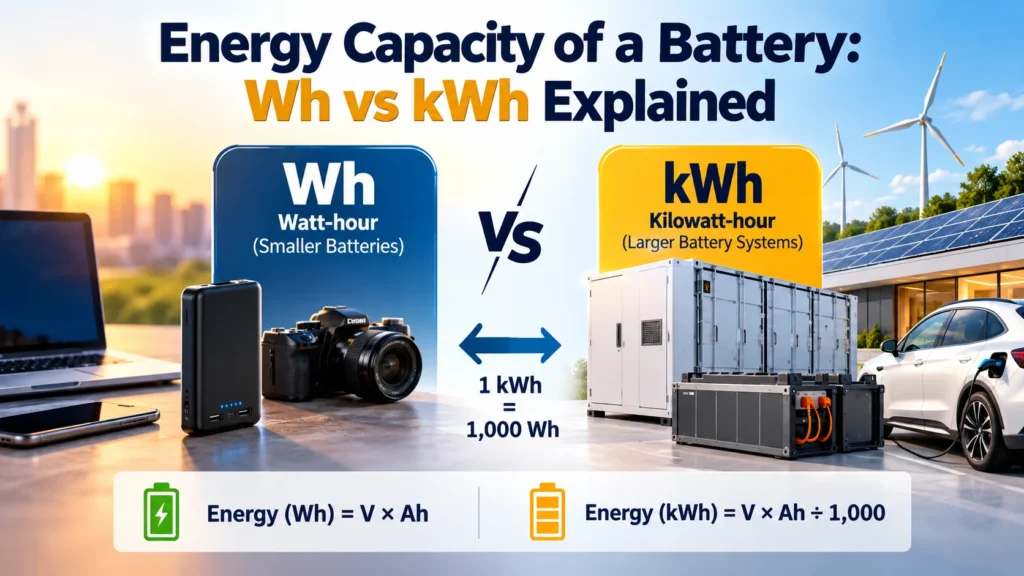
Battery energy capacity is the amount of electrical energy a battery can store or deliver under specified conditions. It is usually measured in watt-hours (Wh) or kilowatt-hours (kWh). One kWh equals 1,000 Wh, while battery energy can be estimated from voltage and ampere-hour capacity using Wh = V × Ah.
Understanding battery energy capacity, Wh vs kWh, and Ah vs Wh, is important when selecting batteries for electric vehicles, backup power, solar storage, portable electronics, and battery energy storage systems (BESS).
What Is the Energy Capacity of a Battery?
The energy capacity of a battery indicates how much electrical energy the battery can store under its specified rating conditions.
Common units include:
- Wh (watt-hours): Used mainly for smaller batteries.
- kWh (kilowatt-hours): Used mainly for larger battery systems.
For example:
- 500 Wh = 0.5 kWh
- 1,500 Wh = 1.5 kWh
- 10,000 Wh = 10 kWh
Battery energy capacity is different from power capacity. Energy capacity describes how much energy a battery can store, while power capacity describes how quickly it can deliver energy.
Wh vs kWh: What Is the Difference?
Wh and kWh are not different types of battery capacity. They are the same unit of energy expressed at different scales.
| Unit | Conversion | Common battery applications |
| Wh | 1 Wh | Power banks, laptops, portable batteries |
| kWh | 1,000 Wh | EVs, home storage, commercial and industrial BESS |
Therefore:
1 kWh = 1,000 Wh
1 Wh = 0.001 kWh
What Is Wh?
A watt-hour (Wh) is a unit of energy representing the amount of energy associated with one watt of power operating for one hour.
Wh is commonly used to describe smaller battery packs and portable electronic devices.
What Is kWh?
A kilowatt-hour (kWh) equals 1,000 watt-hours. It is more convenient for describing larger battery capacities, including electric vehicle batteries, solar energy storage systems, backup batteries, and industrial BESS.
For example, a 10 kWh battery has a nominal energy capacity of 10,000 Wh.
How Do You Calculate Battery Energy Capacity?
If the battery’s voltage and ampere-hour rating are known, use this basic formula:
Battery energy (Wh) = Voltage (V) × Capacity (Ah)
To calculate the capacity in kWh:
Battery energy (kWh) = Voltage (V) × Capacity (Ah) ÷ 1,000
Example: Calculate Battery Capacity in Wh
For a 12 V, 100 Ah battery:
12 × 100 = 1,200 Wh
Therefore:
1,200 Wh = 1.2 kWh
The battery has a nominal energy capacity of 1.2 kWh.
Example: Calculate Battery Capacity in kWh
For a 48 V, 200 Ah battery:
48 × 200 = 9,600 Wh
Convert Wh to kWh:
9,600 ÷ 1,000 = 9.6 kWh
So, the nominal energy capacity is 9.6 kWh.
How Do You Convert kWh to Ah?
The calculation can also be reversed when the battery’s voltage and energy capacity are known.
Battery capacity (Ah) = Energy (Wh) ÷ Voltage (V)
For example, consider a 5 kWh, 48 V battery:
5,000 Wh ÷ 48 V = 104.2 Ah
So, a 5 kWh battery operating at 48 V has an approximate capacity of 104.2 Ah.
This conversion is useful when comparing battery specifications that are expressed using different units.
Wh vs Ah: What Is the Difference?
Ah and Wh measure different aspects of a battery.
| Specification | What it measures |
| Ah | Electrical charge capacity |
| Wh | Energy capacity |
| kWh | Energy capacity at a larger scale |
| W/kW | Power or rate of energy delivery |
Ah alone does not indicate the total energy capacity because voltage must also be considered.
For example:
12 V × 100 Ah = 1,200 Wh
while:
48 V × 100 Ah = 4,800 Wh
Both batteries have a 100 Ah rating, but the 48 V battery has four times the calculated energy capacity.
This is why Wh or kWh is generally more useful than Ah alone when comparing the energy capacity of batteries with different voltages.
What Does a Battery’s kWh Rating Mean?
A battery’s kWh rating represents its stated energy capacity under specified rating conditions.
A higher kWh rating generally indicates that a battery can store more energy. However, the rated kWh should not automatically be treated as the exact amount of energy available to the connected load.
For example, a battery rated at 10 kWh may provide less than 10 kWh of usable energy because of operating limits, conversion losses, allowable depth of discharge, temperature, and battery degradation.
For commercial and industrial applications, comparing rated energy with usable energy is therefore important when selecting a battery system.
Rated Energy vs Usable Energy
Rated or nominal energy is the capacity stated under specified test or operating conditions.
Usable energy is the amount of energy that can actually be delivered within the battery and system’s operating limits.
The available energy can be affected by:
- Depth-of-discharge limits
- Battery management system settings
- Temperature
- Battery age and degradation
- Discharge rate
- Power conversion losses
For BESS procurement and system design, the usable energy specification can therefore be more informative than the headline kWh rating alone.
Battery Energy Capacity vs Power Capacity
Energy capacity and power capacity answer different questions.
| Battery specification | Meaning | Unit |
| Energy capacity | How much energy the battery can store | Wh/kWh |
| Power capacity | How quickly the battery can deliver energy | W/kW |
For example, a battery may be rated at 20 kWh of energy capacity and 5 kW of power.
The 20 kWh describes the battery’s energy capacity, while 5 kW describes its power-delivery rating.
A higher kWh rating therefore does not necessarily mean a battery can deliver more instantaneous power. Battery selection should consider both specifications when the application has specific power and runtime requirements.
How Much Battery Energy Capacity Do You Need?
The required battery energy capacity depends primarily on the load power and required operating time.
A basic energy requirement can be calculated as:
Required energy (kWh) = Load (kW) × Operating time (hours)
For example, a system requiring a continuous 2 kW load for 5 hours needs:
2 kW × 5 hours = 10 kWh
This is the theoretical energy required by the load. In a real battery system, the required nominal battery capacity may need to be higher because of:
- System efficiency losses
- Allowable depth of discharge
- Operating reserves
- Temperature
- Battery operating limits
Therefore, battery sizing should be based on usable energy requirements, not simply the load calculation.
Why Battery Energy Capacity Matters
Battery energy capacity is a key specification across several applications:
| Application | Importance of energy capacity |
| Electric vehicles | Indicates the amount of stored energy available for driving |
| Solar energy storage | Determines how much generated energy can be stored |
| Backup power | Influences how long supported loads can operate |
| Commercial BESS | Determines the available stored energy for the intended application |
| Portable electronics | Helps indicate potential operating duration |
For manufacturers, system integrators, and battery buyers, energy capacity should be evaluated together with voltage, power rating, usable energy, efficiency, and operating conditions.
Conclusion
Wh and kWh both measure battery energy capacity, with 1 kWh equal to 1,000 Wh. Battery energy can be estimated using Wh = V × Ah, but the rated capacity does not always equal the usable energy available to an application. For accurate battery selection, particularly for EVs, solar storage, backup power, and BESS, consider energy capacity, power rating, usable energy, and operating conditions together.
FAQs
Battery energy capacity is the amount of electrical energy a battery can store or deliver under specified conditions. It is commonly expressed in Wh or kWh.
Neither is better. Both measure energy. Wh is commonly used for smaller batteries, while kWh is more practical for larger battery systems.
1 kWh = 1,000 Wh.
Use:
Battery energy (Wh) = Voltage (V) × Capacity (Ah)
For example, a 12 V, 100 Ah battery has a calculated capacity of 1,200 Wh or 1.2 kWh.
Ah measures electrical charge capacity, while kWh measures energy capacity. Voltage is required to convert Ah into kWh.
kWh = V × Ah ÷ 1,000
No. The appropriate battery capacity depends on the application’s load, required runtime, power requirement, usable energy, and operating conditions.
No. Energy capacity indicates how much energy is stored and is measured in Wh or kWh. Power capacity indicates how quickly energy can be delivered and is measured in W or kW.