

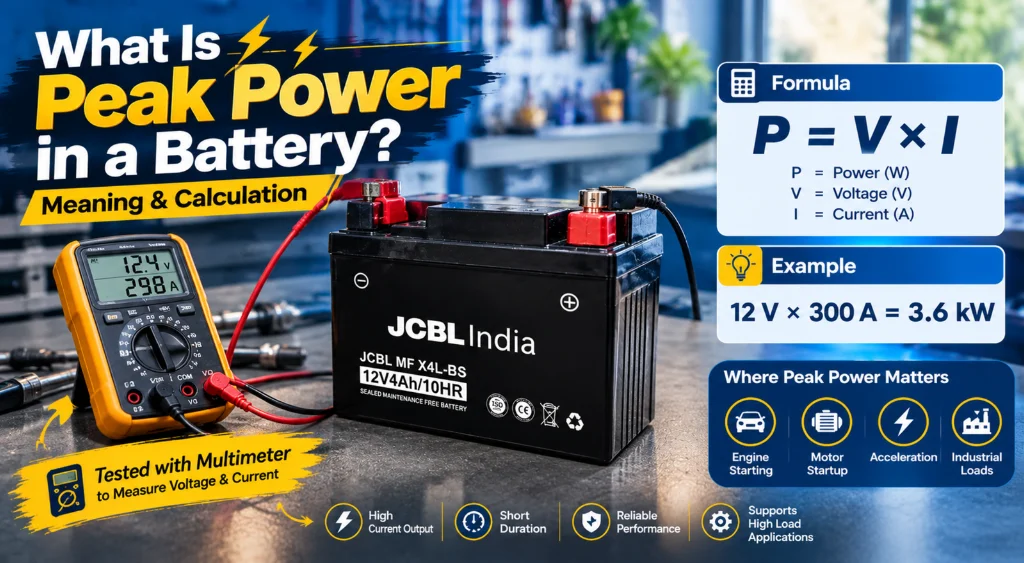
Battery peak power is the maximum electrical power a battery can deliver for a specified short duration under defined operating conditions. It is usually measured in watts (W) or kilowatts (kW) and depends on factors such as voltage, current, temperature, state of charge, internal resistance, and battery design.
Peak power is important for applications that require a temporary surge of electrical output, such as engine starting, motor startup, electric vehicle acceleration, and industrial equipment.
What Is Peak Power in a Battery?
Peak power refers to the highest power a battery can deliver during a short, defined period while operating within specified limits.
Unlike continuous power, which represents output that can be sustained for a longer period, peak power describes the battery’s ability to handle a temporary high-power demand.
For example, a battery may deliver a high current for a few seconds during engine cranking or motor startup, even though it cannot safely supply that same current continuously.
A battery’s peak-power capability should therefore be considered together with the duration of the peak, operating temperature, state of charge, voltage, and maximum discharge current.
How Is Battery Peak Power Calculated?
For a DC battery system, electrical power can be calculated using:
P = V × I
Where:
- P = power in watts (W)
- V = voltage in volts (V)
- I = current in amperes (A)
For peak power:
Peak Power (W) = Voltage During Peak Event (V) × Peak Current During Peak Event (A)
Example of Peak Power Calculation
Suppose a battery delivers 12 V and 300 A during a short high-current event.
Peak Power = 12 × 300
Peak Power = 3,600 W or 3.6 kW
So, the estimated peak power under those conditions is 3.6 kW.
However, this is a simplified calculation. If 12 V is only the battery’s nominal voltage, the actual terminal voltage during the high-current event may be lower because of voltage drop and internal resistance. For engineering and procurement decisions, the manufacturer’s specified peak-power or maximum-discharge rating should take priority over a theoretical calculation.
Is Peak Power the Same as Maximum Discharge Power?
Not necessarily. Maximum discharge current specifies how much current a battery can deliver under defined conditions, while peak power expresses the resulting electrical power based on voltage and current.
A manufacturer may specify:
- Maximum continuous discharge current
- Peak or pulse discharge current
- Peak discharge duration
- Maximum discharge power
- Operating temperature and state-of-charge conditions
For a battery system that includes components such as a battery management system (BMS) or inverter, the system’s usable peak power can also be limited by those components.
Therefore, a battery’s theoretical power calculated from voltage and current should not automatically be treated as its certified or usable system-level peak-power rating.
Peak Power vs Continuous Power: What Is the Difference?
| Parameter | Peak Power | Continuous Power |
| Duration | Short, specified period | Extended operation |
| Purpose | Handles temporary high loads | Supports sustained loads |
| Current demand | Typically higher | Designed for sustainable output |
| Main consideration | Short-term current and voltage performance | Long-term thermal and electrical performance |
| Typical applications | Starting, acceleration, motor startup, surge loads | Ongoing equipment and electrical loads |
A battery can have a high peak-power capability without being designed to deliver that same output continuously.
The duration associated with a peak rating is therefore essential when comparing batteries.
What Determines a Battery’s Peak Power?
Several electrical, physical, and operating factors affect peak-power capability.
1. Battery Voltage
Power increases with voltage when current remains constant. However, the relevant value for peak-power calculation is the voltage during the peak event, not necessarily the nominal battery voltage.
2. Maximum Discharge Current
A battery must be designed to supply the required current safely. Higher allowable discharge current generally provides greater potential peak-power capability at a given voltage.
3. Internal Resistance
Internal resistance causes voltage to drop when high current flows. Lower internal resistance generally allows a battery to deliver high current with less voltage loss.
4. State of Charge
A battery’s power capability can change as its state of charge changes. A heavily discharged battery may not deliver the same peak performance as it would at a higher state of charge.
5. Temperature
Temperature affects battery voltage, resistance, and current-delivery capability. Extreme temperatures can therefore reduce available peak power.
6. Battery Age and Condition
Battery degradation can increase internal resistance and reduce high-current performance. As a result, an older battery may not deliver the same peak output as a new battery under identical conditions.
7. Battery Chemistry and Design
Cell chemistry, electrode design, cell construction, and overall battery architecture influence high-power performance. Batteries designed for high-power applications can have different discharge characteristics from batteries optimized primarily for energy storage.
Why Is Peak Power Important?
Peak power matters when equipment experiences sudden increases in electrical demand.
For example, an engine starter requires a large current for a short period, while an electric motor may draw significantly more current during startup than during normal operation.
Understanding peak power helps battery manufacturers, engineers, system integrators, and buyers:
- Match battery output to equipment requirements.
- Account for short-duration startup and surge loads.
- Avoid selecting a battery based only on capacity.
- Check whether voltage can remain within the required operating range during high-current events.
- Compare battery specifications using the same test conditions.
- Design appropriate performance margins into the battery system.
For electric vehicles, hybrid systems, industrial equipment, and energy-storage applications, peak-power capability can directly affect how the system responds to sudden changes in load.
Peak Power vs. Battery Capacity: What’s the Difference?
Peak power and battery capacity measure different aspects of battery performance.
- Peak power (W or kW): The power a battery can deliver during a specified high-demand event.
- Capacity (Ah or Wh): The amount of charge or energy the battery can store.
A higher Ah rating does not automatically mean higher peak power.
For example, a battery with greater capacity may be designed primarily for long-duration energy delivery, while a smaller battery may be engineered to provide high current for short periods.
Therefore, battery capacity alone cannot determine peak power. Voltage, maximum discharge current, internal resistance, battery design, and operating conditions must also be considered.
How Do You Find the Peak Power Rating of a Battery?
For battery selection and engineering applications, start with the manufacturer’s datasheet rather than calculating a rating from capacity alone.
Look for specifications such as:
- Peak discharge current
- Maximum discharge current
- Maximum or peak power
- Pulse discharge rating
- Cranking or starting current, where applicable
- Peak-output duration
- Test temperature
- State-of-charge conditions
If the relevant voltage and peak current are provided, use:
Peak Power = Voltage During Peak Event × Peak Current
When comparing batteries for commercial or industrial applications, make sure the peak duration and test conditions are comparable. A peak-power figure without its duration or operating conditions may not provide a meaningful basis for comparison.
Conclusion
Battery peak power indicates how much electrical power a battery can deliver during a short, high-demand event. It can be estimated using P = V × I, but actual peak performance depends on voltage under load, discharge-current capability, internal resistance, temperature, state of charge, battery design, and the specified peak duration.
For accurate battery selection, evaluate the manufacturer’s peak-power or maximum-discharge specifications together with their duration and test conditions. This provides a more reliable basis for matching a battery to automotive, industrial, electric mobility, and energy-storage applications.
FAQs
Peak power is the maximum electrical power a battery can deliver for a specified short duration under defined operating conditions. It is generally measured in watts or kilowatts.
Use P = V × I, multiplying the voltage during the peak event by the current delivered during that event. Actual peak output can differ from a simple calculation because of voltage drop and operating conditions.
No. Battery capacity and peak power measure different characteristics. Peak power also depends on voltage, maximum discharge current, internal resistance, battery design, and operating conditions.
Peak power refers to short-duration output during a high-demand event, while continuous power refers to output that the battery can sustain for a longer period under specified conditions.
Yes. Temperature can affect voltage, internal resistance, and current-delivery capability, which can change the battery’s available peak power.
No. Maximum discharge current measures current capability, while peak power expresses power output. They are related through voltage, but both should be evaluated under their specified operating and time conditions.