

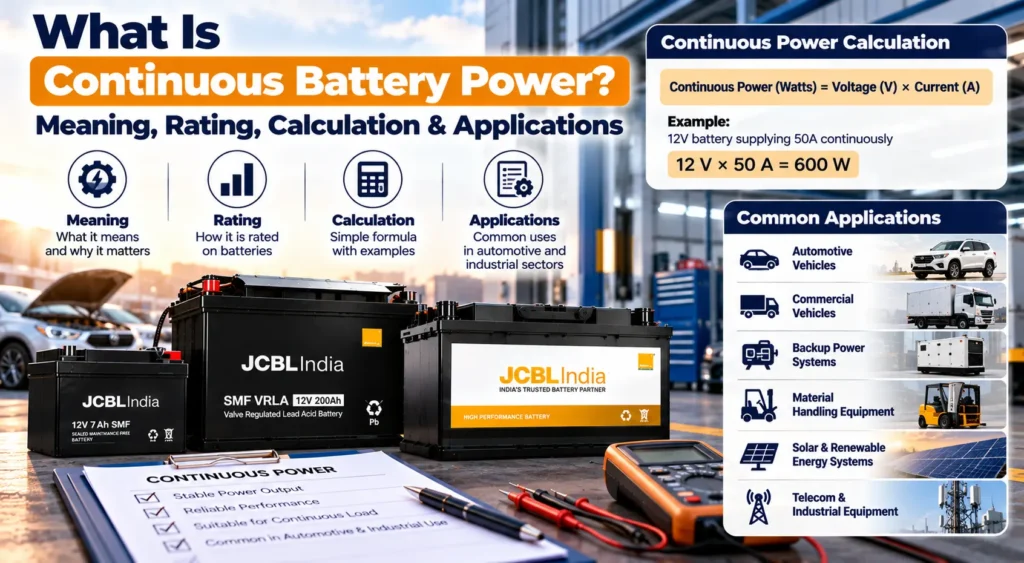
Continuous battery power is the amount of electrical power a battery can deliver continuously under specified operating conditions without exceeding its voltage, current, thermal, or safety limits. It is typically expressed in watts (W) or kilowatts (kW) and is closely related to the battery’s operating voltage and continuous discharge current.
Unlike peak power, which is available only for a limited period, continuous power indicates how much load a battery can support during sustained operation. This makes it an important specification when selecting batteries for electric vehicles, UPS systems, energy storage, and industrial equipment.
What Is Continuous Battery Power?
A battery’s continuous power capability describes its ability to supply electrical power over an extended period while remaining within its specified operating limits.
Manufacturers may specify this capability as continuous power, continuous discharge current, or maximum continuous discharge current. These specifications are normally provided under defined conditions, such as a particular temperature, state of charge, discharge duration, or end-of-discharge voltage.
Therefore, continuous battery power should not be treated as a fixed value that applies under every operating condition. The actual available output can vary depending on battery design, temperature, state of charge, BMS limits, and other system parameters.
How Is Continuous Battery Power Rated?
Continuous battery power is generally expressed in watts (W) or kilowatts (kW). It can be determined from the battery’s operating voltage and continuous current rating.
Continuous Current Rating
The continuous current rating, measured in amperes (A), indicates how much current a battery can supply continuously under specified conditions.
For example, a battery with a 50 A continuous discharge rating can supply up to 50 A continuously under the conditions defined by the manufacturer.
Continuous Power Rating
The continuous power rating represents the electrical power the battery can deliver during sustained operation. Because power depends on both voltage and current, a current rating alone does not provide the complete power specification.
There is no single universal format for reporting continuous battery power. Manufacturers may provide continuous current, continuous power, C-rate, or other discharge specifications. These ratings should therefore be interpreted according to the manufacturer’s stated test conditions and limits.
How to Calculate Continuous Battery Power
The basic electrical relationship is:
Continuous Power (W) = Voltage (V) × Continuous Current (A)
Where:
- P = power in watts
- V = operating voltage in volts
- I = continuous current in amperes
Example
Suppose a battery operates at 48 V and has a continuous discharge rating of 50 A.
48 V × 50 A = 2,400 W
Therefore:
Continuous power = 2.4 kW
This is the calculated electrical output at that operating point. The actual usable system output may be lower because of voltage variation, BMS restrictions, temperature, conversion losses, inverter limitations, or other manufacturer-specified constraints.
Continuous Power vs Peak Power vs Battery Energy
These three battery specifications describe different aspects of performance:
| Parameter | What It Measures | Typical Unit |
| Continuous power | Power the battery can supply for sustained operation | W or kW |
| Peak power | Higher power available for a limited period | W or kW |
| Battery energy | Total amount of energy stored in the battery | Wh or kWh |
For example, a battery may store 10 kWh of energy while having a 5 kW continuous power rating. The energy capacity indicates how much energy is stored, while the power rating indicates how quickly that energy can be delivered.
This distinction is important when sizing a battery system. A battery with sufficient energy capacity may still be unsuitable if its continuous power rating cannot support the connected load.
What Determines a Battery’s Continuous Power Output?
Several factors influence how much power a battery can continuously deliver.
Battery Voltage
Power increases with voltage at a given current. However, battery voltage changes during charging and discharging, so the operating voltage used for calculations should match the relevant system condition.
Continuous Discharge Current
The cells, electrical connections, conductors, and other components must be designed to handle the required current for the intended duration.
Internal Resistance
Internal resistance causes voltage drop and heat generation when current flows. Higher resistance can reduce usable output and increase thermal losses during sustained discharge.
Battery Management System
The Battery Management System (BMS) monitors parameters such as voltage, current, and temperature. It can limit discharge current when operating conditions approach defined safety or performance thresholds.
Thermal Management
Continuous high-power discharge generates heat. The battery’s thermal design and cooling system therefore influence how much power it can safely deliver over time.
Temperature and State of Charge
Battery performance can vary with operating temperature and state of charge. Continuous power ratings should therefore be considered alongside the conditions under which the manufacturer specifies them.
Why Does Continuous Battery Power Rating Matter?
Continuous power is critical when a battery must support a load for an extended period.
- Battery sizing: The continuous rating must meet the application’s normal operating load.
- System compatibility: The battery must provide suitable voltage and power for connected equipment such as motors, inverters, controllers, or electrical loads.
- Thermal performance: Sustained current demand generates heat, making continuous power capability relevant to thermal design.
- Reliable operation: Operating within the specified continuous rating helps prevent the battery from being subjected to excessive electrical or thermal stress.
- Power system design: Engineers need to evaluate continuous and peak requirements separately to select an appropriately sized battery and supporting power electronics.
Applications of Continuous Battery Power
- Electric Vehicles: EV batteries need sufficient continuous power for sustained driving and normal vehicle operation. Higher peak power may additionally be required for short-duration acceleration.
- UPS and Backup Power Systems: In a UPS, continuous power determines how much connected electrical load the battery system can support during an outage. The required rating depends on the load and the expected backup period.
- Battery Energy Storage Systems: In commercial, industrial, and grid-connected energy storage, continuous power determines how quickly stored energy can be supplied to electrical loads or the grid.
- Industrial Equipment: Battery-powered forklifts, mobile machinery, automated equipment, and other industrial systems may require continuous power throughout their operating cycles. The battery must therefore match the equipment’s sustained demand.
- Renewable Energy Systems: Battery storage systems used with solar and other renewable sources rely on adequate continuous power to supply loads when renewable generation is unavailable or insufficient.
How to Choose the Right Continuous Battery Power Rating
Before selecting a battery, evaluate the complete power requirement of the application.
- Determine the continuous load: Identify the power required during normal operation.
- Check system voltage: Ensure the battery’s operating voltage is compatible with the equipment.
- Verify continuous current: Check the manufacturer’s specified continuous discharge rating.
- Identify peak demand: Account separately for temporary high-power requirements such as motor starting or acceleration.
- Consider operating conditions: Review temperature, duty cycle, and expected state of charge.
- Check system limitations: Consider BMS, inverter, controller, and other power-electronics limits.
- Follow manufacturer specifications: Use the stated continuous rating and its applicable test conditions for final selection.
Conclusion
Continuous battery power is the amount of electrical power a battery can supply for sustained operation within its specified electrical, thermal, and safety limits. It can be estimated using P = V × I, but the actual usable output depends on the battery’s design and operating conditions.
For EVs, UPS systems, industrial equipment, and energy storage applications, distinguishing continuous power from peak power and battery energy is essential for accurate sizing, reliable operation, and effective system design.
FAQs
Continuous power is the amount of electrical power a battery can supply for sustained operation while remaining within its specified operating limits.
Continuous battery power can be calculated using P = V × I, where P is power in watts, V is operating voltage in volts, and I is continuous current in amperes.
Continuous power is intended for sustained operation, while peak power represents a higher output that the battery can provide for a limited period.
It indicates the amount of current, measured in amperes, that the battery can continuously supply under specified operating conditions.
No. Power describes how quickly electrical energy can be delivered and is measured in W or kW. Energy describes how much energy is stored and is measured in Wh or kWh.