

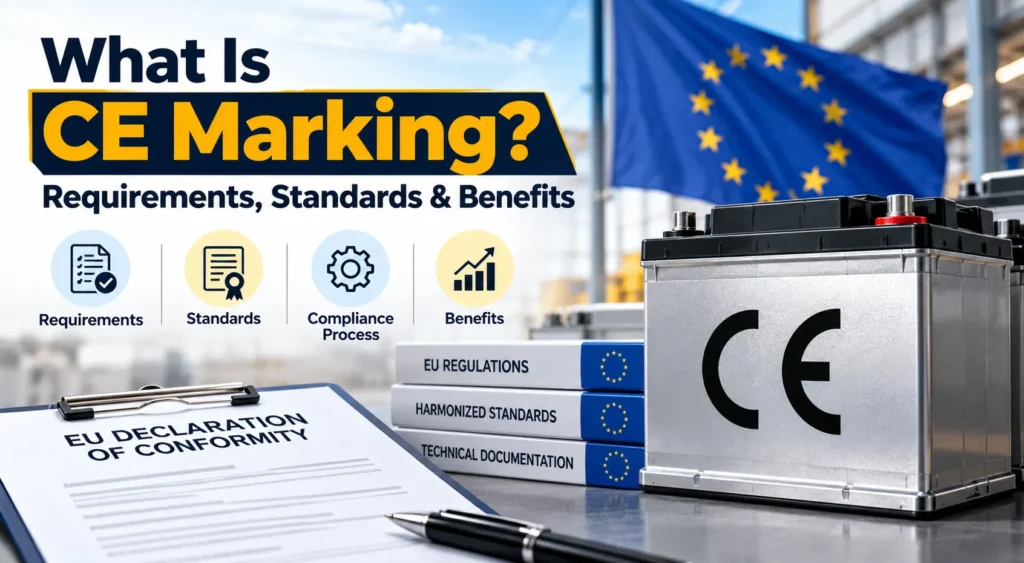
CE marking is a mandatory conformity marking for products covered by specific European Union (EU) legislation. It indicates that the manufacturer has assessed the product against the applicable EU requirements and takes responsibility for its conformity. CE marking is relevant to manufacturers, exporters, importers, and distributors supplying regulated products to the European Economic Area (EEA).
For battery manufacturers, CE marking is particularly important because the EU Batteries Regulation (EU) 2023/1542 establishes specific requirements for battery safety, conformity assessment, labelling, documentation, and CE marking.
What Is CE Marking?
CE marking is a conformity marking used on products that fall within the scope of EU legislation requiring it. By affixing the CE mark, the manufacturer declares that the product complies with all applicable EU legal requirements covered by the relevant legislation.
CE stands for “Conformité Européenne,” meaning “European Conformity.”
CE marking is not:
- An EU quality certification
- An approval issued by the European Union
- Proof that a product was manufactured in Europe
- A guarantee of product quality
- Required for every product sold in Europe
Only products covered by EU legislation that specifically requires CE marking should carry it.
Why Is CE Marking Important?
CE marking provides a common conformity framework for regulated products entering the European market. It helps manufacturers demonstrate that applicable requirements have been addressed and enables compliant products to be placed on the EEA market.
For manufacturers and B2B suppliers, CE compliance can help:
- Meet applicable EU market-access requirements
- Demonstrate regulatory conformity to customers
- Maintain required technical and compliance documentation
- Support distribution across the EEA
- Establish a consistent product-compliance process
However, CE marking itself does not mean that the EU or another authority has independently approved the product. The manufacturer remains responsible for demonstrating conformity.
Which Products Need CE Marking?
CE marking applies to product categories covered by specific EU harmonization legislation. Depending on the applicable legislation, these can include:
- Machinery
- Electrical and electronic equipment
- Medical devices
- Personal protective equipment
- Toys
- Pressure equipment
- Batteries and other regulated products
A product may also be subject to more than one EU regulation or directive. Therefore, manufacturers must identify all applicable legislation before determining the conformity-assessment route.
For batteries, the relevant framework is increasingly centered on Regulation (EU) 2023/1542 concerning batteries and waste batteries.
CE Marking Requirements
The exact CE marking requirements depend on the product and the EU legislation that applies to it. In general, manufacturers need to complete the following steps:
- Identify Applicable EU Legislation: Determine which EU regulations or directives apply to the product.
- Identify Applicable Standards: Identify relevant harmonized standards and other technical requirements that can be used to demonstrate conformity.
- Assess Product Conformity: Evaluate the product against the applicable safety, health, environmental, performance, or other legal requirements.
- Complete Required Testing: Conduct the testing, inspections, or assessments required by the applicable legislation and conformity-assessment procedure.
- Prepare Technical Documentation: Create and maintain technical documentation containing the evidence needed to demonstrate conformity.
- Use a Notified Body When Required: Some products require independent conformity assessment by an EU-designated notified body. This is not required for every CE-marked product.
- Prepare the EU Declaration of Conformity: The manufacturer signs an EU Declaration of Conformity (DoC) stating that the product meets the applicable requirements.
- Affix the CE Marking: After the required conformity process has been completed, the CE marking is affixed to the product, packaging or accompanying documentation as permitted by the applicable legislation.
What Are CE Marking Standards?
CE marking is not a standard itself. It is a conformity marking based on applicable EU legislation.
Manufacturers may use harmonized European standards where relevant to demonstrate conformity with requirements in EU legislation. These standards are developed by recognized European Standards Organizations such as CEN, CENELEC, and ETSI, and their references must be published in the Official Journal of the European Union to have the relevant legal effect.
The relationship can be simplified as
EU legislation → applicable requirements → relevant standards/testing → conformity assessment → EU Declaration of Conformity → CE marking
The specific standards depend on the product, technology and legislation involved. Therefore, manufacturers should not assume that one CE standard applies to every product.
CE Marking Process: A Simple Guide
For a manufacturer, the CE marking process can be summarized as:
- Identify the applicable EU legislation.
- Determine the product’s applicable requirements.
- Identify relevant harmonized standards.
- Carry out required testing and conformity assessment.
- Determine whether a notified body is required.
- Prepare technical documentation.
- Prepare and sign the EU Declaration of Conformity.
- Affix the CE marking correctly.
- Keep compliance records and monitor continued conformity.
The exact procedure can vary according to the product and legislation.
CE Marking in the Battery Industry
CE marking has become an important compliance requirement for battery manufacturers supplying the EU market.
Under the EU Batteries Regulation (EU) 2023/1542, batteries must meet applicable requirements covering areas such as safety, sustainability, labelling, information, and conformity assessment. The regulation specifically states that the CE marking on a battery indicates conformity with the applicable requirements of the regulation.
This means battery manufacturers need to consider CE compliance as part of their product development and manufacturing process rather than treating CE marking as a final labelling exercise.
For battery manufacturers, the compliance process can involve:
- Battery design and safety requirements
- Applicable conformity-assessment procedures
- Technical documentation
- Testing and verification
- EU Declaration of Conformity
- CE marking
- Battery-specific labelling and information requirements
Importers also have responsibilities. Before placing a battery on the EU market, they must verify, among other things, that the required conformity assessment, technical documentation, EU Declaration of Conformity, and CE marking have been completed.
What Are the CE Marking Requirements for Batteries?
The EU Batteries Regulation establishes specific conformity-assessment procedures for batteries.
For batteries manufactured in series, the regulation provides routes including:
- Module A: Internal Production Control
- Module D1: Quality Assurance of the Production Process
For batteries not manufactured in series, applicable routes include:
- Module A: Internal Production Control
- Module G: Conformity Based on Unit Verification
The applicable procedure depends on the specific requirements and battery category.
Battery manufacturers must also prepare the required technical documentation and complete the applicable conformity-assessment procedure before preparing the EU Declaration of Conformity and affixing the CE marking.
Battery Labeling Requirements
CE marking is only one part of battery compliance.
The EU Batteries Regulation also introduces specific battery labeling and information requirements. From 18 August 2026, subject to the regulation’s stated conditions, batteries must carry specified general information, with additional capacity information applying to certain rechargeable battery categories.
From 18 February 2027, batteries are required to carry a QR code under the regulation. For certain categories, including electric vehicle batteries, light means of transport batteries, and industrial batteries above 2 kWh, the QR code provides access to the battery passport.
These requirements make it important for battery manufacturers to plan compliance across design, testing, documentation, labeling, and production, rather than addressing CE marking only after manufacturing is complete.
Benefits of CE Marking for Manufacturers
CE marking can provide several practical benefits when it is correctly applied:
- Supports EU Market Access: For products subject to CE-marking legislation, conformity is necessary for placing the product on the EEA market.
- Demonstrates Regulatory Conformity: The CE mark provides a visible indication that the manufacturer has completed the applicable conformity process.
- Supports B2B Procurement: Compliance documentation can help customers and procurement teams evaluate whether a product meets applicable EU requirements.
- Creates a Structured Compliance Process: The requirements encourage manufacturers to maintain systematic records covering testing, technical documentation, and conformity assessment.
For battery manufacturers, this structured approach is particularly relevant because battery regulations combine safety, sustainability, labeling, and information requirements.
Common CE Marking Mistakes
Manufacturers should avoid these common compliance errors:
- Assuming every product requires CE marking
- Treating CE marking as a quality certificate
- Selecting the wrong EU legislation
- Assuming a notified body is always required
- Affixing the CE mark before completing the conformity assessment
- Failing to maintain technical documentation
- Using outdated or inappropriate standards
- Treating CE marking as separate from product design and compliance planning
- Overlooking battery-specific labelling and documentation requirements
CE Marking Compliance Checklist
Before placing a regulated product on the EU market, manufacturers should verify:
- Applicable EU legislation identified
- Relevant standards identified
- Product requirements assessed
- Required testing completed
- Correct conformity-assessment procedure completed
- Technical documentation prepared
- EU Declaration of Conformity prepared
- CE marking correctly affixed
- Required product information and labeling completed
- Compliance records maintained
For batteries, also verify applicable requirements under the EU Batteries Regulation, battery-specific conformity assessment, labeling requirements, and applicable QR code or battery passport obligations.
Conclusion
CE marking is a regulatory conformity requirement for products covered by applicable EU legislation. It requires manufacturers to identify the relevant legal requirements, assess conformity, complete required testing or assessment, prepare technical documentation, and issue an EU Declaration of Conformity before affixing the mark.
For battery manufacturers, CE compliance now forms part of a broader EU regulatory framework covering battery safety, sustainability, labeling, documentation, and conformity assessment. Understanding these requirements early can help manufacturers build compliance into product development and production rather than treating it as a final-stage requirement.
FAQs
CE marking is mandatory when a product falls under EU legislation that requires the marking. It is not required for every product sold in Europe.
No. CE marking is generally the manufacturer’s declaration that the product complies with applicable EU requirements. Some products require assessment by a notified body.
No. CE marking does not mean that the European Union has independently approved or certified the product.
Batteries within the scope of the EU Batteries Regulation are subject to CE-marking requirements after the applicable conformity requirements have been fulfilled.
The requirements vary by product, but manufacturers generally need technical documentation and an EU Declaration of Conformity, along with evidence required by the applicable conformity-assessment procedure.
No. Whether a notified body is required depends on the applicable EU legislation and conformity-assessment procedure.