

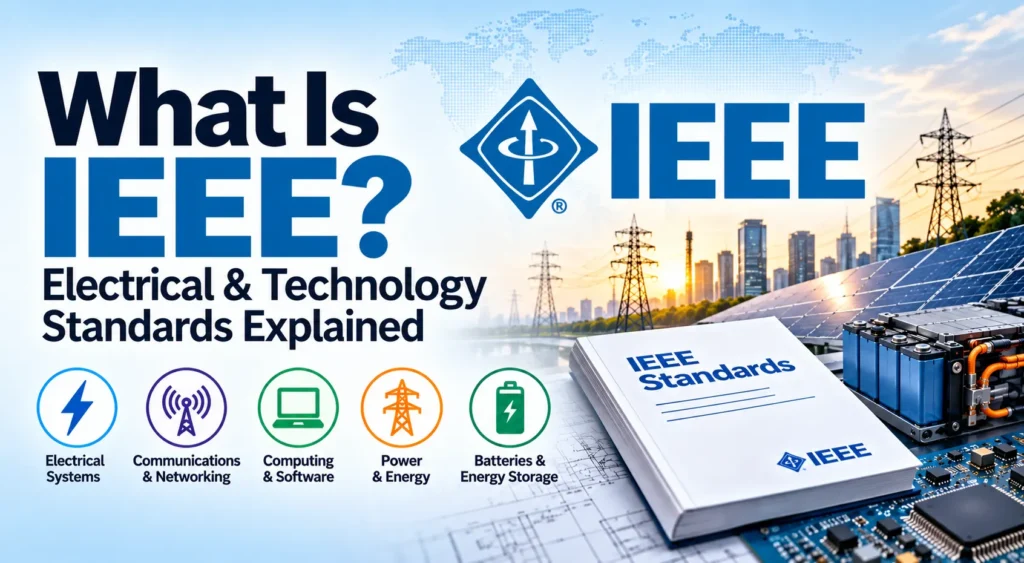
IEEE is a global technical professional organization that advances electrical, electronic, computing, communications, power, and related technologies. One of its major functions is developing technical standards through the IEEE Standards Association (IEEE SA).
IEEE standards provide specifications, requirements, recommended practices, guides, and technical methods that help organizations develop, evaluate, and implement technologies consistently. IEEE standards cover a wide range of applications, including electrical systems, communications, computing, power and energy, and batteries.
For battery manufacturers and energy-storage companies, specific IEEE standards provide technical frameworks for battery evaluation, battery packs, stationary energy storage, and integration with electric power systems.
What Is IEEE?
IEEE stands for the Institute of Electrical and Electronics Engineers. It is a technical professional organization focused on advancing technology and supporting engineering and scientific knowledge.
Through IEEE SA, the organization also develops and publishes technical standards. These standards are created through structured processes involving technical working groups and consensus-based review.
What Are IEEE Standards?
IEEE standards are published technical documents that establish specifications, requirements, measurement or testing methods, recommended practices, guides, terminology, or other technical frameworks for particular technologies and applications.
They provide a common technical reference for manufacturers, engineers, researchers, utilities, technology companies, and other stakeholders.
For example, an IEEE standard may address how a technology should be evaluated, how technical performance is measured, how systems interact, or which engineering practices should be followed within a defined scope.
Why Are IEEE Standards Important?
IEEE standards help organizations work from a common technical framework instead of developing requirements independently for every application.
For manufacturers and technology companies, this can support:
- Consistency: Common technical requirements and terminology.
- Interoperability: Frameworks that help different devices or systems work together where the relevant standard addresses interoperability.
- Testing and evaluation: Defined methods or criteria for particular technologies.
- Product development: Technical references that can reduce the need to develop processes from scratch.
- International collaboration: Standards can provide a common technical basis across organizations and markets.
IEEE states that standards can support compatibility, interoperability, product development, market access, and international trade.
How Are IEEE Standards Developed?
IEEE standards are developed through a structured, consensus-based process. A standards project can begin when a technical need is identified. A working group then develops the technical document, followed by review and balloting before approval and publication.
IEEE SA describes its standards development as a six-stage life cycle. Working groups include individuals and representatives from organizations with relevant technical knowledge or interest, and the process is designed to consider different affected interests.
IEEE standards can take different forms, including standards, recommended practices, guides, and trial-use documents. Their scope and wording determine whether they establish requirements, recommendations, or guidance.
What Technologies Do IEEE Standards Cover?
IEEE standards extend well beyond traditional electrical engineering. The IEEE standards catalogue includes areas such as:
- Electrical and electronic systems
- Power and energy
- Power electronics
- Communications and networking
- Computing and software
- Electromagnetic compatibility
- Transportation
- Smart grids
- Batteries and energy storage
IEEE’s standards catalogue currently lists batteries and power and energy as dedicated subject areas, alongside numerous other technology fields.
This broad scope makes IEEE standards relevant to manufacturers at different stages of technology development, from individual components and equipment to integrated electrical and energy-storage systems.
Why Are IEEE Standards Important in the Battery Industry?
Battery technology increasingly connects with electronics, electric vehicles, renewable energy, telecommunications, and electric power systems. As a result, different battery applications can require different technical considerations.
IEEE standards address specific battery technologies and applications rather than serving as one universal standard for every battery.
For battery manufacturers, engineers, and energy-storage companies, applicable IEEE standards can provide technical references for:
- Battery design and system considerations
- Battery qualification and evaluation
- Performance characterization
- Battery pack construction and controls
- Stationary energy-storage systems
- Operation and maintenance of battery energy-storage systems
- Technical terminology and communication
The applicable standard depends on factors such as battery chemistry, application, system design, and intended use.
Examples of IEEE Battery Standards
IEEE 1725-2021: Rechargeable Batteries for Mobile Phones
IEEE 1725-2021 establishes criteria for design analysis related to the qualification, quality, and reliability of rechargeable lithium-ion batteries used in mobile-phone host devices.
Its scope also includes battery-pack electrical and mechanical construction, packaging technologies, cell- and pack-level charge and discharge controls, and overall system considerations.
This makes IEEE 1725 relevant to manufacturers and engineers working with rechargeable lithium-ion battery packs for mobile applications.
IEEE 2030.2.1-2019: Battery Energy Storage Systems
IEEE 2030.2.1-2019 provides guidance for the design, operation, and maintenance of stationary and mobile battery energy-storage systems and their applications within electric power systems.
Its scope includes BESS technologies such as lead-acid, lithium-ion, flow, and sodium-sulfur batteries. It also addresses engineering considerations and alternatives for connecting BESS to electric power systems.
For battery manufacturers and system integrators, this is particularly relevant when battery storage becomes part of a larger electrical-power application.
IEEE 1679.1-2025: Lithium-Based Batteries for Stationary Applications
IEEE 1679.1-2025 provides guidance for the objective characterization and evaluation of lithium-based energy-storage technologies intended for stationary applications.
The document covers technology descriptions, aging and failure modes, safety issues, evaluation techniques, and regulatory considerations. It applies to secondary lithium-based batteries, including lithium-ion, lithium-ion polymer, and lithium-sulfur batteries, while also discussing emerging solid-state lithium technologies.
IEEE 1881-2016: Stationary Battery Terminology
IEEE 1881-2016 establishes terminology used in the field of stationary batteries. Standardized terminology helps engineers, manufacturers, and other stakeholders communicate technical information consistently.
Its scope is specifically focused on stationary battery terminology and excludes terminology specific to battery manufacturing activities and non-stationary applications such as motive, portable, and marine batteries. IEEE has an active project, P1881, to develop a revised glossary covering energy-storage and stationary battery terminology.
How Do IEEE Standards Apply to Battery Manufacturing?
IEEE standards do not provide one universal manufacturing procedure for every battery. Their application depends on the scope of the individual standard.
For a battery manufacturer, an applicable IEEE standard may serve as a technical reference during:
- Design and engineering: Relevant standards can establish requirements or guidance for specific battery packs, technologies, or applications.
- Testing and evaluation: Certain IEEE documents provide methods or guidance for evaluating battery characteristics, performance, aging, or other defined parameters.
- Battery-system integration: Standards such as IEEE 2030.2.1 address battery energy-storage systems connected to electric power systems.
- Technical communication: Standardized terminology and defined technical concepts can make communication between manufacturers, engineers, customers, and system integrators clearer.
The key is to identify the exact standard and its scope rather than assuming that an IEEE designation applies to every battery product.
IEEE vs IEC vs ISO: What Is the Difference?
IEEE, IEC, and ISO are all involved in standards development, but their technical scopes differ.
| Organization | General focus |
| IEEE | Electrical, electronics, computing, communications, power, energy, and related technologies |
| IEC | International standards for electrical, electronic, and related technologies |
| ISO | International standards covering a broad range of industries and activities |
A battery manufacturer may need to consider standards from more than one organization depending on the product, application, market, and applicable regulatory or customer requirements.
Are IEEE Standards Mandatory?
IEEE standards are generally voluntary. Using or referencing an IEEE standard does not automatically make it a legal requirement. However, an IEEE standard may become relevant when it is referenced by regulations, contracts, customer specifications, procurement requirements, or other applicable requirements.
Therefore, manufacturers should determine which standards are actually applicable to their product and target market instead of assuming that every IEEE standard is mandatory.
Are IEEE Standards the Same as IEEE Certification?
No. An IEEE standard is a technical document, while certification or conformity assessment is a separate process used to evaluate whether a product, service, or system conforms to specified requirements.
IEEE operates conformity-assessment programs through its IEEE Conformity Assessment Program (ICAP), which can involve testing, inspection, certification, and registration. An IEEE standard by itself does not mean that a product is IEEE-certified.
Conclusion
IEEE is a major technical organization that develops and publishes standards covering electrical, electronic, computing, communications, power, energy, and other technology areas. IEEE standards provide technical requirements, recommendations, testing methods, terminology, and guidance for defined applications.
In the battery industry, standards such as IEEE 1725-2021, IEEE 2030.2.1-2019, IEEE 1679.1-2025, and IEEE 1881-2016 address different aspects of rechargeable batteries, stationary battery evaluation, battery energy-storage systems, and technical terminology. Their applicability depends on the specific battery technology and intended application.
FAQs
IEEE stands for the Institute of Electrical and Electronics Engineers.
IEEE standards are technical documents that establish requirements, specifications, testing methods, recommended practices, guides, or terminology for defined technologies and applications.
IEEE standards are generally voluntary, but they may become applicable when referenced by regulations, contracts, customer specifications, or other requirements.
Yes. IEEE maintains standards and standards projects covering rechargeable batteries, stationary batteries, battery energy-storage systems, and related technical terminology.
No. Compliance with a standard and certification are different concepts. Certification requires an applicable conformity-assessment process where one exists.