

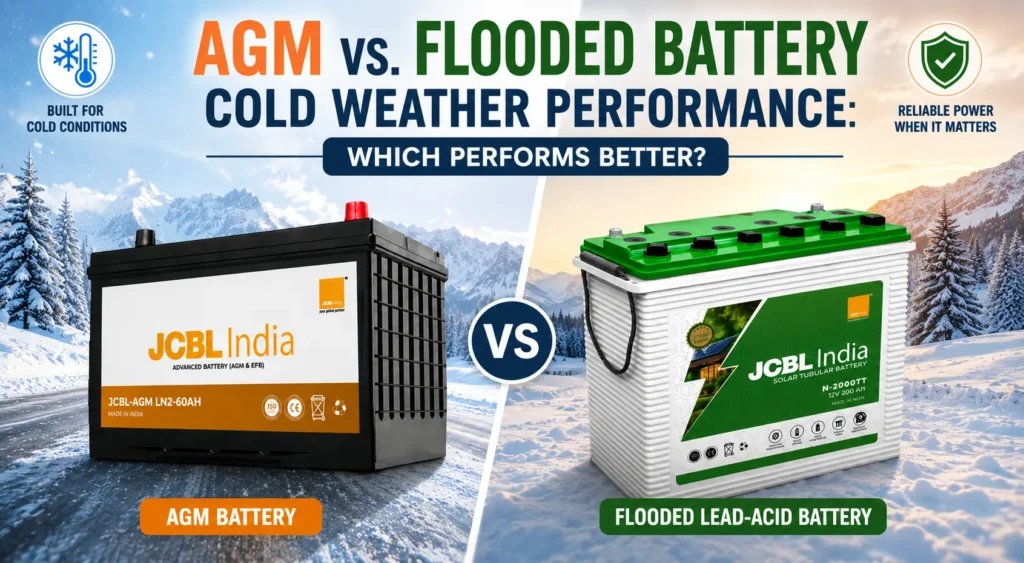
Cold temperatures reduce the performance of all lead-acid batteries, affecting available capacity, charging, and starting power. AGM batteries generally have an advantage over conventional flooded batteries in cold-weather applications, particularly where high starting performance, low maintenance, and resistance to cold-related damage are important. However, AGM is not immune to capacity loss in low temperatures.
For automotive, commercial vehicle, industrial, and backup applications, the right choice depends on cold-cranking amps (CCA), battery capacity, state of charge, operating temperature, charging system, and application requirements.
AGM vs Flooded Battery Cold Weather Performance: Quick Comparison
| Cold-Weather Factor | AGM Battery | Flooded Lead-Acid Battery |
| Cold starting | Generally strong | Good, depending on design |
| Cold-cranking performance | Typically well suited to high-current applications | Depends strongly on CCA and battery design |
| Capacity in cold | Decreases | Decreases |
| Freezing risk | Lower when properly charged | Higher when undercharged |
| Maintenance | Low | Higher |
| Cold-weather charging | Requires temperature-appropriate charging | Requires temperature-appropriate charging |
| Best suited for | Demanding cold-weather applications | Conventional, cost-sensitive applications |
SAE’s automotive battery testing framework specifically covers both flooded and absorptive glass mat (AGM) lead-acid batteries, reinforcing that cold-cranking and durability should be evaluated using defined battery-performance criteria rather than battery type alone.
Which Performs Better in Cold Weather: AGM or Flooded?
AGM generally performs better than a conventional flooded lead-acid battery in cold-weather applications. AGM batteries can provide strong cold-cranking performance and have an electrolyte immobilized in glass mat separators, reducing concerns associated with free liquid electrolyte. However, both AGM and flooded batteries lose available capacity as temperature falls, so CCA, battery size, and state of charge remain critical.
How Cold Weather Affects Lead-Acid Battery Performance
1. Reduced Available Capacity
Low temperatures slow the electrochemical reactions inside lead-acid batteries and reduce the capacity available to the load. Battery capacity ratings are normally specified at a reference temperature, so the usable capacity can be lower when the battery operates in cold conditions.
This applies to both AGM and flooded batteries. Therefore, selecting a battery solely by its nominal Ah rating can be misleading for equipment operating in cold climates.
2. Lower Cold-Cranking Performance
Cold weather makes engine starting more demanding while simultaneously reducing the battery’s ability to deliver current. This makes CCA particularly important for automotive and commercial vehicle applications.
A battery with a higher CCA rating can be better suited to cold starts, but buyers should compare batteries with equivalent specifications rather than assuming every AGM battery has higher CCA than every flooded battery.
3. Greater Freezing Risk at Low State of Charge
Flooded batteries contain free liquid electrolyte. When the battery is discharged, the electrolyte becomes more water-like and can freeze at a higher temperature. Maintaining a lead-acid battery in a properly charged condition reduces this risk.
AGM batteries also require proper state-of-charge management and are not immune to freezing damage when severely discharged.
AGM vs Flooded Battery: Key Cold-Weather Differences
1. Cold-Cranking Performance
For vehicle and equipment applications, cold-cranking capability is one of the most important specifications.
AGM batteries are commonly used where high starting loads and demanding electrical systems require strong current delivery. Flooded batteries can also provide excellent starting performance when correctly specified, so the published CCA rating should be compared before selecting a battery.
For B2B buyers, fleet operators and OEMs, CCA should be evaluated alongside battery capacity, physical dimensions and the vehicle or equipment manufacturer’s requirements.
2. Capacity Retention in Low Temperatures
Neither technology maintains its full rated capacity indefinitely as temperatures fall.
Cold-weather battery sizing, therefore, needs to consider the following:
- Operating temperature
- Required load
- Discharge duration
- Rated Ah capacity
- Battery configuration
- Required reserve capacity
For stationary and industrial systems, manufacturers may provide temperature correction factors for sizing. Rolls Battery, for example, notes that lower temperatures reduce available capacity and provides temperature-based capacity multipliers for flooded lead-acid systems.
3. Freezing and Cold-Weather Damage
Flooded batteries require particular attention to state of charge during winter storage. An undercharged battery has a greater risk of electrolyte freezing.
AGM’s electrolyte is absorbed into a glass mat rather than freely moving inside the battery. This construction is advantageous for applications where leakage, vibration, and maintenance are concerns, although proper charging and storage remain essential.
4. Cold-Weather Charging
Cold temperatures affect charging requirements for lead-acid batteries. Temperature-compensated charging is important for both AGM and flooded batteries.
At lower temperatures, lead-acid batteries generally require a higher charging voltage than at the standard reference temperature. The correct charging profile must still follow the battery manufacturer’s specifications.
For OEMs and industrial battery buyers, the charger and battery should therefore be specified as a compatible system rather than independently.
5. Winter Storage
A battery stored in cold conditions should generally be maintained at an appropriate state of charge and protected from prolonged undercharging.
For flooded batteries, electrolyte condition and water maintenance are additional considerations. AGM batteries require less routine maintenance, but they still need appropriate storage voltage, charging, and temperature management.
AGM vs Flooded Battery Cold Weather Performance by Application
| Application | Better Choice | Main Reason |
| Passenger vehicles | AGM for demanding applications | Strong starting and electrical-load capability |
| Start-stop vehicles | AGM | Designed for higher cycling demands |
| Commercial vehicles | AGM or high-CCA flooded | Depends on duty cycle and OEM specification |
| Agricultural equipment | AGM | Useful where cold starting and low maintenance matter |
| Off-road equipment | AGM | Suitable for demanding operating environments |
| Conventional vehicles | Flooded or AGM | Depends on CCA, cost and vehicle requirements |
| Industrial backup systems | Application-specific | Capacity, temperature and charging profile matter |
For Indian manufacturers and exporters supplying batteries or battery-powered equipment to colder markets, specifications should be matched to the actual destination climate and application rather than relying only on nominal battery capacity.
What Matters More Than Battery Type in Cold Weather?
When comparing AGM and flooded batteries for cold climates, buyers should evaluate the following:
- Cold-cranking amps (CCA)
- Rated capacity and reserve capacity
- Operating temperature range
- State-of-charge requirements
- Charging voltage and temperature compensation
- Battery age and condition
- Application load and duty cycle
- Manufacturer’s cold-weather specifications
These factors can have a greater impact on real-world performance than simply choosing AGM or flooded technology.
How to Choose Between AGM and Flooded Batteries for Cold Climates
Choose AGM when:
- Cold-start reliability is a priority.
- The application has high electrical loads.
- Low-maintenance operation is preferred.
- Vibration resistance is important.
- The equipment operates in demanding or variable conditions.
Choose flooded when:
- Initial purchase cost is a major consideration.
- Conventional battery technology is appropriate.
- Maintenance access is available.
- The battery’s CCA and capacity meet the application requirements.
- Cold-weather operating conditions are moderate.
For B2B procurement, compare the manufacturer’s CCA, Ah capacity, reserve capacity, temperature range, charging requirements, test data, and warranty rather than selecting solely on battery chemistry.
AGM vs Flooded Battery Cold Weather Performance: Final Verdict
AGM batteries generally perform better than conventional flooded batteries in cold-weather applications, especially when strong starting performance, low maintenance, and demanding operating conditions are priorities. However, both battery types experience reduced available capacity at low temperatures.
For automotive, commercial, and industrial applications, the best battery depends on the CCA rating, capacity, state of charge, operating temperature, charging system, and duty cycle. Indian battery manufacturers and B2B buyers supplying cold-climate markets should therefore validate performance against application-specific temperature requirements and manufacturer test data.
Conclusion
AGM batteries generally outperform flooded batteries in cold-weather applications, offering strong cold-cranking performance, lower maintenance, and better resistance to cold-related damage. However, both battery types lose capacity as temperatures fall.
For B2B buyers, OEMs, and exporters, the best choice should be based on CCA, capacity, operating temperature, state of charge, charging requirements, and application demands rather than battery type alone. AGM is typically the better choice for demanding cold climates, while flooded batteries remain suitable for cost-sensitive applications with appropriate specifications.
FAQs
Yes. AGM batteries are generally better suited to demanding cold-weather applications because of their strong cold-cranking performance, low maintenance, and resistance to cold-related damage. However, both battery types lose capacity as temperatures decrease.
AGM batteries can provide strong cold-cranking performance, but actual performance depends on the battery’s CCA rating, design and application requirements. Always compare CCA specifications rather than battery type alone.
Yes. Cold temperatures reduce the available capacity of both AGM and flooded lead-acid batteries. Battery sizing should therefore account for operating temperature and load requirements.
Yes. A significantly discharged flooded battery has a higher risk of electrolyte freezing. Keeping the battery properly charged helps reduce freezing risk during cold-weather storage and operation.
AGM is generally the better choice for demanding cold-start applications, but the battery’s CCA rating and compatibility with the vehicle should determine the final selection.