

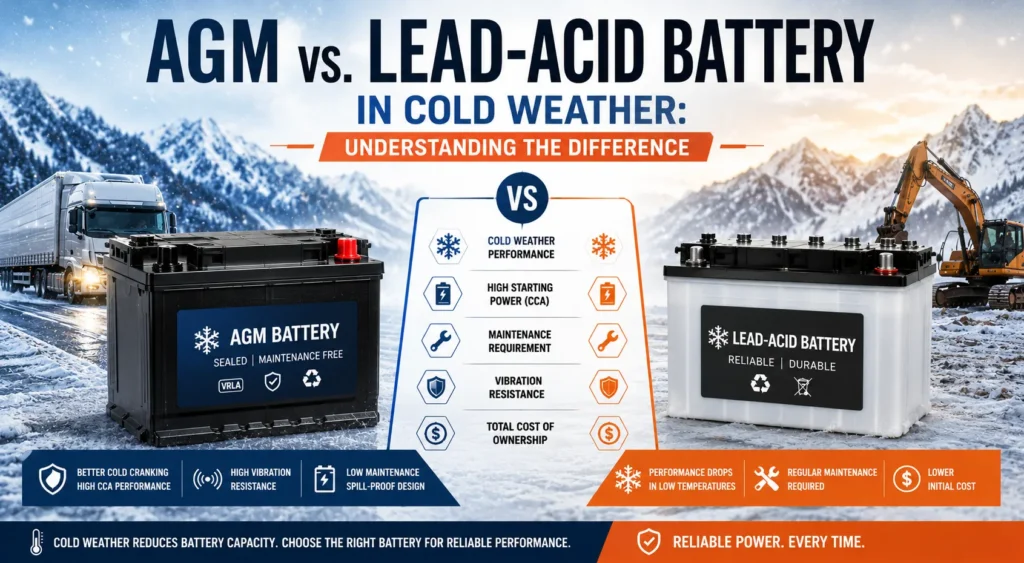
Cold temperatures can significantly affect battery performance, especially in vehicles, fleets, industrial equipment, telecom systems, and backup-power applications. While both AGM and conventional flooded lead-acid batteries are based on lead-acid chemistry, their construction and operating characteristics can make a difference in demanding environments.
So, is AGM better than lead acid in cold weather? In many applications, AGM can offer advantages in high-current delivery, vibration resistance, and maintenance requirements. However, neither technology is immune to cold-related capacity loss. The right choice depends on temperature, CCA, capacity, duty cycle, charging system, and application requirements.
AGM vs Lead Acid in Cold Weather
| Factor | AGM Battery | Flooded Lead-Acid Battery |
| Cold-weather performance | Generally strong | Application-dependent |
| Cold Cranking Amps (CCA) | Often well suited to high-current demands | Varies by battery design |
| Capacity in low temperatures | Decreases | Decreases |
| Electrolyte | Absorbed in glass mat | Free liquid |
| Vibration resistance | High | Generally lower |
| Maintenance | Low | Higher |
| Freeze risk when deeply discharged | Yes | Yes |
| Upfront cost | Usually higher | Usually lower |
| Suitable for demanding B2B applications | Often | Depends on operating conditions |
Important: AGM is not a different battery chemistry from lead acid. It is an Absorbent Glass Mat (AGM) form of a valve-regulated lead-acid (VRLA) battery. In this article, “lead acid” refers specifically to conventional flooded lead-acid batteries.
How Does Cold Weather Affect a Lead-Acid Battery?
Cold temperatures reduce the performance of lead-acid batteries by slowing electrochemical reactions, reducing available capacity, and increasing the difficulty of delivering high current.
The key effects include the following:
- Reduced battery capacity: As temperature falls, a lead-acid battery delivers less of its rated capacity than it would under standard test conditions.
- Higher starting demand: Cold engines require more power to crank, increasing the electrical demand on the battery when its performance is already reduced.
- Lower power delivery: Increased internal resistance at low temperatures can limit the battery’s ability to deliver high current when needed.
- CCA becomes important: For engine-starting applications, Cold Cranking Amps (CCA) is a more relevant specification than Ah alone because it indicates the battery’s ability to deliver starting current under standardized cold conditions.
- Ah and CCA serve different purposes: Ah measures battery capacity under specified test conditions, while CCA relates to high-current starting performance. A higher Ah rating does not automatically mean better cold-start performance.
- Application matters: Fleet vehicles, industrial equipment, backup systems, and other B2B applications should be evaluated based on their actual temperature range, load requirements, duty cycle, and battery specifications.
Key takeaway: Cold weather affects both the energy available from a lead-acid battery and its ability to deliver high starting current, making temperature, CCA, and application-specific sizing important factors in battery selection.
What Makes AGM Different in Cold Weather?
An AGM battery immobilizes its electrolyte within an absorbent glass-mat separator. This sealed VRLA construction eliminates the free-flowing electrolyte found in conventional flooded batteries.
For businesses operating vehicles or equipment in challenging environments, AGM technology can provide several practical benefits:
- High current delivery for demanding starting applications
- Strong resistance to vibration
- Minimal routine electrolyte maintenance
- Flexible installation compared with flooded designs
- Good suitability for applications involving frequent electrical loads
Research has also investigated VRLA/AGM batteries under extremely cold conditions. One study found robust operation of tested AGM batteries at temperatures down to -30°C, although performance still depended on operating conditions and battery behavior at low temperatures.
That does not mean every AGM battery will perform identically at −30°C. Battery construction, state of charge, discharge rate, and manufacturer specifications all matter.
AGM vs Flooded Lead Acid: Which Is Better in Cold Weather?
1. Cold-start performance
For vehicles and equipment that need reliable starting in cold conditions, CCA is one of the most important specifications to evaluate.
AGM batteries are commonly designed for applications requiring strong starting performance and can be particularly useful where high electrical loads and frequent cycling occur. However, CCA should always be compared between specific battery models rather than assuming every AGM battery will outperform every flooded battery.
2. Capacity loss
Both AGM and flooded lead-acid batteries lose available capacity as temperature falls.
For example, technical battery guidance notes that capacity decreases at low temperatures and that the standard Ah rating is normally specified under defined temperature and discharge conditions.
Therefore, B2B battery selection should account for the actual minimum operating temperature and load profile, rather than selecting a battery solely according to its nominal Ah rating.
3. Freeze risk
Cold weather becomes particularly concerning when a lead-acid battery is left partially or deeply discharged. A lower state of charge makes the electrolyte more water-like, increasing its vulnerability to freezing.
AGM construction does not eliminate this risk. Maintaining an appropriate state of charge is important for either battery type.
4. Vibration and maintenance
For commercial vehicles, construction equipment, and mobile machinery, vibration can be a significant operating factor.
The immobilized electrolyte and sealed construction of AGM batteries can make them attractive for applications where vibration, limited maintenance access, or installation constraints are concerns. Research has also reported advantages of AGM technology in demanding automotive applications.
Why Battery Charging Matters in Cold Weather
Cold weather affects not only battery discharge but also how a lead-acid battery should be charged.
Key considerations include:
- Charging voltage: Lead-acid batteries generally require a higher charging voltage at lower temperatures and a lower voltage at higher temperatures.
- Temperature compensation: A temperature-compensated charger can adjust charging voltage according to battery temperature, helping maintain appropriate charging conditions.
- AGM charging requirements: AGM batteries should be charged using a profile recommended by the battery manufacturer. Incorrect voltage settings can cause undercharging, overcharging, or premature battery degradation.
- Battery temperature monitoring: Monitoring battery temperature can help optimize charging and protect battery performance in cold or fluctuating conditions.
- B2B reliability: For telecom backup systems, UPS equipment, industrial applications, and off-grid power systems, correctly matched charging controls can help maintain battery reliability and reduce the risk of performance-related downtime.
Key takeaway: In cold weather, battery selection and charging strategy should be considered together to maintain reliable performance and battery life.
Choosing AGM or Lead Acid for Indian and Global Applications
Cold-weather battery requirements are not limited to polar climates. Businesses operating across North India, the Himalayan region, and other areas with significant winter temperature drops may need to consider low-temperature performance during battery selection.
For fleet operators and equipment manufacturers, the decision should consider:
- Operating temperature: Determine the actual minimum temperature at which the battery must operate.
- CCA requirement: Match starting-current requirements to the equipment rather than relying only on Ah.
- Duty cycle: A battery used for engine starting has different requirements from one used for standby or cyclic applications.
- Charging system: Confirm compatibility between the charger, alternator, or power-management system and the selected battery.
- Maintenance access: Consider whether regular inspection and servicing are practical.
- Total cost of ownership: Compare purchase price with maintenance, service life, replacement frequency, and potential downtime.
Which Is Better for Your Business: AGM or Flooded Lead Acid?
AGM is generally the better choice for demanding business applications where cold-weather reliability, vibration resistance, low maintenance, and high electrical loads are priorities. Flooded lead-acid batteries can be more suitable when upfront cost is the main concern and regular maintenance is practical.
Choose AGM when:
- Reliable starting and power delivery are critical.
- Equipment operates in cold, high-vibration, or demanding environments.
- Battery maintenance and access are limited.
- The application involves frequent cycling or high electrical loads.
- Downtime has a significant operational or financial impact.
Choose flooded lead-acid when:
- Lower initial purchase cost is a priority.
- Routine inspection and maintenance can be performed.
- Operating conditions are relatively moderate.
- The application does not require the additional features of AGM technology.
For B2B applications, the best choice should be based on CCA, Ah capacity, operating temperature, duty cycle, charging compatibility, maintenance requirements, and total cost of ownership—not battery type alone.
How to Improve Battery Performance in Cold Weather
Businesses can reduce cold-weather battery problems by:
- Keeping the battery adequately charged.
- Selecting sufficient CCA for the application.
- Accounting for temperature-related capacity reduction during sizing.
- Using the manufacturer’s recommended charging profile.
- Employing temperature-compensated charging where appropriate.
- Inspecting terminals, connections, and battery condition regularly.
- Avoiding prolonged periods of deep discharge.
- Monitoring battery temperature in critical installations.
For fixed infrastructure in particularly cold locations, thermal management may also be necessary. Research into outdoor telecom battery systems, for example, has examined heating and insulation strategies to maintain lead-acid battery performance in cold environments.
Conclusion
AGM is often the stronger option for demanding cold-weather applications, but it is not automatically the best choice for every business. Both AGM and flooded lead-acid batteries lose capacity as temperatures fall, making correct sizing, CCA, state of charge, and charging control essential.
For fleet, automotive, industrial, telecom, and backup-power applications in India or colder international markets, the best decision should be based on the complete operating profile, not simply the label “AGM” or “lead acid.”
Technical note: Battery performance varies by model, manufacturer, test standard, temperature, discharge rate, and state of charge. Always verify application-specific specifications before selecting or replacing a battery.
FAQs
AGM can be advantageous in demanding cold-weather applications because of its construction, current-delivery characteristics, and low-maintenance design. However, both AGM and flooded lead-acid batteries experience reduced capacity at low temperatures.
Yes. AGM batteries are still lead-acid batteries, so available capacity decreases as temperature falls. The extent of the reduction depends on battery design, discharge rate, state of charge, and operating conditions.
Yes. AGM batteries can be damaged by freezing, particularly when discharged. Maintaining an appropriate state of charge is important when batteries are exposed to freezing temperatures.
For engine starting, CCA is particularly important because it indicates the battery’s ability to deliver high current under standardized cold-cranking conditions. Ah is more relevant when evaluating energy-storage requirements.
AGM batteries should be charged using a profile compatible with the manufacturer’s specifications. Temperature compensation can also be important for lead-acid charging in cold environments.