

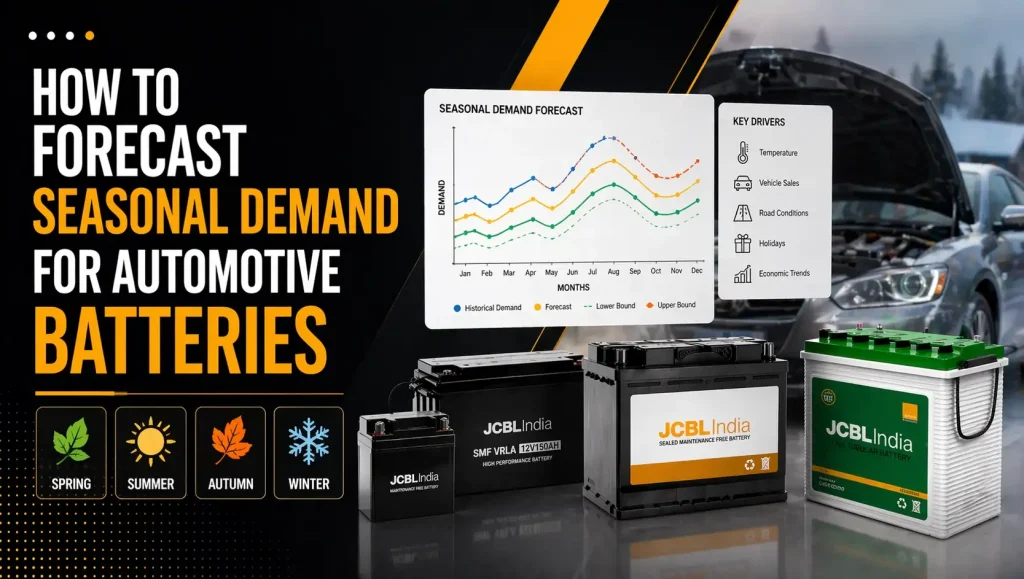
Seasonal demand fluctuations are one of the most critical variables in the automotive battery distribution business. Unlike many automotive components, battery demand is highly sensitive to temperature extremes, leading to predictable yet often underestimated demand spikes.
For distributors and importers, inaccurate forecasting can result in stockouts during peak seasons or excess inventory during low-demand periods, directly impacting revenue and working capital. This makes seasonal demand forecasting a key operational function, not just a planning exercise.
What Is Seasonal Demand Forecasting for Automotive Batteries?
Seasonal demand for automotive batteries is best forecasted by combining historical sales data with regional climate patterns and supplier lead times. Demand typically peaks during extreme temperatures, winter due to cold-start failures, and summer due to heat-related battery degradation, making proactive, data-driven planning essential for distributors to avoid stockouts and excess inventory.
Understanding Seasonal Demand Patterns in Automotive Batteries
Winter Demand Surge
Cold weather significantly reduces battery efficiency. At low temperatures, automotive batteries can lose approximately 31% of their starting power, while engines simultaneously require more energy to start.
This creates a sharp increase in:
- Battery failures
- Replacement demand
- Emergency purchases
As a result, distributors supplying colder regions often experience short, high-intensity demand spikes during winter months.
Summer Demand Spike
High temperatures are equally damaging, though in a different way. Heat accelerates internal chemical reactions, which can double the rate of battery degradation.
Common effects include:
- Electrolyte evaporation
- Internal corrosion
- Reduced battery lifespan
Unlike winter, summer demand is often more gradual but sustained, especially in regions with prolonged heat exposure.
Regional Demand Variations
Seasonal demand is not uniform across markets:
- Cold climates: Sharp, predictable winter spikes
- Hot climates: Extended summer replacement cycles
- Moderate climates: Balanced but less extreme fluctuations
Understanding these variations is essential for building accurate, region-specific forecasts rather than relying on a one-size-fits-all model.
Using Historical Sales Data to Identify Seasonal Trends
Historical sales data remains the most reliable input for forecasting, but only when used correctly. Distributors should analyze at least 2–3 years of data to identify consistent seasonal patterns.
Key insights to extract:
- Monthly sales trends: Identify recurring peak periods
- Year-over-year comparisons: Validate demand consistency
- SKU-level performance: Understand which battery types move faster in specific seasons
For example, batteries designed for higher cold-cranking performance may see stronger demand in winter-driven markets, while others may perform better in high-temperature regions.
The goal is to move from broad forecasting to SKU-level precision, which significantly improves planning accuracy.
How to Build a Simple Seasonal Demand Forecast
A structured approach helps translate raw data into actionable decisions.
The following four-step framework is designed specifically for distributors managing multiple SKUs and markets:
Step 1: Analyze Past Sales Trends
Identify recurring seasonal spikes and low-demand periods. Focus on consistent patterns rather than one-time anomalies.
Step 2: Map Demand with Seasonal Weather Changes
Align historical sales data with temperature patterns.
Demand typically rises during:
- Temperature drops (winter)
- Heatwaves (summer)
This establishes a clear link between climate conditions and battery failure rates.
Step 3: Segment by Region or Market
Break down your forecast based on:
- Climate zones
- Market type (urban vs rural)
- Vehicle usage intensity
Regional segmentation prevents overstocking in low-demand areas and shortages in high-demand markets.
Step 4: Adjust Forecast Based on Lead Time
Forecasting must account for procurement timelines. If your lead time is 45–60 days, planning must begin well before seasonal demand peaks.
This ensures:
- Timely stock availability
- Reduced risk of missed sales
- Better alignment between demand and supply cycles
What High-Performing Distributors Do Differently
Accurate forecasting is not just about data; it’s about how that data is used.
High-performing distributors typically:
- Forecast at the SKU level, not just category level
- Adjust demand based on climate zones, not just historical averages
- Incorporate lead time constraints early in the planning process
- Continuously refine forecasts using real-time demand signals
This approach allows them to stay ahead of demand shifts rather than reacting to them.
Key External Factors That Influence Seasonal Demand
While climate and historical trends are primary drivers, external variables can impact forecasting accuracy:
- Economic Conditions: Reduced economic activity can delay battery replacement cycles, softening expected demand spikes.
- Fuel Price Fluctuations: Higher fuel costs may reduce driving frequency, indirectly affecting battery wear and replacement rates.
- Changing Usage Patterns: Growth in logistics, ride-sharing, and commercial vehicle usage can increase battery demand in specific regions.
These factors should be treated as adjustments to your forecast, not replacements for core demand drivers.
Common Mistakes in Seasonal Demand Forecasting
Even with data, forecasting errors are common. Key mistakes to avoid include the following:
- Relying Only on Past Data: Historical trends must be combined with current climate patterns and market conditions to remain relevant.
- Ignoring Regional Differences: Applying a single forecast across multiple regions often leads to imbalanced inventory.
- Not Accounting for Lead Times: Delayed planning can result in missing peak demand windows, even with accurate forecasts.
Avoiding these mistakes can significantly improve both forecast reliability and operational efficiency.
Conclusion
Seasonal demand forecasting for automotive batteries is most effective when it integrates historical data, climate insights, and lead time planning into a single, structured approach.
Distributors that rely only on past sales data often miss critical demand shifts. In contrast, those who incorporate temperature patterns and procurement timelines into their forecasting strategy gain a clear advantage in maintaining stock availability, reducing excess inventory, and improving overall supply reliability.
Working closely with a reliable supplier further strengthens forecasting accuracy by ensuring consistent product availability, predictable lead times, and better coordination across the supply chain.
In a market where timing directly impacts profitability, forecast accuracy becomes a competitive edge, not just an operational task.
FAQs
Automotive battery demand typically peaks during extreme weather conditions, winter due to cold-start failures, and summer due to heat-related battery degradation.
Historical sales data helps identify recurring seasonal patterns, validate demand trends, and enable SKU-level forecasting for more precise planning.
Seasonal demand should generally be forecasted 1–2 months in advance, depending on supplier lead times and market conditions.
Key factors include temperature extremes, regional climate conditions, economic activity, fuel prices, and vehicle usage patterns.