

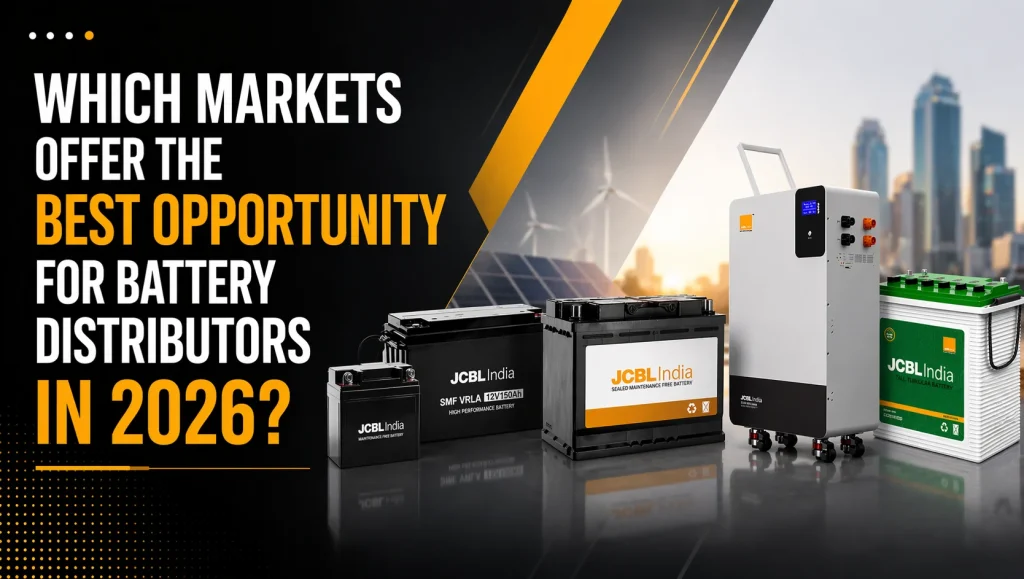
The best markets for battery distributors in 2026 include Africa, the Middle East, Latin America, and Southeast Asia. These regions offer strong growth due to rising vehicle ownership, extreme climate conditions, and high replacement demand, making them more attractive than saturated markets with intense competition.
Key Takeaways
- Markets with high import dependency and low local production offer better entry opportunities
- Replacement demand drives more consistent revenue than new installations (in regions like Africa and the Middle East, battery replacement demand drives up to 80% of sales)
- Hot climates increase battery turnover, making them more profitable for distributors
- Emerging markets outperform saturated ones in both growth and margin potential
- The most attractive regions combine demand consistency, low competition, and supply gaps
Top 5 Best Markets for Battery Distributors in 2026 (Ranked)
- Africa & Middle East: Best for high margins and replacement demand
- India & Southeast Asia: Best for high-volume growth
- Latin America: Best for stable and predictable demand
- Eastern Europe: Emerging opportunity with moderate competition
- North America: Large but highly competitive market
Why Is the Automotive Battery Replacement Market Growing Globally?
The real opportunity in battery distribution lies in the aftermarket, not OEM supply. Working with a trusted battery supplier ensures consistent availability and quality in high-demand markets, while new vehicle production fluctuates with economic cycles and replacement demand remains relatively stable.
Key Drivers:
- Aging vehicle fleets: Vehicles in emerging markets often last 10–15 years, increasing replacement cycles
- Short battery lifespan in harsh climates: Heat and humidity accelerate degradation
- ICE vehicle dominance: Over 73.4% of demand still comes from conventional vehicles
- Massive installed vehicle base: For example, North America alone has 280M+ vehicles requiring periodic replacement
Replacement demand is not only great, but it’s also predictable, recurring, and less volatile, making it one of the most reliable segments in the automotive supply chain.
Which Regions Offer the Highest Growth Potential for Battery Distribution?
Africa & Middle East
Africa and the Middle East represent high-opportunity, supply-constrained battery markets where growth is largely driven by replacement demand and reliance on imports.
In these regions, battery usage is primarily tied to maintaining existing systems rather than new installations. Limited local manufacturing creates a consistent gap between demand and supply, making imports essential. At the same time, harsh environmental conditions, especially extreme heat, accelerate battery wear, increasing the frequency of replacements.
For distributors, this creates a favorable environment where demand is recurring, competition is relatively low, and long-term customer relationships are easier to build.
- Strong reliance on imports creates an easier market entry
- Demand is driven by replacement rather than new sales
- Harsh conditions increase repeat purchase frequency
- Lower competition compared to mature markets
Latin America
Latin America offers a stable, demand-driven battery market supported by a large installed base and consistent usage patterns across sectors.
Demand in this region is fueled by widespread usage in transportation, infrastructure, and backup power systems. As urbanization continues, vehicles and energy systems are used more intensively, which naturally shortens battery life and drives regular replacement cycles.
This creates a balanced market where growth is steady and less dependent on sudden economic or industrial shifts, making it attractive for distributors seeking predictable demand.
- Large installed base ensures continuous demand
- Usage intensity drives natural replacement cycles
- Urban growth supports long-term consumption
- Stable and predictable market conditions
Asia (Emerging Markets)
Emerging Asian markets represent a high-volume, multi-application battery landscape driven by rapid growth and diverse demand sources.
Battery demand here spans multiple sectors, including mobility, energy storage, consumer electronics, and small-scale industrial use. This diversity significantly expands the overall market size and reduces reliance on any single segment. Rapid urbanization and infrastructure development further accelerate demand across both urban and semi-urban areas.
While pricing can be competitive, the scale of demand makes this region highly attractive for distributors focused on volume-driven growth.
- Demand spans multiple sectors, not a single industry
- High-volume market with strong growth momentum
- Rapid urbanization increases overall consumption
- Best suited for scale-driven distribution strategies
| Region | Core Opportunity | Market Nature |
| Africa & Middle East | Supply gap | Replacement-driven, import-reliant |
| Latin America | Stability | Usage-driven, predictable demand |
| Asia (Emerging Markets) | Scale | High-volume, multi-application demand |
Africa & the Middle East offer supply-gap opportunities, Latin America provides stable and predictable demand, and Asia delivers high-volume growth at scale.
How Does Climate Impact Battery Demand in Different Regions?
Climate is one of the most underestimated factors in battery demand, yet it has a direct impact on replacement frequency.
Hot Regions (Middle East, Africa, Latin America)
High temperatures accelerate chemical reactions inside batteries, leading to faster degradation. In extreme conditions, battery lifespan can drop to just a few years. This creates a cycle of frequent replacements, which directly benefits distributors.
Cold Regions (North America, Europe)
In colder climates, batteries are more likely to fail during winter due to reduced starting power. While overall lifespan may be longer than in hot regions, demand tends to spike seasonally.
While both climates generate demand, hot regions create more consistent, year-round replacement cycles, making them more attractive for distribution businesses.
Which Markets Have the Lowest Competition for Battery Distributors?
Not all high-demand markets are easy to enter. In fact, the most developed regions often come with the highest barriers.
Low-competition, high-opportunity regions include Africa, the Middle East, and parts of Southeast Asia. These markets typically have fragmented distribution networks and fewer dominant players, allowing new entrants to establish themselves more easily.
In contrast, North America and Western Europe are highly saturated. Strong brand presence, established supply chains, and price competition make it difficult for new distributors to gain traction.
The best opportunities often lie in markets that are growing fast but not yet fully organized.
What Regulatory and Import Factors Should Distributors Consider?
Before entering a new market, understanding regulatory and logistical challenges is essential.
Key factors include:
- Import duties and tax structures
- Environmental and recycling regulations
- Certification and compliance requirements
- Shipping and logistics infrastructure
In many emerging markets, limited local production means imports are essential—but this also means navigating regulatory frameworks carefully.
Markets with high import dependency can be highly profitable, but success depends on efficient compliance and supply chain management.
Market Opportunity Comparison Table
| Region | Demand Driver | Competition | Import Dependency | Opportunity Level |
| Africa | Replacement demand + heat | Low | High | High |
| Middle East | Climate + vehicle growth | Moderate | High | High |
| Latin America | Large vehicle base | Moderate | Moderate | Moderate |
| Southeast Asia | Vehicle growth | Moderate | Moderate | Moderate |
| North America | Mature market | High | Low | Low |
Strategic Insights for Battery Distributors (Expert Perspective)
Looking at global patterns, one thing becomes clear: success in battery distribution is less about entering the largest markets and more about choosing the right kind of markets.
The most attractive regions share a few common traits:
- High reliance on replacement demand
- Harsh operating conditions for batteries
- Limited local manufacturing capacity
- Fragmented distribution networks
Rather than competing in saturated markets, distributors can achieve better margins and faster growth by focusing on regions where demand is strong but supply chains are still developing.
The most profitable opportunities are often found where demand is consistent, competition is limited, and entry barriers are manageable.
Why the Biggest Battery Markets Are Not Always the Most Profitable
The largest battery markets are not always the best for distributors. Mature regions often have strong local manufacturing, established brands, and intense price competition, which can limit margins and slow entry.
In contrast, smaller or emerging markets often offer better opportunities because they rely heavily on imports and have less structured distribution networks.
The best battery markets are not the biggest—they are the least saturated
with the highest replacement demand.
Conclusion
The most promising opportunities in battery distribution are no longer defined by how large a market is, but by how it behaves. Regions like Africa and the Middle East stand out for their strong replacement-driven demand and supply gaps, while Asia offers unmatched scale fueled by rapid adoption across multiple applications. Latin America, on the other hand, provides a more stable and predictable environment where consistent usage supports steady growth.
What this signals is a shift in strategy. Success in today’s battery distribution landscape depends on identifying markets where demand is not only growing, but also recurring and less saturated. Distributors who align their expansion with these underlying demand patterns, rather than simply chasing size, are better positioned to build sustainable, long-term growth.
FAQs
High-growth markets typically have rising vehicle ownership, extreme climates, aging fleets, and strong replacement demand cycles.
Yes, emerging markets often offer higher margins and lower competition, especially where import dependency is high.
Hot climates reduce battery lifespan, increasing replacement frequency, while cold climates create seasonal demand spikes.
Africa and the Middle East rely heavily on imports due to limited local manufacturing capacity.
The aftermarket replacement segment, which dominates demand in most emerging economies.