

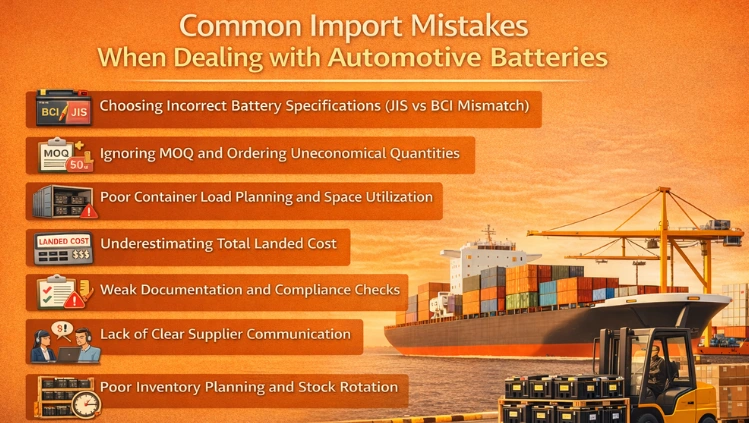
Importing car batteries can lead to costly mistakes if critical factors like specifications, logistics planning, and documentation are overlooked. The most common battery import errors include incorrect battery selection, poor landed cost calculation, and inefficient container utilization, each of which can significantly impact profitability, inventory efficiency, and supply chain reliability.
Common Car Battery Import Mistakes—Quick Overview
- Choosing incorrect battery specifications (JIS vs BCI mismatch)
- Ignoring MOQ and ordering uneconomical quantities
- Poor container load planning and space utilization
- Underestimating total landed cost
- Weak documentation and compliance checks
- Lack of clear supplier communication
- Poor inventory planning and stock rotation
Mistake #1: Choosing the Wrong Battery Specifications
Importers often select incompatible battery types due to differences in global standards such as JIS and BCI. Incorrect Ah (Ampere-hour) and CCA (Cold Cranking Amps) ratings are frequently chosen without aligning with vehicle requirements or environmental conditions. Climate compatibility is another commonly overlooked factor.
Impact of This Mistake
- High product return rates due to fitment issues
- Poor battery performance in real-world conditions
- Inventory stuck in non-moving SKUs
- Loss of distributor trust and repeat orders
For reference on configurations, explore the Auto Starting Series Category:
https://jcblbatteries.com/category/auto-starting-series/
Mistake #2: Ignoring Minimum Order Quantity Structure
Importers often place orders without aligning with supplier MOQ requirements or fail to connect MOQ with container capacity and demand planning. This results in inefficient procurement decisions.
Impact of This Mistake
- Higher per-unit cost due to low-volume ordering
- Increased freight cost per battery
- Poor working capital utilization
- Reduced competitiveness in local markets
To optimize procurement strategy, it is important to understand the role of the minimum order quantity (MOQ) in bulk battery supply.
Mistake #3: Poor Container Load Planning
Container planning is often treated as a routine task rather than a cost optimization opportunity. Importers may leave unused space, overload specific SKUs, or ignore weight constraints.
In large-scale battery exports, inefficient container loading is one of the most common operational gaps observed among new importers.
Impact of This Mistake
- 10–20% higher logistics cost per unit
- Inefficient SKU mix affecting sales
- Risk of exceeding container weight limits
- Lower profitability per shipment
In practical scenarios, inefficient container planning can increase overall logistics cost by up to 15% per shipment. To improve shipment efficiency, importers should follow a structured approach to planning a full container load of car batteries.
Mistake #4: Underestimating Total Landed Cost
Many importers calculate cost based only on product price, ignoring additional expenses such as freight, duties, port charges, and banking fees. Many first-time importers focus only on FOB pricing, which often leads to margin erosion once additional costs are realized after shipment arrival.
Impact of This Mistake
- Unexpected cost increases after shipment arrival
- Reduced or negative profit margins
- Pricing challenges in competitive markets
- Financial planning disruptions
Even a 5–8% miscalculation in landed cost can significantly impact pricing and profitability in competitive B2B markets.
For accurate calculation, refer to:
How to Calculate Landed Cost for Imported Car Batteries
Mistake #5: Weak Documentation Review
Errors in documentation, such as incorrect HS codes, missing MSDS, or incomplete invoices, are common due to the regulatory complexity of battery imports.
Impact of This Mistake
- Customs clearance delays
- Additional inspection or penalty costs
- Shipment holds or rejection
- Disruption in supply chain timelines
For full requirements, see:
What Documents Are Required for Battery Import Clearance?
Mistake #6: Poor Communication with Export Supplier
Lack of structured communication and reliance on informal agreements often lead to misunderstandings regarding specifications, timelines, and shipment details. In the international battery trade, a lack of documented communication is a leading cause of shipment errors and avoidable disputes.
Impact of This Mistake
- Incorrect product dispatch
- Shipment delays
- Disputes with suppliers
- Operational inefficiencies
To improve coordination, refer to:
How to Import Automotive Batteries in Bulk from India
Mistake #7: Ignoring Seasonal Demand and Inventory Rotation
Importers often fail to align procurement with market demand cycles and overlook battery shelf life and performance degradation over time.
Impact of This Mistake
- Inventory aging and reduced product performance
- Increased warranty claims
- Capital locked in slow-moving stock
- Financial losses due to unsold inventory
For better planning, see:
How to Manage Repeat Orders with a Battery Export Supplier
Real Cost Impact of These Mistakes
Even small battery import errors can have measurable financial consequences in bulk operations:
- Incorrect specifications: Increased return rates and loss of distributor trust
- Poor container utilization: Up to 10–15% higher freight cost per unit
- Landed cost miscalculation: 5–8% margin loss in competitive markets
- Documentation errors: 1–3 week delays in customs clearance
- Poor inventory planning: Capital locked in slow-moving or degraded stock
How to Avoid These Mistakes
To avoid common mistakes when importing car batteries, B2B buyers should follow a structured approach covering product selection, cost planning, logistics, and supplier coordination.
- Validate specifications thoroughly: Ensure compatibility with target market standards, including JIS/BCI, Ah, CCA, and climate conditions.
- Align MOQ with demand and logistics: Plan order quantities based on container capacity and sales forecasts to maintain cost efficiency.
- Optimize container load planning: Maximize space utilization while balancing SKU mix and weight distribution.
- Calculate total landed cost accurately: Include all cost components—freight, duties, port charges, and financial fees.
- Conduct detailed documentation checks: Verify HS codes, MSDS, and invoices before shipment to avoid clearance issues.
- Maintain clear supplier communication: Use written confirmations, defined timelines, and pre-shipment approvals.
- Plan inventory based on demand cycles: Avoid overstocking and ensure proper stock rotation to prevent battery aging.
Conclusion
Avoiding common mistakes when importing car batteries requires disciplined planning across specifications, logistics, cost management, and supplier coordination. By proactively addressing bulk battery import risks and minimizing battery import errors, B2B buyers can improve profitability, ensure consistent product quality, and build a more reliable supply chain.
FAQs
The most common mistake when importing car batteries is selecting incorrect specifications, such as mismatching JIS and BCI standards or choosing the wrong Ah and CCA ratings, leading to compatibility issues and product returns.
es, you can import small quantities initially, but it is generally not cost-efficient in bulk battery import, as ordering below MOQ increases per-unit cost and logistics expenses.
Battery aging can be minimized by aligning inventory with demand, ensuring proper storage conditions, and maintaining efficient stock rotation.
Yes, using a Letter of Credit (LC) is recommended for first-time battery import transactions, as it reduces payment risk and ensures compliance with agreed shipment terms.