

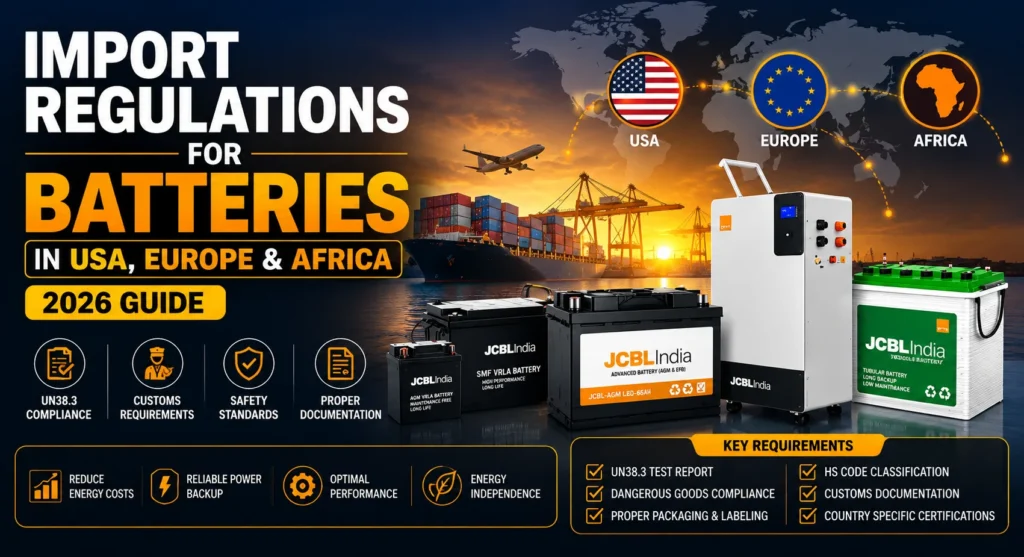
Importing batteries into the USA, Europe, and Africa requires compliance with transport safety laws, customs documentation, lithium battery shipping regulations, and country-specific certification standards. For lithium-ion batteries, UN38.3 testing, hazardous goods labeling, and accurate HS classification are mandatory in most international markets.
What Are the Main Regulations for Importing Batteries?
Battery imports are regulated through UN38.3 transport testing, dangerous goods shipping rules, customs declarations, packaging standards, and regional compliance frameworks. Lithium batteries face stricter controls because of fire and thermal runaway risks during transport.
The most commonly used battery HS codes include:
| Battery Type | HS Code |
| Lithium-Ion Batteries | 8507.60 |
| Lead-Acid Batteries | 8507.20 |
| Nickel-Cadmium Batteries | 8507.30 |
Most importers also require:
- UN38.3 Test Report
- SDS/MSDS
- Commercial Invoice
- Packing List
- Dangerous Goods Declaration
- Certificate of Origin
What is the UN38.3 Battery Test Requirement?
UN38.3 is the global transport safety standard for lithium batteries under the UN Manual of Tests and Criteria. It requires batteries to pass altitude, vibration, shock, thermal, short-circuit, impact, and overcharge testing before international shipment.
Lithium battery air freight is also regulated under the IATA dangerous goods rules.
Key transport thresholds include:
- Lithium-ion cells below 20 Wh,
- Lithium-ion batteries below 100 Wh for excepted shipments,
- A mandatory 30% State of Charge (SoC) limit for air-freighted lithium-ion batteries.
Standalone lithium-ion batteries classified as UN3480 are prohibited on passenger aircraft and must move under the Cargo Aircraft Only (CAO) label.
Battery Import Regulations in the United States
Battery imports into the United States are regulated by PHMSA (Pipeline and Hazardous Materials Safety Administration) under 49 CFR § 173.185 and enforced through U.S. Customs and Border Protection (CBP).
Importers must comply with the following:
- UN38.3 testing,
- Class 9 hazardous goods rules,
- Lithium battery labeling,
- Packaging standards,
- Customs documentation requirements.
Shipments entering the U.S. typically require:
- HS tariff classification,
- Commercial invoice,
- Country of origin declaration,
- Dangerous goods documentation.
Undeclared lithium batteries, incorrect packaging, and inaccurate customs declarations are among the most common causes of shipment delays and penalties.
Battery Import Regulations in Europe
Battery imports into Europe are governed by Regulation (EU) 2023/1542 along with CE Mark, RoHS, and REACH compliance requirements. The regulation applies to portable batteries, EV batteries, industrial batteries, and energy storage systems.
European battery compliance focuses on:
- Product safety
- Sustainability
- Recycling
- Chemical disclosure
- Traceability.
Importers may need:
- CE marking,
- Technical documentation,
- Recycling labels,
- Compliance declarations before market entry.
A major upcoming requirement is the EU Digital Battery Passport. While enforcement begins in 2027, 2026 is the critical preparation period for:
- supply chain data mapping,
- carbon footprint calculations,
- and QR-code integration systems.
The regulation will apply primarily to EV batteries and industrial batteries above 2 kWh.
Battery Import Regulations in Africa
Battery import regulations in Africa vary by country, although many markets follow IEC standards, UN transport rules, and EU-aligned compliance frameworks.
South Africa
South Africa regulates imported batteries through the NRCS (National Regulator for Compulsory Specifications). Many battery products require a Letter of Authority (LOA) before customs clearance.
Importers may face:
- product inspections,
- labeling verification,
- and conformity checks for lithium and industrial batteries.
Nigeria
Nigeria regulates battery imports through SONCAP (Standards Organisation of Nigeria Conformity Assessment Programme). Importers commonly require a Product Certificate (PC) and conformity assessment documentation before shipment approval.
Kenya & East Africa
Kenya and several East African markets use PVoC (Pre-Export Verification of Conformity) frameworks for imported battery products.
Most shipments require:
- Conformity certificates,
- customs declarations,
- and UN38.3 transport documentation.
Why Do Battery Shipments Get Rejected at Customs?
Battery shipments are most commonly rejected because of missing UN38.3 reports, incorrect lithium battery labeling, undeclared hazardous materials, improper packaging, or inaccurate HS classification.
The most common compliance failures include:
| Compliance Issue | Result |
| Missing UN38.3 Report | Shipment rejection |
| Incorrect HS Code | Customs delays |
| Improper Packaging | Carrier refusal |
| Missing Dangerous Goods Declaration | Port detention |
| Incorrect Lithium Labels | Regulatory penalties |
Lithium battery shipments face higher inspection rates globally because of aviation and fire safety concerns.
USA vs Europe vs Africa: Battery Regulation Comparison
| Requirement | USA | Europe | Africa |
| UN38.3 Testing | Mandatory | Mandatory | Widely required |
| CE Marking | Not required | Required | Sometimes referenced |
| Dangerous Goods Compliance | Strict | Strict | Country dependent |
| Digital Battery Passport | No | Mandatory from 2027 | Not implemented |
| Conformity Programs | Moderate | High | Common in many countries |
Conclusion
Battery import regulations in the USA, Europe, and Africa are becoming stricter as lithium battery usage expands across EVs, energy storage systems, and consumer electronics.
For importers, compliance now depends on accurate HS classification, UN38.3 testing, dangerous goods declarations, packaging conformity, and region-specific certification requirements. With Europe preparing for Digital Battery Passport enforcement and global regulators tightening lithium battery transport rules, 2026 is a critical compliance year for battery importers and suppliers.
FAQs
Battery certification is the process of verifying that a battery meets required safety, transport, and compliance standards before import, shipping, or sale. Common certifications include UN38.3, CE Marking, RoHS, and BIS certification.
Battery shipping regulations for 2026 require UN38.3 testing, Class 9 hazardous goods labeling, compliant packaging, and dangerous goods declarations. IATA also limits lithium-ion air shipments to 30% State of Charge and restricts standalone UN3480 batteries to Cargo Aircraft Only transport.
The 40/80 rule recommends keeping lithium-ion battery charge levels between 40% and 80% to reduce battery degradation and extend lifespan. It is commonly used for EV batteries, laptops, and energy storage systems.
The Europe battery regulation for 2027 refers to Regulation (EU) 2023/1542, which introduces Digital Battery Passports, carbon footprint reporting, recycling requirements, and stricter sustainability compliance for EV and industrial batteries sold in the EU.
BIS certification is a mandatory product compliance requirement issued by Bureau of Indian Standards for certain batteries and electronic products imported into India under the Compulsory Registration Scheme (CRS).