

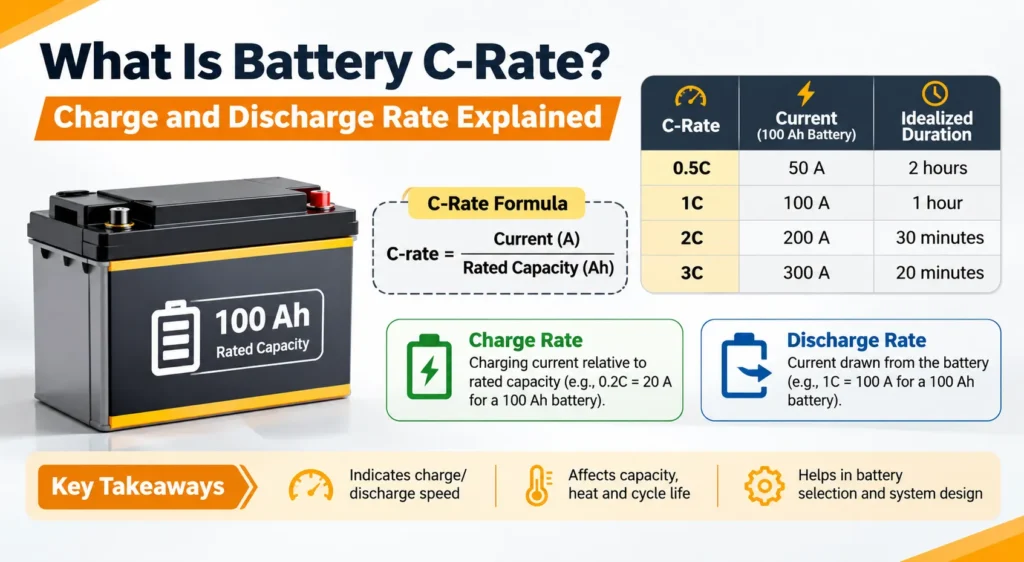
Battery C-rate measures how quickly a battery charges or discharges relative to its rated capacity. It helps battery engineers, manufacturers, OEMs, and energy storage system (ESS) integrators calculate current requirements and evaluate whether a battery can meet an application’s power demands.
Understanding C-rate is essential for battery selection, charging system design, performance testing, and verifying that operating currents remain within manufacturer specifications.
What Is Battery C-Rate?
Battery C-rate is the ratio of charging or discharging current to a battery’s rated capacity, expressed as a multiple of that capacity. A 1C rate theoretically transfers an amount of charge equal to the rated capacity in one hour. A 0.5C rate uses half that current, while a 2C rate uses twice that current. Actual charging and discharging times depend on battery characteristics and operating conditions.
Example: A 100 Ah battery operating at 50 A has a C-rate of 0.5C. At 100 A, its C-rate is 1C.
C-rate provides a standardized way to express current relative to battery capacity, making it useful for comparing test conditions and evaluating different battery designs.
How to Calculate Battery C-Rate
The battery C-rate formula is:
To calculate the current required for a specific C-rate, use:
Example: Calculating the C-Rate of a 100 Ah Battery
Consider a battery with a rated capacity of 100 Ah operating at a current of 50 A.
C-rate = 50 A ÷ 100 Ah = 0.5C
If the same battery operates at 100 A, the C-rate is 1C. At 200 A, it is 2C, provided the battery is rated to support that current.
What Do 0.5C, 1C, 2C, and 3C Mean?
The C-rate indicates current relative to rated capacity. For the same battery, a higher C-rate corresponds to higher current and a shorter theoretical operating duration.
| C-rate | Current for a 100 Ah Battery | Idealized Duration |
| 0.5C | 50 A | 2 hours |
| 1C | 100 A | 1 hour |
| 2C | 200 A | 30 minutes |
| 3C | 300 A | 20 minutes |
Battery Charge Rate vs. Discharge Rate
Charge and discharge C-rates use the same formula but describe current flowing in opposite directions. Their allowable limits may differ for the same battery.
What Is Battery Charge Rate?
The battery charge rate expresses the charging current relative to rated capacity.
For example, charging a 100 Ah battery at 20 A corresponds to 0.2C. Although this represents a theoretical five-hour capacity-equivalent duration, the complete charging process may take longer because charging current can decrease as the battery approaches full charge.
The permitted charging rate depends on battery chemistry, cell design, temperature, state of charge, and manufacturer specifications.
What Is Battery Discharge Rate?
The battery discharge rate expresses the current drawn from a battery to power a connected load.
A 100 Ah battery supplying 50 A operates at 0.5C. If it supplies 100 A, the discharge rate is 1C.
Higher discharge rates can support greater current demand, but actual runtime and usable capacity depend on the battery’s voltage response, internal resistance, temperature, and discharge cutoff.
How Does C-Rate Affect Battery Performance?
C-rate affects several parameters relevant to battery performance and system design.
- Charging and discharging time: Higher C-rates enable faster charge transfer or greater current delivery, within the battery’s operating limits.
- Heat generation: Higher currents can increase resistive heating, making thermal management important in high-current applications.
- Usable capacity: Some batteries deliver less usable capacity at higher discharge rates because voltage reaches the cutoff threshold sooner.
- Cycle life: Repeated operation outside recommended current and temperature limits can accelerate battery degradation.
- System design: C-rate influences current-handling requirements for conductors, connectors, power electronics, and battery management systems (BMS).
The extent of these effects varies by battery chemistry and design. C-rate should therefore be evaluated alongside manufacturer specifications and relevant test data, rather than treated as a standalone measure of battery quality. [1][2]
How to Choose the Right C-Rate for a Battery Application
Selecting the right C-rate requires matching the application’s current demand and operating duration to the battery’s rated capacity and permitted current limits.
For battery energy storage systems (BESS), engineers should assess required power output, usable energy capacity, discharge duration, and thermal constraints. C-rate helps relate current to capacity, but it does not independently determine deliverable power. Power calculations also require voltage and consideration of system losses.
For electric vehicles and industrial equipment, battery selection should account for continuous and peak current demand, charging requirements, duty cycle, and operating temperature.
For B2B procurement and OEM integration, verify the following before approving a battery:
- Rated capacity and the conditions under which it was measured.
- Maximum continuous and peak discharge current.
- Maximum permitted charging current.
- Operating temperature range.
- BMS current limits and protection settings.
- Applicable performance, cycle-life, and rate-capability test data.
Application Example: If an application requires a continuous current of 150 A and the selected battery has a rated capacity of 100 Ah, the required discharge rate is:
150 A ÷ 100 Ah = 1.5C
The battery is suitable only if its documented continuous discharge rating supports that requirement under the intended operating conditions.
The correct C-rate is the one that meets the application’s current requirements without exceeding the battery’s specified operating limits.
Conclusion
Battery C-rate expresses charging or discharging current relative to rated capacity. Its formula helps engineers calculate current requirements and estimate theoretical operating duration. For battery manufacturers, OEMs, and energy storage integrators, C-rate selection should be based on application demands, verified test data, and the battery’s documented operating limits.
Frequently Asked Questions (FAQs)
1. What is a good C-rate for a battery?
A suitable C-rate depends on battery chemistry, design, application, and manufacturer specifications. The required current and operating duration should determine the selection.
2. Is a higher battery C-rate better?
Not necessarily. A higher C-rate supports greater current relative to capacity but may increase heat generation and reduce usable discharge capacity. Suitability depends on the application’s requirements and the battery’s ratings.
3. What is the difference between 0.5C and 1C?
For a 100 Ah battery, 0.5C equals 50 A, while 1C equals 100 A. Their idealized durations are two hours and one hour, respectively, assuming the full rated capacity is available.
4. How do you calculate battery charging current?
Multiply the rated capacity in Ah by the desired C-rate. For example, a 100 Ah battery charged at 0.2C requires 20 A, provided the manufacturer permits that charging current.
5. Does a higher discharge C-rate reduce battery capacity?
It can reduce usable capacity measured during discharge because voltage may reach the cutoff threshold sooner. The effect depends on battery chemistry, temperature, internal resistance, and test conditions.
6. Are battery charge and discharge C-rates the same?
They use the same formula, but the permitted rates may differ. Manufacturers can specify separate maximum charging, continuous discharging, and peak discharging currents.